Printable Time Management Journal
Track tasks, time, and energy to reclaim your day
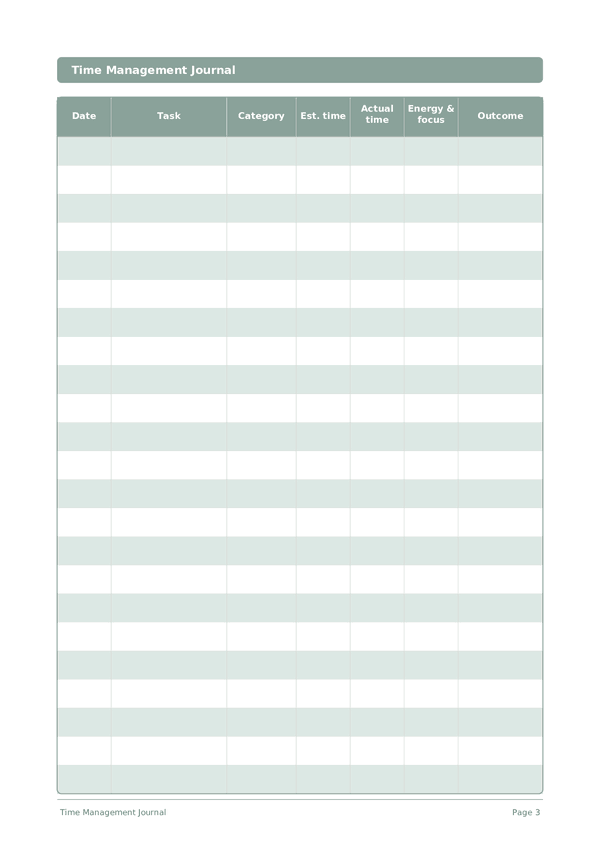
A structured time log for recording what you work on, how long it takes, and how focused you feel. By tracking estimated vs. actual duration and energy levels, you reveal where your time really goes — and when you do your best work.
Customize fields
Toggle fields on or off. Click the pencil to rename, or add your own fields.
Benefits
How to Use
What is this journal?
A time management journal is a structured log for tracking how you actually spend your time versus how you plan to. By recording tasks alongside their estimated and actual durations, energy required, and outcomes, you develop an increasingly accurate understanding of where your time really goes.
This journal is for anyone who feels like the day disappears without enough to show for it. It is especially powerful for freelancers, remote workers, students, and anyone whose time is self-directed. The gap between how we think we spend time and how we actually spend it is typically 30-50% — this journal closes that gap.
Time perception research reveals that humans are notoriously poor at estimating how long tasks take — a phenomenon called the "planning fallacy." By consistently recording actual durations alongside estimates, you calibrate your internal clock, improve your ability to plan realistic schedules, and identify the time sinks that silently consume your most productive hours.
Filled example
Here's what a typical entry looks like when filled in:
| Date | Task | Category | Est. time | Actual time | Energy & focus | Outcome |
|---|---|---|---|---|---|---|
| 2025-03-04 | Write Q1 strategy document | Deep work | 2 hours | 2h 45m | High energy, peak focus | Completed first draft. Quality exceeded expectations. Best to schedule deep work before 11am. |
| 2025-03-04 | Email triage and responses | Admin | 30 min | 55 min | Low energy needed | Cleared inbox but took longer than expected. 3 emails required research. Batch email at set times. |
| 2025-03-04 | Design mockup review | Collaboration | 1 hour | 1h 20m | Medium energy, attention to detail | Approved 4 of 6 mockups. Remaining 2 need color revisions. Faster in person than async. |
| 2025-03-04 | Team 1-on-1 meeting | Management | 30 min | 45 min | Medium energy, empathetic listening | Productive conversation about career goals. Went over time but worth it. |
| 2025-03-04 | Social media scrolling | Distraction | 0 | 35 min | Zero — mindless | Unplanned. Noticed I reach for phone when transitioning between tasks. Set up app timer. |
How to fill in each field
Each page is a table with columns. Fill in one row per entry. Here's what each column is for:
Date
Write today's date. This anchors your entry in time and helps when reviewing entries later.
Task
Category
Assign a category to this entry (e.g., food, transport, entertainment). Consistent categories make your data easy to analyze.
Est. time
Actual time
Energy & focus
Outcome
What actually happened as a result?
Tips for success
When and how often to write
Log each task as you start and finish it throughout the day \u2014 real-time tracking is far more accurate than end-of-day reconstruction. At the end of the day, review your log and note the gap between estimated and actual time for each task. Weekly, calculate total time spent per category to see where your hours actually go. Monthly, use this data to restructure your schedule, placing high-focus work during your proven peak hours.
Frequently Asked Questions
What does the seven-column structure of this time log capture?
Each row records date, task, category, estimated duration, actual duration, energy/focus, and outcome — 14 rows per page. This mirrors the recording discipline behind Peter Drucker's The Effective Executive (HarperBusiness, 1967), where Drucker insisted executives must first know where their time actually goes before they can manage it. The estimated-versus-actual columns expose the planning fallacy in your own work.
How is logging estimated vs actual duration useful in practice?
Most people systematically underestimate task duration — the well-known planning fallacy documented in Kahneman's broader work on judgement. Tracking both columns for two to four weeks builds calibration: you discover, for example, that 'one-hour' meetings actually run 90 minutes including prep. Future estimates become realistic, schedules less broken, and Tim Ferriss-style batching (The 4-Hour Workweek, Crown, 2007) becomes possible because you finally know real durations.
How is this different from time-tracking apps like Toggl or Clockify?
Apps automate measurement; the journal forces deliberate reflection. Writing the energy/focus column and outcome by hand makes you notice when you worked at low capacity, what got blocked, and what to carry forward — context apps can't capture. Cal Newport's Deep Work (Grand Central, 2016) argues this metacognitive layer, not raw time data, is what turns tracking into better future schedules.
What's the right category granularity — broad or narrow?
Use five to eight categories: too few hides patterns, too many fragments data. Examples: deep work, admin, meetings, communication, learning, deep rest. Stephen Covey's 7 Habits of Highly Effective People (Free Press, 1989) and the Eisenhower Matrix it popularized suggest sorting by importance and urgency too. After two weeks, weekly category totals reveal where hours actually go versus where you assumed.
How long until time-log patterns become useful?
Two to four weeks of consistent logging surfaces peak energy windows and over-estimated task types. Mark, Gudith, and Klocke (2008, CHI conference) found task switching cost roughly 23 minutes of recovery time — the journal's energy/focus column lets you see how fragmented days correlate with low ratings. By week three, you have enough data to redesign your calendar around real focus windows.
Should I log every single task or only major ones?
Log meaningful work blocks — anything 15 minutes or longer — and group truly small items as 'admin' or 'communication'. Logging every two-minute email destroys the system; missing 90-minute blocks defeats the point. David Allen's Getting Things Done (Penguin, 2001; revised 2015) uses a similar two-minute rule: tiny tasks get handled, not logged. Track what's worth analyzing.
What's the most common mistake users make with this journal?
Logging tasks only after finishing, from memory, rather than writing estimates before starting. Without a real prediction, you can't measure the planning fallacy or improve calibration. The 'est. time' column must be filled before work begins. Sophie Leroy (2009, Organizational Behavior and Human Decision Processes, 109(2)) on attention residue also suggests jotting context before context-switching, which the journal naturally encourages.
Can the journal show me my best hours for deep work?
Yes — that's its strongest use. Cross-reference high energy/focus ratings against time of day and task type. Within two to three weeks, your highest-quality focus window becomes obvious. Cal Newport's Deep Work (Grand Central, 2016) recommends scheduling cognitively demanding work in that window and protecting it from meetings. The data, not generic advice, tells you whether you're a morning or afternoon deep worker.
You Might Also Like
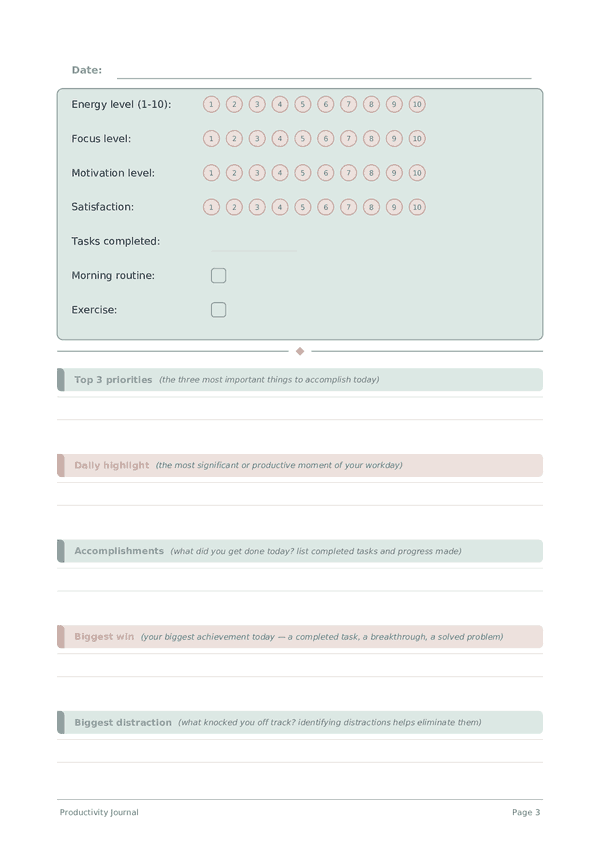
Productivity Journal
Track energy, focus, and daily output to build peak performance habits
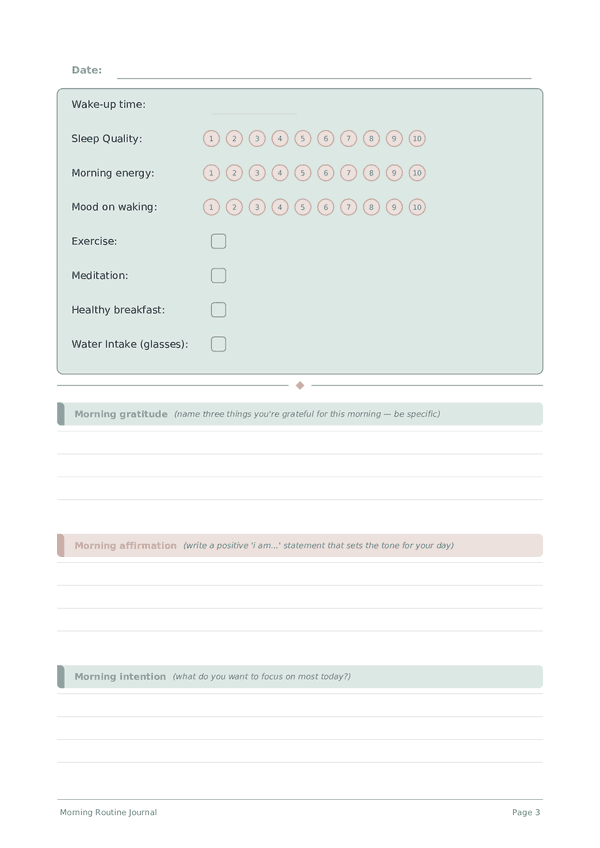
Morning Routine Journal
Start every day with clarity, gratitude, and intention
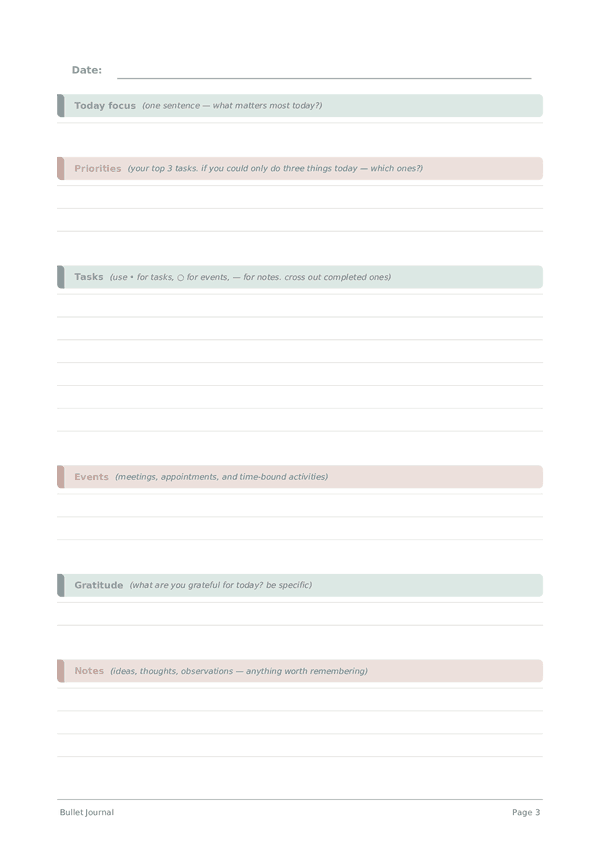
Bullet Journal
Structured daily log for rapid logging
Decision Journal
Think clearly, decide confidently, learn from every choice
Scroll to zoom, drag to move