Printable Morning Routine Journal
Start every day with clarity, gratitude, and intention
A hybrid morning journal that combines quick habit tracking with reflective writing. Track wake-up time, sleep quality, energy level, and key morning habits like exercise, meditation, and healthy eating — then write your gratitude, affirmation, intention, and reflection. Based on research from positive psychology and the most effective morning routine frameworks, this journal helps you build a powerful ritual that transforms how you start each day.
Customize fields
Toggle fields on or off. Click the pencil to rename, or add your own fields.
Benefits
How to Use
What is this journal?
A morning routine journal is a daily check-in that tracks and optimizes the first hours of your day. By logging wake-up time, sleep quality, and which routine elements you completed alongside morning reflections, you discover which habits consistently lead to your best mornings — and therefore your best days.
This journal is for anyone who wants to take control of their mornings instead of stumbling through them on autopilot. Whether you are building a morning routine from scratch or refining an existing one, the data you collect reveals what actually works for your body and mind versus what you think should work.
Research on circadian rhythms and habit formation shows that the first 90 minutes after waking set the neurochemical tone for the entire day. Morning routines that include movement, mindfulness, and intentional nutrition consistently outperform rushed, reactive mornings in measures of mood, focus, and productivity. This journal helps you find your optimal morning formula.
Filled example
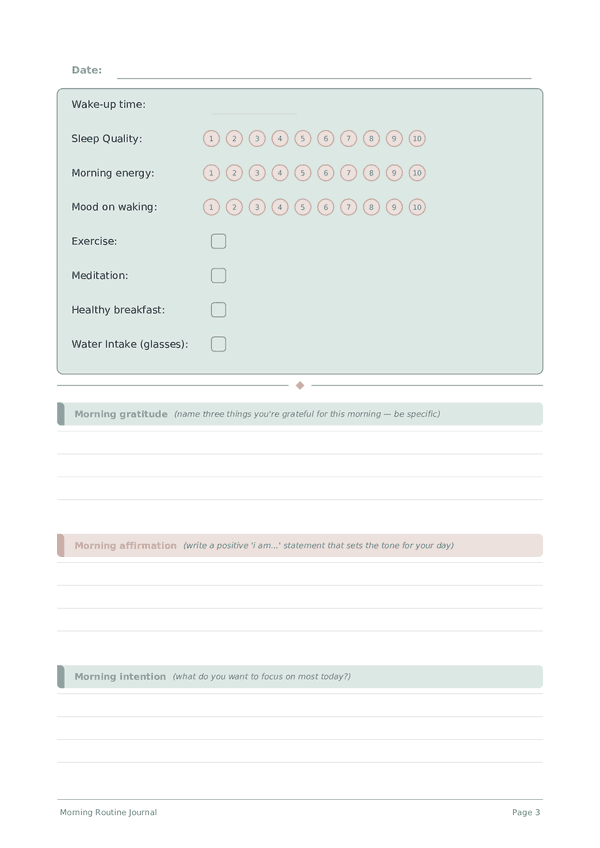
Here's what a typical entry looks like when filled in:
How to fill in each field
The top of each page has quick-fill fields (ratings, checkboxes, numbers). Below that is a lined section for writing. Here's what each field means:
Wake-up time
What time did you wake up? Use 24-hour format, e.g. 6 means 6:00
Sleep Quality
Rate how restful your sleep was. 1 means terrible and restless, 5 means deep and refreshing. Quality matters as much as quantity.
Morning energy
How energized do you feel right now? Rate from 1 (exhausted) to 10 (fully charged)
Mood on waking
How did you feel the moment you woke up? Rate from 1 (rough) to 10 (great)
Exercise
Check off whether you exercised today. Even a 10-minute walk counts. The goal is building awareness of your activity patterns.
Meditation
How long did you sit? What technique? How did it feel to settle in?
Healthy breakfast
Did you eat a nutritious, balanced breakfast this morning?
Water Intake (glasses)
How many glasses of water did you drink today? Aim for 6–8 glasses for optimal skin hydration
Morning gratitude
Name three things you're grateful for this morning — be specific
Morning affirmation
Write a positive 'I am...' statement that sets the tone for your day
Morning intention
What do you want to focus on most today?
Morning reflection
How are you feeling this morning? What dreams, thoughts, or emotions do you want to capture?
Tips for success
When and how often to write
Fill in the tracker every morning within the first hour of waking \u2014 this is non-negotiable for accuracy, since memory of your morning state fades quickly. The habit checkboxes take 30 seconds; the writing prompts take 5 minutes. On weekends, still log your data even if your routine differs \u2014 understanding how weekends affect your Monday is itself a valuable insight. Weekly, compare mornings that felt great with those that felt sluggish to find what made the difference.
Frequently Asked Questions
What habits does the Morning Routine Journal track, and why these?
The tracker captures wake-up time, sleep quality (1-10), morning energy (1-10), and mood on waking (1-10), plus four checkboxes: exercise, meditation, healthy breakfast, water intake. These map onto well-documented levers from positive psychology and behavior-design research, including BJ Fogg's Tiny Habits (2019), which frames small, anchored morning behaviors as the most reliable foundation for larger routines.
Why include both gratitude and intention prompts in the morning?
The lined section pairs morning gratitude with affirmation, intention, and reflection prompts. Gratitude practices have been studied repeatedly in positive psychology literature, while intention-setting connects to Edwin Locke and Gary Latham's goal-setting theory (2002, American Psychologist, 57(9)). Writing both primes attention for what already works and what you want to accomplish today, short-circuiting drift on autopilot.
How long should my morning routine take using this journal?
The tracker itself takes about two minutes; the written section adds three to five. A sustainable routine, including the habit checkboxes, typically runs 20-30 minutes. BJ Fogg's Tiny Habits (2019) recommends starting with the smallest viable version, even one line of gratitude and one intention, then expanding once it sticks. Consistency beats length, especially in the first month.
Does writing down gratitude actually change anything?
Gratitude journaling is one of the most replicated interventions in positive psychology research. Practitioners typically report improvements in mood and sleep quality. This journal asks for three items rather than long entries, keeping the practice sustainable. Note that this is supportive self-care, not a treatment for clinical depression or anxiety; those require qualified professional support, not a journal alone.
What if I'm not a morning person — will this still work?
Yes. The wake-up time field is a number 0-24, not a target. Rate sleep quality and mood on waking honestly to identify your real chronotype rather than forcing an idealized 5 a.m. start. Cal Newport's Deep Work (Grand Central, 2016) argues that effective routines are personalized, not copied. Over two to three weeks of data, your optimal window emerges.
How is this different from a habit tracker app?
Apps mostly check off completion; this journal layers reflection on top. The four 1-10 ratings (sleep, energy, mood, plus checkboxes) let you correlate which morning habits actually improve how you feel, not just whether you did them. James Clear's Atomic Habits (Avery, 2018) frames identity-based reflection, not streaks alone, as the driver of lasting change. Writing forces that reflection.
Can I use this journal alongside meditation or therapy?
Yes, and many do. The meditation checkbox and reflection prompt complement structured contemplative practice. But this is a self-tracking tool, not a clinical intervention. If you're working with a therapist on anxiety, depression, or trauma, share the journal patterns with them rather than treating it as a substitute. Consult a qualified clinician for diagnosable conditions; use the journal for ongoing self-awareness.
How should I review the data weekly to refine my routine?
Every seven days, scan for two patterns: which checkboxes correlate with higher energy and mood ratings, and which mornings rated lowest. Edwin Locke and Gary Latham (2002, American Psychologist, 57(9)) showed that feedback on goal progress drives performance more than goals alone. Drop habits that don't move the ratings, double down on ones that do, and your routine evolves from data, not advice.
You Might Also Like
Scroll to zoom, drag to move