Printable Cooking Journal
Recipe testing and cooking notes journal
Document your culinary adventures with detailed recipe notes, ingredient lists, and technique observations. Rate dishes, note improvements, and build a personalized cookbook of your greatest hits.
Customize fields
Toggle fields on or off. Click the pencil to rename, or add your own fields.
What is this journal?
A cooking journal is where your kitchen experiments stop being one-off events and start becoming a personal recipe archive enriched with honest notes on what actually happened. Cookbooks tell you what should work; your journal tells you what did work — and what did not — in your kitchen, with your ingredients, on your stove. That first-hand knowledge is irreplaceable.
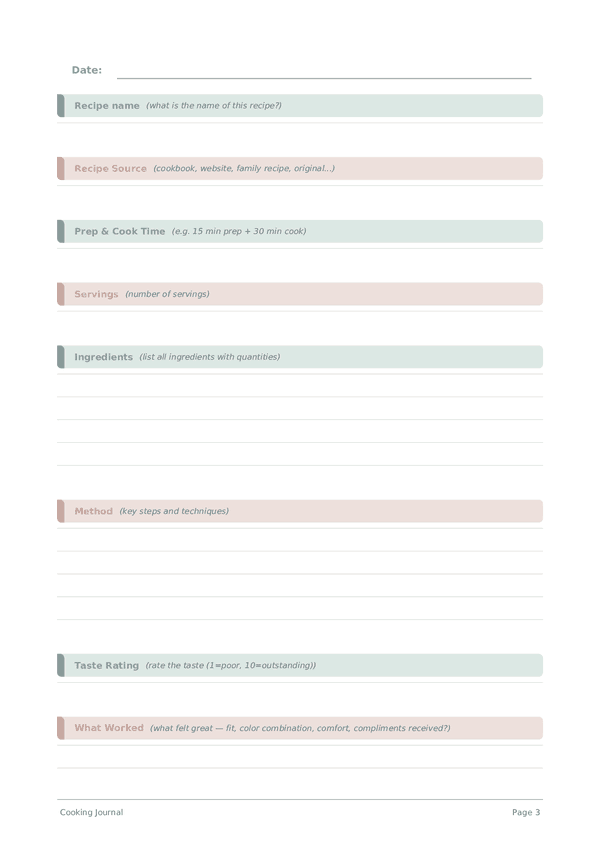
Each entry captures the recipe name and source, prep and cook time, servings, a full ingredient list, your method notes, a taste rating, what worked well, and whether you would make it again. Writing these details down right after cooking preserves the small adjustments — an extra pinch of salt, two minutes less in the oven — that make the difference between good and great.
Over time your journal becomes a living cookbook tailored to your palate, your pantry, and your skill level. It is also the fastest way to improve: when you review past entries you spot repeating mistakes, identify techniques that reliably produce great results, and build confidence to improvise rather than follow every recipe to the letter.
Filled example
Here's what a typical entry looks like when filled in:
How to fill in each field
Each day you'll find several labeled sections with lines for writing. Here's what each section is for:
Recipe name
What is the name of this recipe?
Recipe Source
Cookbook, website, family recipe, original...
Prep & Cook Time
e.g. 15 min prep + 30 min cook
Servings
Number of servings
Ingredients
List all ingredients with quantities
Method
Key steps and techniques
Taste Rating
Rate the taste (1=poor, 10=outstanding)
What Worked
What felt great — fit, color combination, comfort, compliments received?
Would Make Again?
Yes, No, or Maybe with tweaks
Tips for success
When and how often to write
Make an entry every time you cook something noteworthy — a new recipe, a significant modification, or an interesting failure. For daily home cooks, three to four entries per week capture enough to build a useful personal cookbook without turning meals into homework. Write immediately after eating while taste memory is still acute. Weekly, plan your next cooking experiments based on journal insights. Seasonally, review your entries and compile your greatest hits into a personal recipe collection. Over a year, you will have a cookbook that no store can sell you — one perfectly tuned to your life.