Printable Idea Journal
Capture, evaluate, and develop your best ideas
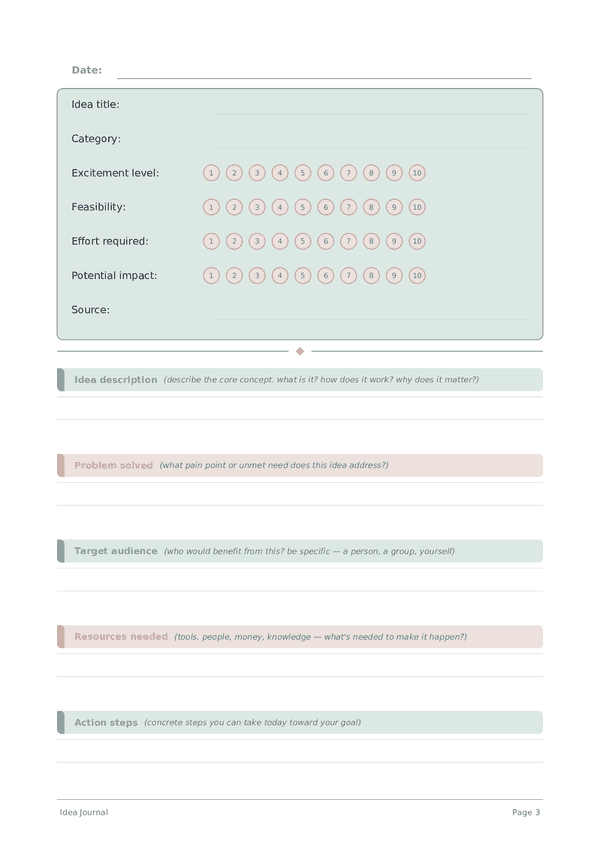
A structured journal for capturing creative ideas and evaluating their potential. Each page combines quick-rating fields for excitement, feasibility, effort, and impact with guided writing prompts to flesh out the concept. Turn fleeting thoughts into actionable plans.
Customize fields
Toggle fields on or off. Click the pencil to rename, or add your own fields.
Benefits
How to Use
What is this journal?
An Idea Journal is a hybrid capture tool that helps you evaluate and develop ideas systematically instead of letting them vanish. The top section lets you rate each idea on excitement, feasibility, effort required, and potential impact, along with a title, category, and source. The bottom section provides space to describe the idea in detail, define the problem it solves, identify the target audience, list needed resources, outline action steps, and note related ideas.
Great ideas are fragile — they appear at unexpected moments and disappear just as quickly if not recorded. But capturing ideas is only the first step. The real power of this journal is in the structured evaluation: by rating each idea against consistent criteria, you can objectively compare them later and decide which ones deserve your time and energy.
Carry this journal everywhere or keep it on your desk. When an idea strikes, fill in the top ratings immediately to capture your initial gut feeling. Then, when you have a quiet moment, flesh out the bottom section with details. Review your collected ideas monthly to spot patterns, combine related concepts, and choose the most promising ones to pursue.
Filled example
Here's what a typical entry looks like when filled in:
How to fill in each field
The top of each page has quick-fill fields (ratings, checkboxes, numbers). Below that is a lined section for writing. Here's what each field means:
Idea title
Give your idea a clear, memorable name you can find later
Category
Assign a category to this entry (e.g., food, transport, entertainment). Consistent categories make your data easy to analyze.
Excitement level
How excited are you about this idea? 1 = meh, 10 = can't stop thinking about it
Feasibility
How realistic is it to execute? 1 = moon shot, 10 = could start today
Effort required
How much time, energy, and resources would it take? 1 = minimal, 10 = massive
Potential impact
If it works, how big is the payoff? 1 = small win, 10 = life-changing
Source
Book, course, video, article, person...
Idea description
Describe the core concept. What is it? How does it work? Why does it matter?
Problem solved
What pain point or unmet need does this idea address?
Target audience
Who would benefit from this? Be specific — a person, a group, yourself
Resources needed
Tools, people, money, knowledge — what's needed to make it happen?
Action steps
Break your goal into concrete next actions. What exactly will you do, when, and how? The more specific, the better.
Related ideas
Is this idea connected to others? Cross-pollination breeds breakthroughs
Tips for success
When and how often to write
Capture ideas whenever they strike — this journal should be always accessible, not confined to a scheduled time. However, set a weekly 20-minute session to review, rate, and expand on ideas captured during the week. Many will seem less exciting on second look, and that is valuable filtering. Monthly, review all ideas from the past 30 days and select one or two to develop further or act on. The goal is not to have more ideas but to systematically surface the best ones.
Frequently Asked Questions
What is the Idea Journal designed for?
This journal captures fleeting creative ideas before they fade and helps you evaluate them objectively. Each page has a top tracker for idea title, category, and four ratings (excitement, feasibility, effort, potential impact, each on a 0-10 scale), plus a writing section for problem solved, target audience, resources needed, action steps, and related ideas. It turns scattered inspiration into a structured archive.
How should I use the four rating fields (excitement, feasibility, effort, impact)?
Score each on a 0-10 scale immediately after capturing the idea. Excitement reflects your intrinsic motivation, which Amabile (2011, The Progress Principle, Harvard Business Review Press) shows predicts creative follow-through. Feasibility and effort estimate cost; potential impact estimates reward. Ideas scoring high on excitement and impact but moderate on effort typically deserve first action. Re-rate after a week — initial enthusiasm often fades.
Does writing ideas down actually help with creativity?
Yes. Csikszentmihalyi (1996, Creativity, HarperCollins) found that creative individuals systematically capture and revisit ideas rather than relying on memory. Getting ideas out of your head frees working memory for combination and elaboration — the core mechanism behind innovation. The Idea Journal's structured fields (source, category, action steps) make ideas retrievable, so old entries can spark new connections during review.
How is this different from a notes app like Notion or Evernote?
Apps store ideas; this journal evaluates them. The fixed rating scales (0-10) force comparison across ideas, and the structured prompts (problem solved, target audience, resources needed) prevent the vague one-liners that fill most digital inboxes. Paper also reduces context-switching and notification noise during ideation. Use the journal for evaluation and elaboration, an app for storage if you wish.
Why does the template ask for the idea's source?
The source field (book, conversation, observation, problem) makes patterns visible over months. You discover which environments produce your best ideas — a key principle in Csikszentmihalyi's flow research (Csikszentmihalyi, 1990, Flow, Harper). Tracking source also credits influences honestly and helps you return to fertile inputs. Write a brief tag like 'podcast / shower / client call' rather than a long citation.
How often should I review past idea entries?
Weekly for active capture, monthly for pattern-finding. Reviewing draws on the spacing effect documented by Cepeda et al. (2006, Psychological Bulletin, 132(3), 354-380) — distributed re-exposure strengthens recall and surfaces unexpected combinations. Mark entries you want to act on; archive or cross out the rest. Most ideas won't survive review, and that's the point: the journal filters for the few worth pursuing.
What's the most common mistake when keeping an idea journal?
Recording the title without filling in problem solved, target audience, and action steps. An idea you can't restate clearly six months later is effectively lost. Spend 3-5 minutes per entry — enough to make it retrievable, not so long it blocks the next idea. Excitement alone fades quickly; the structured prompts force the kind of elaboration that distinguishes a usable idea from a passing thought.
Is this journal suitable for entrepreneurs, writers, or scientists alike?
Yes — the structure is domain-neutral. A founder uses category and target audience for products; a novelist uses them for story premises; a researcher uses them for hypotheses. The effort/impact ratings function as a lightweight prioritization matrix similar to those described in Amabile's workplace creativity research (Amabile, 2011, The Progress Principle, Harvard Business Review Press). Adapt the source field to your discipline.
You Might Also Like
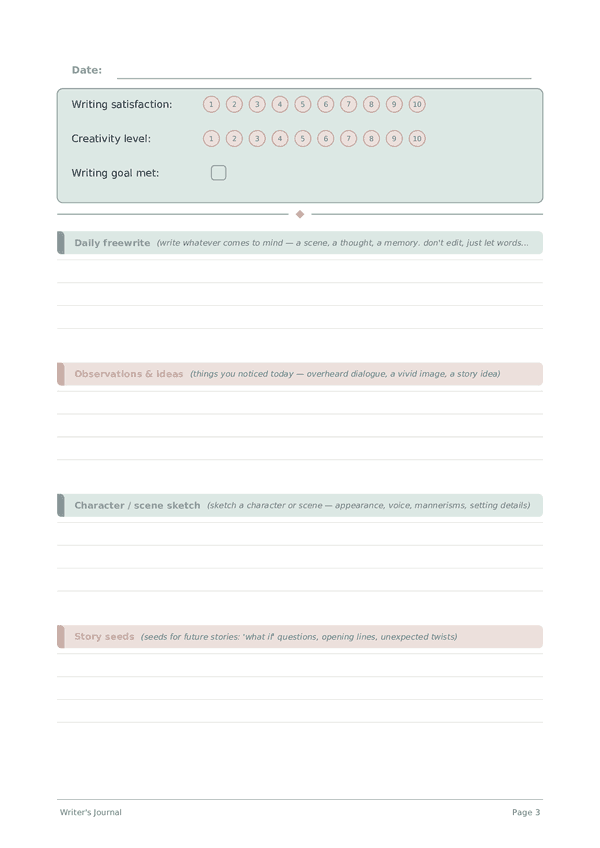
Writer's Journal
Daily creative writing practice & craft development
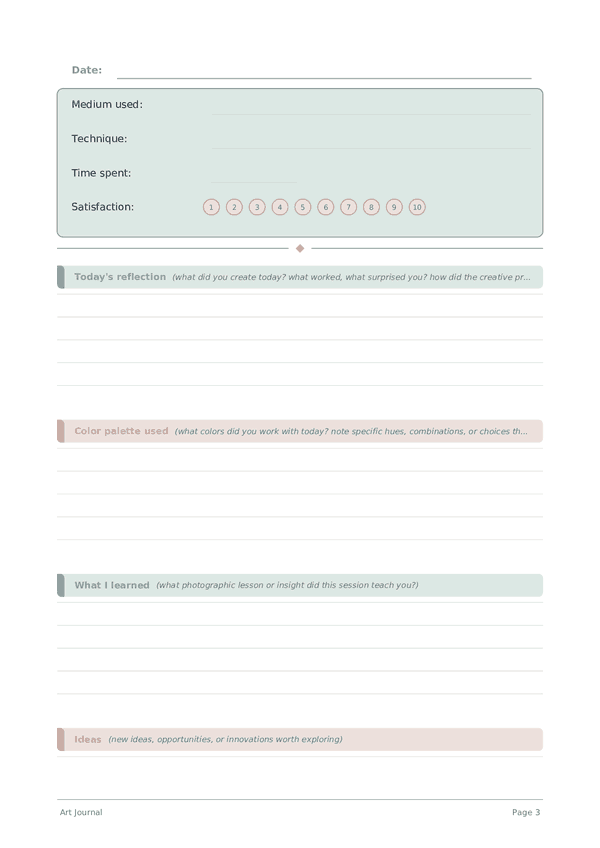
Art Journal
Document your creative process and artistic growth
Sketch Journal
Open dot-grid pages for sketching, drawing, and visual exploration

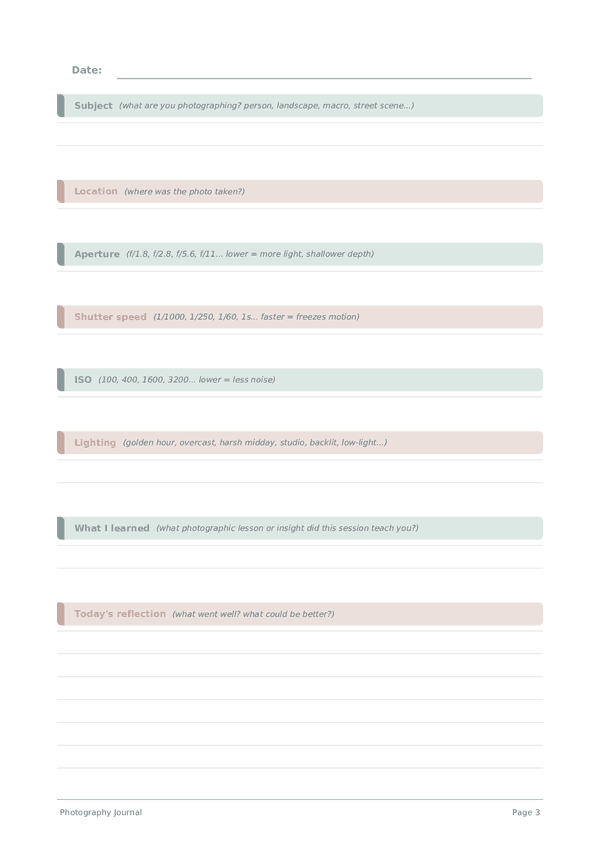
Photography Journal
Log your shoots, settings, and creative insights after every session
Scroll to zoom, drag to move