Printable Photography Journal
Log your shoots, settings, and creative insights after every session
A structured photography journal to record subjects, camera settings, lighting, and reflections. Reviewing your process helps you develop consistent technique and a stronger photographic vision.
Customize fields
Toggle fields on or off. Click the pencil to rename, or add your own fields.
Benefits
How to Use
What is this journal?
A photography journal is a dedicated space where you document every shoot — from camera settings and lighting conditions to creative reflections and lessons learned. Whether you are a hobbyist discovering your style or a working photographer refining your craft, writing down the details of each session accelerates your growth in ways that reviewing photos alone cannot.
Each entry prompts you to record the subject you photographed, the technical settings you chose (aperture, shutter speed, ISO), and the lighting you worked with. More importantly, it asks you to reflect on what you learned and what you would do differently next time. Over weeks and months these notes reveal patterns in your decision-making that help you become a more intentional photographer.
Use this journal right after a shoot while the details are still fresh. It takes only a few minutes per session and builds a searchable archive of your entire photographic journey — one that no camera roll can replace.
Filled example
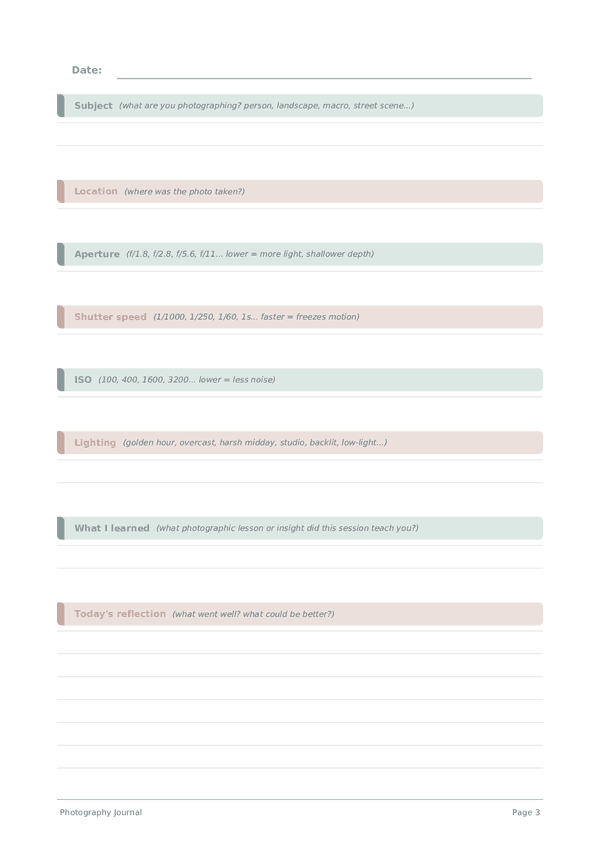
Here's what a typical entry looks like when filled in:
How to fill in each field
Each day you'll find several labeled sections with lines for writing. Here's what each section is for:
Subject
What are you photographing? Person, landscape, macro, street scene...
Location
Where was the photo taken?
Aperture
f/1.8, f/2.8, f/5.6, f/11... Lower = more light, shallower depth
Shutter speed
1/1000, 1/250, 1/60, 1s... Faster = freezes motion
ISO
100, 400, 1600, 3200... Lower = less noise
Lighting
Golden hour, overcast, harsh midday, studio, backlit, low-light...
What I learned
Write one new thing you learned today. It can be a fact, a skill, an insight about yourself, or a life lesson. Daily learning compounds into wisdom.
Today's reflection
Look back at your day honestly. What went well? What could be better? This isn't about judgment — it's about learning and growing.
Tips for success
When and how often to write
Make a journal entry after every dedicated shoot or photo walk while the experience is still tactile. If you shoot casually throughout the week, batch your reflections into one focused session on the weekend. Monthly, review your entries to identify recurring themes and technical gaps. Quarterly, select your ten best images from journal entries and compare them to the previous quarter — this curated comparison reveals growth that daily shooting alone obscures.
Frequently Asked Questions
What does the Photography Journal record after each shoot?
Eight fields per session: subject, location, aperture, shutter speed, ISO, lighting conditions, what I learned, and reflection. The exposure triangle (aperture, shutter, ISO) plus subject and lighting create a complete technical record of each shot or session. The learning and reflection fields turn the technical log into a deliberate-practice tool rather than a metadata dump.
Why record aperture, shutter speed, and ISO when my camera already stores EXIF data?
EXIF tells you what the camera did; the journal makes you remember why. Writing 'f/1.8 because I wanted shallow depth' creates the explicit reasoning Ericsson et al. (1993, Psychological Review, 100(3), 363-406) call essential for deliberate practice. Without putting it into words, your settings become habit rather than choice. Searching and sorting by EXIF is also tedious; a structured paper log is reviewable in minutes.
How do I describe lighting conditions usefully in two lines?
Cover four elements: source (natural/artificial/mixed), direction (front, side, back, overhead), quality (hard, soft, diffused), and color (warm, neutral, cool). Example: '4 PM, overcast, soft north-window side light, cool blue.' Over 30-50 sessions, this becomes a self-built lighting reference. Photographers who name light see it better — a perceptual training effect documented across visual disciplines.
What should I write in 'what I learned' versus 'reflection'?
What I learned = one specific, transferable lesson ('backlit subjects need +1 EV exposure compensation'). Reflection = broader thoughts about the session — what felt creative, what frustrated you, what you'd try differently. The split mirrors the deliberate practice structure from Ericsson (2016, Peak, Houghton Mifflin Harcourt): a technical takeaway plus metacognitive review accelerate skill growth more than either alone.
Does logging shoots really improve photography skill?
Yes — for the same reason deliberate practice works in any skilled domain. Roediger and Karpicke (2006, Psychological Science, 17(3), 249-255) showed that retrieval and articulation strengthen memory more than re-exposure. Writing your settings and reasoning is retrieval practice. Photographers who journal consistently identify their failure patterns 2-3x faster than those who only review images visually.
How is the journal different from Lightroom keywords or a photo app?
Lightroom catalogs images; this journal catalogs your thinking. The eight fields draw out narrative reasoning that no app captures: the why behind settings, the felt quality of light, the gap between intent and result. Use both — Lightroom for image management, the journal for craft development. Paper review also reduces screen fatigue and improves recall, per multiple cognition studies.
Should I fill this in for every shot or once per session?
Once per session for casual shoots; per keeper shot for portfolio or learning work. Aim for 5-10 minutes of journaling per hour of shooting — enough to capture the key technical decisions and one clear lesson. Filling it for every frame is overkill and breaks the habit; filling it only for big shoots loses the small-session learning where most growth happens.
How often should I review past entries?
Weekly skim, monthly deep review. The spacing effect from Cepeda et al. (2006, Psychological Bulletin, 132(3), 354-380) shows distributed review consolidates learning. Look for recurring failures ('I keep underexposing snow') and emerging style ('I'm drawn to side light at low angles'). The journal becomes a personal photography handbook — built from your specific patterns, not generic advice.
You Might Also Like

Scroll to zoom, drag to move