Printable Writer's Journal
Daily creative writing practice & craft development
A structured daily journal for writers of all levels. Each page combines quick satisfaction and creativity trackers with generous writing space for freewriting, character sketches, story seeds, and craft reflection. Whether you write fiction, poetry, memoir, or essays — this journal builds the daily habit that transforms aspiring writers into practicing ones.
Customize fields
Toggle fields on or off. Click the pencil to rename, or add your own fields.
Benefits
How to Use
What is this journal?
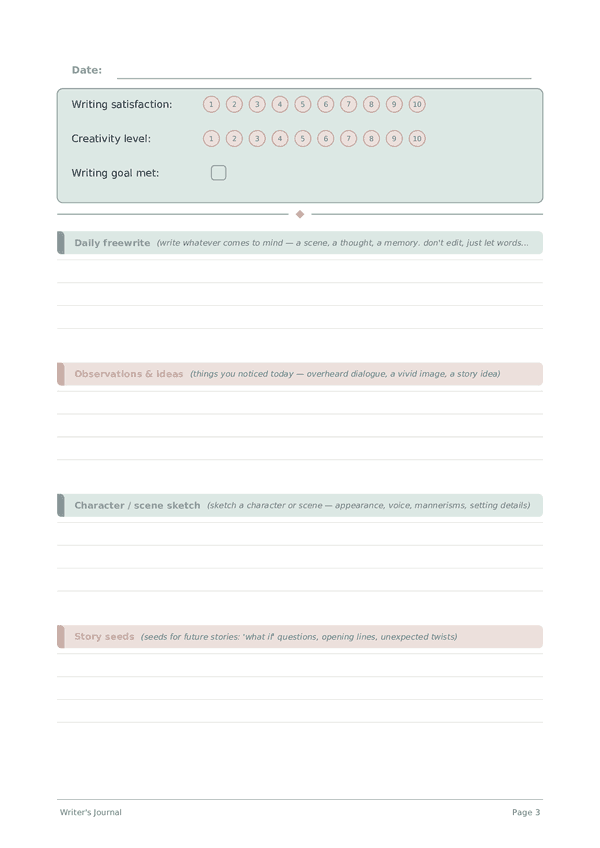
A Writer's Journal is a hybrid tool that pairs daily writing metrics with creative reflection. The top section tracks your writing satisfaction, creativity level, and whether you met your writing goal. The bottom section provides generous space for freewriting, capturing observations and ideas, sketching characters or scenes, planting story seeds, and reflecting on your writing practice. It is both a log and a creative incubator.
Every published author will tell you that consistency matters more than inspiration. This journal supports that consistency by making your writing practice visible and measurable. The tracker section takes the guesswork out of progress — you can see at a glance whether your satisfaction and creativity are trending up or down over weeks. The writing sections keep your creative muscles engaged even on days when the main project feels stuck.
Use the freewrite section first thing each morning to warm up your writing brain. Do not edit, do not censor — just let words flow for ten minutes. Then fill in observations, character sketches, or story seeds throughout the day as they occur to you. At the end of the day, complete the tracker and write a brief reflection on what worked and what did not. Over months, this journal becomes a goldmine of raw material for your larger projects.
Filled example
Here's what a typical entry looks like when filled in:
How to fill in each field
The top of each page has quick-fill fields (ratings, checkboxes, numbers). Below that is a lined section for writing. Here's what each field means:
Writing satisfaction
How satisfied are you with today's writing? 1 = frustrated, 10 = deeply fulfilled
Creativity level
How creative did you feel today? 1 = completely blocked, 10 = ideas flowing freely
Writing goal met
Did you hit your writing goal today — word count, time, or pages? Yes, no, or partially
Daily freewrite
Write whatever comes to mind — a scene, a thought, a memory. Don't edit, just let words flow
Observations & ideas
Things you noticed today — overheard dialogue, a vivid image, a story idea
Character / scene sketch
Sketch a character or scene — appearance, voice, mannerisms, setting details
Story seeds
Seeds for future stories: 'what if' questions, opening lines, unexpected twists
Writing reflection
What did you learn about your writing today? What worked, where did you get stuck?
Tips for success
When and how often to write
Write daily, ideally at the same time to build a routine. Morning pages work best for clearing mental clutter; evening sessions suit reflective and narrative writing. Aim for a minimum of 15-20 minutes or 300 words — enough to warm up and produce something real. Weekly, reread the week’s entries and highlight any phrases, ideas, or scenes worth developing. Monthly, review your word count trends and satisfaction ratings to see if your practice is growing or stagnating, and adjust your routine accordingly.
Frequently Asked Questions
What is a Writer's Journal and who is it for?
It's a daily journal for writers at any level — fiction, poetry, memoir, essays. Each page pairs a short tracker (writing satisfaction, creativity level, goal-met checkbox) with ten lined rows for daily freewriting, observations, character or scene sketches, story seeds, and craft reflection. The point is to build the steady practice that Anne Lamott (1994, Bird by Bird, Anchor) and Stephen King (2000, On Writing, Scribner) both describe as the actual job of writing.
How long should I freewrite on each page?
Fifteen to twenty minutes is the standard — long enough to push past surface thoughts. Pennebaker's expressive writing protocols (used in dozens of published studies on writing and well-being) consistently use 15-20 minute sessions. Write without stopping or editing; if you stall, repeat your last sentence. The ten lined rows give roughly that volume in longhand.
How do I use the satisfaction and creativity ratings effectively?
Rate right after writing, not before. Over weeks, the two scores show when you work best — time of day, sleep level, after exercise, before email. Csikszentmihalyi (1990, Flow, Harper) stressed that creators do not have constant flow; tracking exposes the conditions that produce it. The goal-met checkbox separates effort from output: meeting a daily goal matters more than feeling brilliant.
Does daily writing practice actually improve craft?
Yes — deliberate practice principles from Ericsson, Krampe and Tesch-Römer (1993, Psychological Review, 100(3), 363-406) transfer to writing when sessions include specific goals and reflection. The Writer's Journal builds that loop: a clear goal at the top, focused practice in the freewrite, and craft reflection at the bottom. Ericsson's later book Peak (2016, Houghton Mifflin Harcourt) extends this to creative domains.
What goes into the character or scene sketch section?
A short paragraph — physical detail, voice, gesture, one revealing action. Lamott (1994, Bird by Bird, Anchor) calls these 'short assignments' and argues they are how books actually get written: not in arcs but in small, concrete pieces. Use sensory specifics over abstractions. Today's two-line sketch may become tomorrow's chapter, but its first job is to train your eye for detail.
How is this different from morning pages or journaling apps?
Morning pages (three pages of stream-of-consciousness) clear mental clutter; this journal is for craft. The tracker enforces measurement, the extra prompts (story seeds, character sketch) force generative output, and the reflection line builds metacognition about your own writing. Apps lack the friction that, per Zinsser (2006, On Writing Well, Harper Perennial), forces clearer thinking — slow handwriting often produces sharper prose.
What if I have writer's block — what should I write?
Use the prompts in order: observations from today, a sentence overheard, one sensory detail, a single character's gesture. Block usually means trying to write the wrong thing — Lamott (1994, Bird by Bird, Anchor) recommends the 'one-inch picture frame' approach: write only what fits in a tiny scene. The freewrite section is built for exactly this — low-stakes generation, not finished prose.
How long until I see real improvement from daily journaling?
Expect noticeable change in 8-12 weeks of consistent practice and measurable craft growth in 6-12 months. Ericsson's research (Ericsson et al., 1993, Psychological Review, 100(3)) shows that focused, reflective practice — not raw hours — produces gains. Twenty minutes daily with the satisfaction tracker and reflection prompts beats two unfocused hours weekly. Review entries monthly to confirm progress.
You Might Also Like

Scroll to zoom, drag to move