Printable Cooking Journal
Recipe testing and cooking notes journal
Document your culinary adventures with detailed recipe notes, ingredient lists, and technique observations. Rate dishes, note improvements, and build a personalized cookbook of your greatest hits.
Customize fields
Toggle fields on or off. Click the pencil to rename, or add your own fields.
What is this journal?
A cooking journal is where your kitchen experiments stop being one-off events and start becoming a personal recipe archive enriched with honest notes on what actually happened. Cookbooks tell you what should work; your journal tells you what did work — and what did not — in your kitchen, with your ingredients, on your stove. That first-hand knowledge is irreplaceable.
Each entry captures the recipe name and source, prep and cook time, servings, a full ingredient list, your method notes, a taste rating, what worked well, and whether you would make it again. Writing these details down right after cooking preserves the small adjustments — an extra pinch of salt, two minutes less in the oven — that make the difference between good and great.
Over time your journal becomes a living cookbook tailored to your palate, your pantry, and your skill level. It is also the fastest way to improve: when you review past entries you spot repeating mistakes, identify techniques that reliably produce great results, and build confidence to improvise rather than follow every recipe to the letter.
Filled example
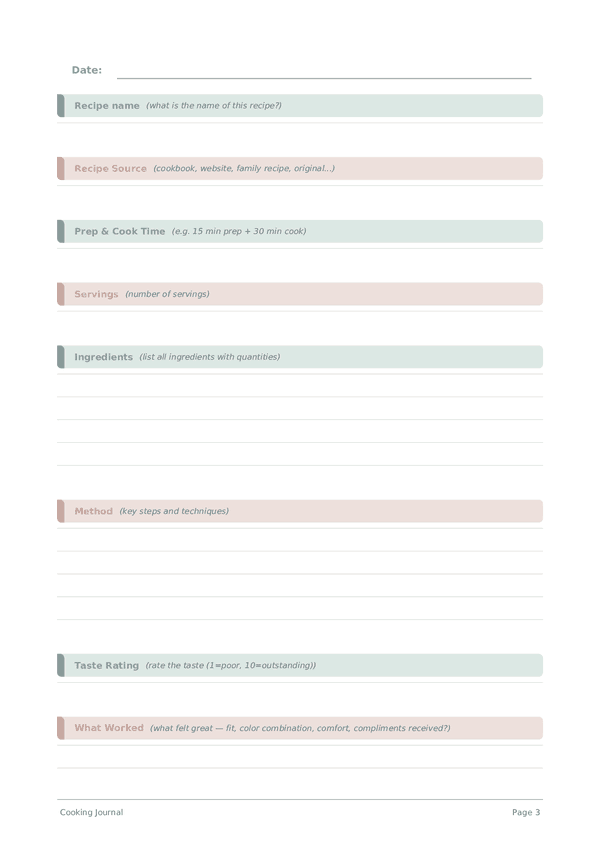
Here's what a typical entry looks like when filled in:
How to fill in each field
Each day you'll find several labeled sections with lines for writing. Here's what each section is for:
Recipe name
What is the name of this recipe?
Recipe Source
Cookbook, website, family recipe, original...
Prep & Cook Time
e.g. 15 min prep + 30 min cook
Servings
Number of servings
Ingredients
List all ingredients with quantities
Method
Key steps and techniques
Taste Rating
Rate the taste (1=poor, 10=outstanding)
What Worked
What felt great — fit, color combination, comfort, compliments received?
Would Make Again?
Yes, No, or Maybe with tweaks
Tips for success
When and how often to write
Make an entry every time you cook something noteworthy — a new recipe, a significant modification, or an interesting failure. For daily home cooks, three to four entries per week capture enough to build a useful personal cookbook without turning meals into homework. Write immediately after eating while taste memory is still acute. Weekly, plan your next cooking experiments based on journal insights. Seasonally, review your entries and compile your greatest hits into a personal recipe collection. Over a year, you will have a cookbook that no store can sell you — one perfectly tuned to your life.
Frequently Asked Questions
What does the Cooking Journal record per dish?
Nine fields per recipe: recipe name, recipe source, prep and cook time, servings, ingredients (5 lines), method (5 lines), taste rating, what worked (2 lines), and would make again? The structure turns each cooking attempt into a documented experiment rather than a one-off — over time you build a personal cookbook tuned to your actual taste, ingredients, and equipment.
Why log ingredients when the recipe source already has them?
You log what you actually used, not what the recipe specified. Substitutions, available cuts, ripe versus underripe produce, and quantity adjustments all change the outcome. Recording your real ingredients turns a one-time success into a repeatable one — and a failure into a problem you can diagnose. The 5-line ingredient space fits a moderately complex dish; complex recipes can split across pages.
How is this different from saving recipes online?
Saved recipes are bookmarks; this journal is a personal record of your version. Online recipes assume an ideal kitchen and average ingredients; your journal records what happened in your kitchen with your stove, your salt, your oven's hot spots. After 20-30 entries the journal becomes more useful than any cookbook because it's calibrated to your specific cooking environment and preferences.
What goes in the what worked section?
Specific technique observations: 'reduced the broth by half before adding cream — sauce coated the back of a spoon,' '60-second sear made better crust than 90.' Be specific: vague entries ('came out great') fade; concrete ones build cooking intuition you can transfer. Across cuisines and methods, the what worked column becomes your personal collection of small techniques learned the hard way.
How do I use the taste rating field honestly?
Rate against your expectation for the dish, not against a Michelin standard. A solid weeknight pasta rated 7/10 against 'good weeknight pasta' is more useful than 4/10 against an unrealistic ideal. Pair the rating with notes — a 5/10 with 'too salty' is actionable; a 5/10 alone is just discouragement. Over time, rating patterns reveal the cuisines and methods that consistently work for you.
Should I log dishes I make often, or only new recipes?
Both, but for different reasons. New recipes need the full template — you're learning. Repeat dishes benefit from occasional entries to track refinement: changes you've made, what improved, what plateaued. Many home cooks hit a comfortable ceiling on familiar dishes without noticing they've stopped iterating. The journal interrupts that drift by making each repeat a chance for one small change.
Does keeping a cooking journal actually make me a better cook?
Yes, when entries include specific observations and revision. Cooking improves through the same deliberate practice mechanism Ericsson (2016, Peak, Houghton Mifflin Harcourt) documents in other skill domains — focused attention on specific techniques with feedback. The taste rating provides the feedback; what worked provides the specific attention. Without writing, most cooks repeat the same dishes without consciously improving them.
How do I use the journal for meal planning or shopping?
Flip through entries marked would make again? = yes to build the week's plan, then compile a shopping list from the ingredients sections. This avoids the common trap of buying for aspirational meals that never get cooked. A quarterly review of taste ratings shows which categories of food consistently land well — useful both for planning and for upgrading the recipes you cook most often.
You Might Also Like

Scroll to zoom, drag to move