Printable Creative Journal
Open-format creative expression and art journal
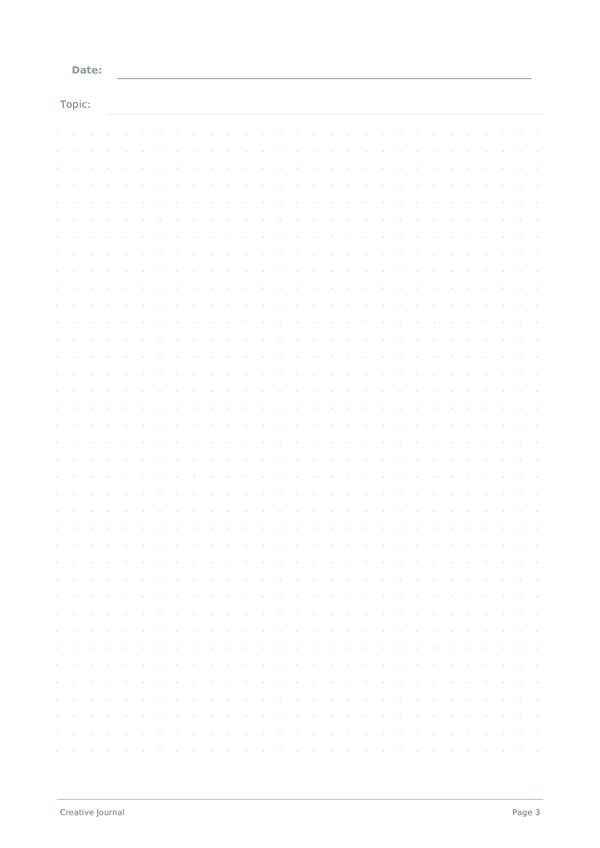
Unleash your creativity in a free-flowing dot-grid format. Sketch, write, brainstorm, or express yourself in any medium. A judgment-free space for daily creative exploration and artistic growth.
What is this journal?
A creative journal is an open canvas for your imagination — a place where ideas, experiments, and creative play live without rules or judgement. Unlike structured journals that guide you through specific prompts, this freeform space invites you to write, draw, brainstorm, or collage in whatever way the moment demands. The only requirement is showing up and letting something out.
Each page starts with a date header and optional guided prompts to help you get started — the creative medium you are exploring, a prompt for the day, and your source of inspiration. But you are free to ignore all of them and go wherever your mind takes you. The dot grid background supports handwriting, sketching, mind maps, and doodling with equal grace.
Use this journal daily, weekly, or whenever the creative urge hits. Over time the pages become a vivid record of your creative evolution — patterns emerge, recurring themes surface, and you begin to see connections between ideas that once seemed unrelated. That is where the real magic of a creative journal lives.
Filled example
Here's what a typical entry looks like when filled in:
Tips for success
When and how often to write
Use your creative journal whenever the impulse arises — creative energy does not follow a clock. That said, establishing a minimum of three entries per week prevents the journal from gathering dust. Many creatives find that a 10-minute morning session (sometimes called "morning pages lite") primes the brain for creative thinking throughout the day. Monthly, spend 30 minutes rereading and connecting ideas from different entries. The real value of a creative journal compounds over time, so consistency matters more than volume.
Frequently Asked Questions
What makes the Creative Journal different from a sketchbook or diary?
It's a free-format dot-grid journal with a date-title header and three guided prompts (creative medium, today's prompt, inspiration source), and otherwise blank space for any medium — sketches, writing, collage, mind maps, brainstorming. Unlike a single-purpose journal, it fits whatever creative output emerges that day. The prompts give it structure without dictating the medium.
Why the three prompts — what should I write in each?
Creative medium = what you used (ink, watercolour, prose, photography, scissors). Today's prompt = the question, theme, or constraint you worked with ('explore solitude,' 'five-minute self-portrait'). Inspiration source = what triggered it (an artwork, a sentence, a walk). The three together document the conditions of creation, not just the output — making the journal a record of process across years.
Does an open-format journal actually help develop creativity?
Yes, when used consistently. Csikszentmihalyi (1996, Creativity, HarperCollins) found that highly creative people across domains share daily creative engagement and reflection — not specific techniques. The journal's date-stamped pages build the streak; the three prompts make you choose a medium and theme on purpose rather than doodle passively. Both elements matter for sustained creative growth.
How is this different from the Inspiration Journal or Art Journal?
The Inspiration Journal focuses on capturing sparks (often verbal). The Art Journal logs structured art sessions with ratings. The Creative Journal sits between: more open than the Art Journal, more action-oriented than the Inspiration Journal. Use it when your creative practice spans media — writing one day, sketching the next, mind-mapping a project on the third — and you want a single home for all of it.
What if some days I only sketch and other days only write?
That's the point. The dot grid supports both without bias, and the creative medium prompt records which mode you used. Over months, the pattern shows your dominant and neglected modes. Csikszentmihalyi's flow research (1990, Flow, Harper) suggests creators benefit from rotating modes — staying in one too long produces ruts. The journal makes that rotation visible and intentional.
How long should each daily session be?
10-30 minutes covers most use cases. The 8% margin gives generous space without overwhelming. For creative practice, consistency matters more than session length — Ericsson's deliberate practice principles (Ericsson, 2016, Peak, Houghton Mifflin Harcourt) favor focused short sessions over long unfocused ones. Use the date header to keep the streak going; protect frequency before you optimize duration.
What should today's prompt be — should I plan it in advance?
Either way works. Pre-planned prompts ('every Tuesday is color study') build discipline; spontaneous prompts capture in-the-moment curiosity. Many creators use a hybrid — weekly themes with daily flexibility. The prompt's job is to set a creative constraint that, per Amabile (2011, The Progress Principle, Harvard Business Review Press), often produces more interesting output than open-ended freedom.
How do I review and learn from past entries?
A monthly flip-through with attention to the three prompts: which media dominate, which themes recur, which inspiration sources prove generative. Spreading that review out benefits from the spacing principle documented by Cepeda et al. (2006, Psychological Bulletin, 132(3), 354-380). After 3-6 months, group related entries — clusters often reveal a longer-form project you've been building in fragments without realising it.
You Might Also Like

Scroll to zoom, drag to move