Printable Learning Journal
Learn deeper with the Feynman technique
Apply the Feynman technique to every study session. Explain what you learned in plain words, surface knowledge gaps, spark new questions, and turn insights into concrete action — all in one daily entry.
Customize fields
Toggle fields on or off. Click the pencil to rename, or add your own fields.
Benefits
How to Use
What is this journal?
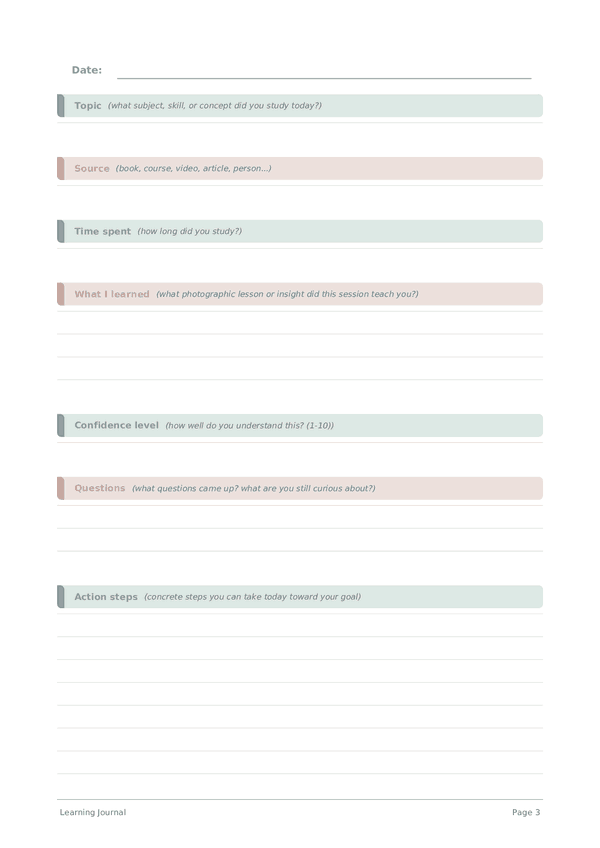
A learning journal built on the Feynman technique is one of the most effective tools for deep understanding. The core idea is simple: if you cannot explain something in plain language, you do not truly understand it. Each entry challenges you to articulate what you learned, identify gaps, and plan concrete next steps — turning passive consumption into active mastery.
Every session begins by noting the topic, source, and time invested. Then you write what you learned as if explaining it to someone with no background in the subject. This act of simplification exposes fuzzy thinking and forgotten details far faster than re-reading notes ever could.
Finally, you record your confidence level, lingering questions, and specific action steps. Over weeks, your journal becomes a personal knowledge base that charts not just what you studied, but how deeply you understood it — and where you still need to dig deeper.
Filled example
Here's what a typical entry looks like when filled in:
How to fill in each field
Each day you'll find several labeled sections with lines for writing. Here's what each section is for:
Topic
What subject, skill, or concept did you study today?
Source
Book, course, video, article, person...
Time spent
How long did you study?
What I learned
Write one new thing you learned today. It can be a fact, a skill, an insight about yourself, or a life lesson. Daily learning compounds into wisdom.
Confidence level
How well do you understand this? (1-10)
Questions
What questions came up? What are you still curious about?
Action steps
Break your goal into concrete next actions. What exactly will you do, when, and how? The more specific, the better.
Tips for success
When and how often to write
Write an entry after every study session or significant learning event — the same day, ideally within an hour, when recall is strongest. If you are in a course or structured program, daily entries keep pace with new material. For self-directed learners, three to four entries per week maintain momentum without burnout. Weekly, review your entries and rewrite key concepts from memory as spaced repetition. Monthly, identify which topics need revisiting based on your self-rated understanding scores.