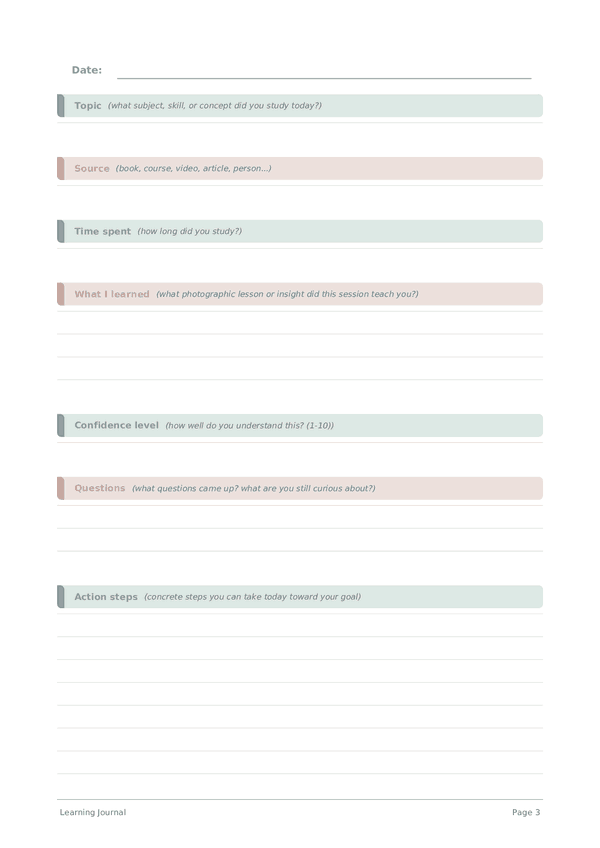
Printable Learning Journal
Learn deeper with the Feynman technique
Apply the Feynman technique to every study session. Explain what you learned in plain words, surface knowledge gaps, spark new questions, and turn insights into concrete action — all in one daily entry.
Customize fields
Toggle fields on or off. Click the pencil to rename, or add your own fields.
Benefits
How to Use
What is this journal?
A learning journal built on the Feynman technique is one of the most effective tools for deep understanding. The core idea is simple: if you cannot explain something in plain language, you do not truly understand it. Each entry challenges you to articulate what you learned, identify gaps, and plan concrete next steps — turning passive consumption into active mastery.
Every session begins by noting the topic, source, and time invested. Then you write what you learned as if explaining it to someone with no background in the subject. This act of simplification exposes fuzzy thinking and forgotten details far faster than re-reading notes ever could.
Finally, you record your confidence level, lingering questions, and specific action steps. Over weeks, your journal becomes a personal knowledge base that charts not just what you studied, but how deeply you understood it — and where you still need to dig deeper.
Filled example
Here's what a typical entry looks like when filled in:
How to fill in each field
Each day you'll find several labeled sections with lines for writing. Here's what each section is for:
Topic
What subject, skill, or concept did you study today?
Source
Book, course, video, article, person...
Time spent
How long did you study?
What I learned
Write one new thing you learned today. It can be a fact, a skill, an insight about yourself, or a life lesson. Daily learning compounds into wisdom.
Confidence level
How well do you understand this? (1-10)
Questions
What questions came up? What are you still curious about?
Action steps
Break your goal into concrete next actions. What exactly will you do, when, and how? The more specific, the better.
Tips for success
When and how often to write
Write an entry after every study session or significant learning event — the same day, ideally within an hour, when recall is strongest. If you are in a course or structured program, daily entries keep pace with new material. For self-directed learners, three to four entries per week maintain momentum without burnout. Weekly, review your entries and rewrite key concepts from memory as spaced repetition. Monthly, identify which topics need revisiting based on your self-rated understanding scores.
Frequently Asked Questions
What is the Feynman technique and how does this journal apply it?
The Feynman technique: pick a topic, explain it in plain language as if teaching a child, find gaps, refine. This journal's structure mirrors that — topic field, what I learned written in your own words, confidence level for gap-finding, questions field for what you couldn't explain, action steps for follow-up. Each daily entry forces the explain-find-refine loop on a single learning session.
Why explain what I learned 'as if teaching a child'?
Generating an explanation in your own words is retrieval practice — the strongest learning mechanism in cognitive science. Roediger and Karpicke (2006, Psychological Science, 17(3), 249-255) showed retrieval produces dramatically better long-term retention than re-reading. Simplifying for a non-expert audience exposes the words you're parroting versus the ideas you actually understand. The four-line what I learned field is the working space for this.
How do I use the confidence level field to find knowledge gaps?
Rate your confidence on the day's topic immediately after writing the explanation. Low confidence on a topic you just 'learned' is a fluency illusion warning — recognizing material is not the same as recalling or applying it (Bjork & Bjork, 2011, Psychology and the Real World, Worth Publishers). Use those low ratings to flag topics for spaced review in the action steps field.
What goes in the questions section?
Everything you couldn't answer in your own explanation, plus things the material made you curious about. The three lines force you to name your ignorance specifically — 'why does X cause Y?' rather than 'I don't get this.' Sweller's cognitive load theory (Educational Psychology Review, multiple papers) shows that articulated questions reduce extraneous load on future study sessions because you arrive with focused targets.
How does the action steps field bridge learning and practice?
Two lines for what you'll do — review with spaced repetition, build a small project, find a worked example, teach the topic. Without this step, learning stays passive. Ericsson's deliberate practice framework (Ericsson et al., 1993, Psychological Review, 100(3), 363-406) requires targeted application, not just exposure. The best action steps are small and time-bound: 'redo problem 4.2 tomorrow without notes.'
How often should I review old learning entries?
Use spaced intervals — 1 day, 3 days, 1 week, 2 weeks, 1 month. Cepeda et al. (2006, Psychological Bulletin, 132(3), 354-380) found expanding intervals optimize long-term retention. The journal's date and topic fields make it scannable for review. Re-read your own explanation first; if you can extend or correct it without notes, the topic is consolidating. If not, return to source material.
How is this different from Anki or a flashcard app?
Anki and SRS apps (descended from Wozniak's SuperMemo, 1985) optimize factual recall through spaced repetition. This journal builds understanding through explanation and reflection — a complement, not a duplicate. Use both: journal entries surface what you understand and don't; flashcards drill the facts. The questions field often becomes the source of your best Anki cards.
Will this journal work for technical, language, or humanities learning?
Yes — the Feynman technique works across subjects. Engineers use it on algorithms and proofs; language learners use it on grammar rules; history students use it on causal chains. Oakley (2014, A Mind for Numbers, Tarcher) explicitly applies similar plain-language explanation to STEM. The source field captures the material type so cross-domain patterns become visible over time.
You Might Also Like

Scroll to zoom, drag to move