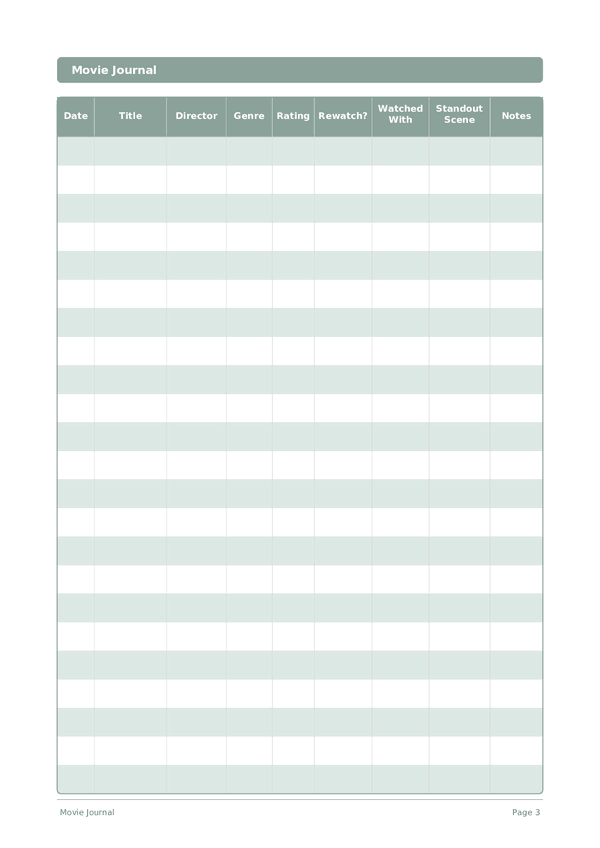
Printable Movie Journal
Personal movie watchlist and film review journal
Build your personal film library with ratings, reviews, and memorable moments. Track everything you watch, discover patterns in your taste, and never forget a great movie again.
Customize fields
Toggle fields on or off. Click the pencil to rename, or add your own fields.
What is this journal?
A movie journal turns passive viewing into an active, reflective habit. Instead of letting films blur together in memory, each row in your log captures the essential details — title, director, genre, your rating, and brief notes — so you build a personal film library you can search, sort, and revisit whenever you need a recommendation or want to remember what made a particular film special.
The table format makes it easy to scan your viewing history at a glance and spot patterns: which genres you gravitate toward, which directors consistently impress you, and how your taste evolves over time. A dedicated column for whether you watched with someone and a standout-scene note add personal context that no streaming algorithm can replicate.
Fill in a row right after the credits roll, while your impressions are still fresh. Even a few words in the notes column are enough to bring the whole experience back months later. Over time, your movie journal becomes a curated guide to the films that shaped your taste — and an instant answer to "What should we watch tonight?"
Filled example
Here's what a typical entry looks like when filled in:
| Date | Title | Director | Genre | Rating | Rewatch? | Watched With | Standout Scene | Notes |
|---|---|---|---|---|---|---|---|---|
| 2025-01-10 | Past Lives | Celine Song | Drama | 9 | Yes | Anna | Final scene on the stoop | Devastating and quiet. The space between what is said and felt. |
| 2025-01-17 | The Banshees of Inisherin | Martin McDonagh | Dark Comedy | 8 | Maybe | Solo | The pub argument | Funny and bleak. Friendship as a thing you can lose without warning. |
| 2025-01-24 | Spirited Away | Hayao Miyazaki | Animation | 10 | Yes | Family | Train over the water | Third viewing — still discover new details. Pure visual storytelling. |
How to fill in each field
Each page is a table with columns. Fill in one row per entry. Here's what each column is for:
Date
Write today's date. This anchors your entry in time and helps when reviewing entries later.
Title
Director
Genre
Rating
Overall rating of the experience
Rewatch?
Watched With
Standout Scene
Notes
Add any additional context or thoughts. This catch-all column is for anything that doesn't fit elsewhere but might be useful later.
Tips for success
When and how often to write
Write an entry after every film you watch, ideally the same evening. For series or TV shows, one entry per season or per significant episode is sufficient. If you watch several films a week, brief entries (three to four sentences plus ratings) keep the habit sustainable. Once a month, review your ratings and write a short summary of your month in film — best discovery, biggest disappointment, any patterns in genre or mood. At year-end, compile a personal top-ten list from your entries. This annual ritual is deeply satisfying and becomes a cherished record of your cinematic journey.
Frequently Asked Questions
What is the Movie Journal designed to track?
A table-format log with 12 rows per page and 9 columns: date, title, director, genre, rating, rewatch, watched with, standout scene, and notes. The table layout supports rapid logging immediately after viewing, designed for film fans, students of cinema, and anyone who wants to remember what they watched and why it mattered.
Why include director and genre — isn't the title enough?
Director and genre let the journal become analytic over time. After 100 entries, you can scan for directors you keep returning to, genres you avoid, or patterns linking ratings to specific filmmakers. The title alone produces a list; director plus genre produces a personal cinematic map. This is how serious film viewers, from critics to film-school students, track how their taste develops.
How do I use the standout scene column meaningfully?
Name one specific moment in 5-10 words: 'opening tracking shot through casino,' 'closing dialogue on the porch.' Specificity matters. Roediger and Karpicke (2006, Psychological Science, 17(3), 249-255) demonstrated that retrieval of specific details produces stronger memory than general impressions. Vague entries ('the ending') fade; specific ones ('the cut from the train to the silent close-up') stay vivid for years.
Should the rewatch column be a yes/no or a count?
Either works; pick one and stay consistent. A simple yes/no (would I watch again?) suits casual logging. A count (this is my 3rd viewing) suits cinephiles studying specific films. The 7-character width supports both. Rewatches are where cinematic depth reveals itself, so tracking them honestly is more useful than the first-rating column most apps over-emphasize.
How is this different from Letterboxd or IMDb ratings?
Apps optimize for sharing and discovery; this journal optimizes for personal memory. The standout scene and notes columns capture what apps don't: your specific reaction to specific moments. Paper logs also reduce the public-rating bias that nudges users toward consensus scores. Use Letterboxd for community, this journal for the honest personal record. Many cinephiles keep both.
What goes in the notes column when it's only 12 characters wide?
Tags or short codes: 'tense,' 'cinematog,' 'weak end,' 'rewatch soon,' 'book first.' The narrow column forces compression, which paradoxically makes scanning easier. For longer responses, keep a separate page or use this as your shorthand index pointing to a detailed entry elsewhere. The constraint keeps the journal from becoming a wall of text impossible to skim.
How often should I review past entries?
Quarterly is the minimum for pattern-spotting. The full 12-row pages make trends visible at a glance: genre clusters, ratings climbing or dropping, repeated directors. Cepeda et al. (2006, Psychological Bulletin, 132(3), 354-380) document how distributed review supports recall, which here means remembering films you'd otherwise forget you'd seen. Year-end review with sorted ratings is a near-universal cinephile practice.
Is this useful for film students or only casual viewers?
Both. Casual viewers gain a memory aid and a visible viewing history. Film students gain a structured record they can analyze: directors over genres, ratings against viewing context (alone vs. group), patterns in what they rate highly. The watched with column matters more than it looks: social context shapes reception, and seeing the pattern improves your awareness of your own responses.
You Might Also Like
Scroll to zoom, drag to move