Printable Music Journal
Track practice sessions, tempo, and musical growth
A focused music practice journal to log every session with intention. Record the instrument, piece, practice duration, tempo, and rate your overall performance. Reflect on what improved, what still challenges you, and set goals for your next session. Consistent journaling reveals your musical progress over time and sharpens your practice.
Customize fields
Toggle fields on or off. Click the pencil to rename, or add your own fields.
Benefits
How to Use
What is this journal?
A music journal helps you turn every practice session into a purposeful step forward. Instead of sitting down and noodling aimlessly, you set clear intentions, track measurable progress, and reflect on what actually improved. Over time, these notes become a personal coaching log that reveals your strengths, exposes weak spots, and keeps motivation high.
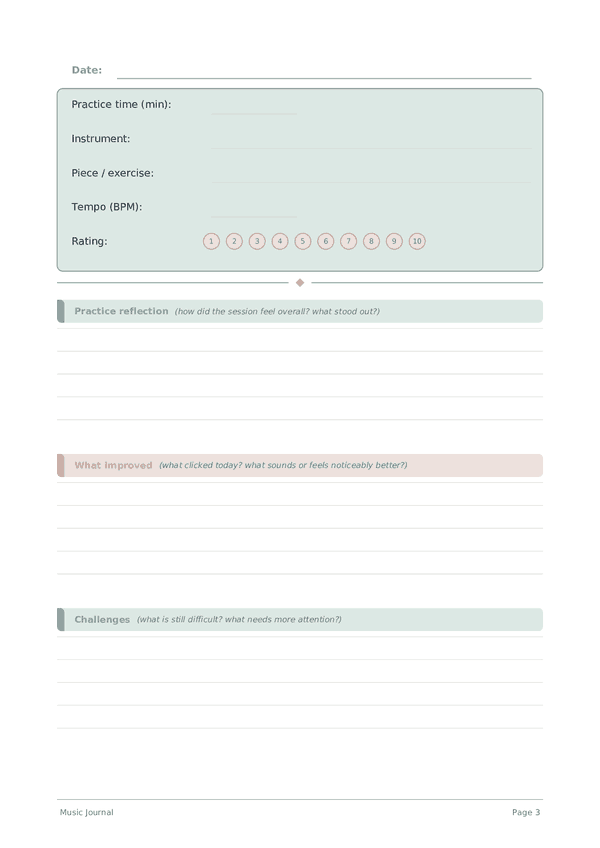
The top section captures quick metrics — how long you practised, which instrument and piece you worked on, the tempo you reached, and an overall session rating. The bottom section is where the real learning happens: you write about what improved, what challenged you, and what you plan to tackle next time.
Whether you are preparing for a recital, learning a new instrument, or simply playing for the love of music, consistent journaling transforms scattered practice into deliberate progress. Fill in the tracker during or right after your session, then spend two minutes writing your reflection while the experience is vivid.
Filled example
Here's what a typical entry looks like when filled in:
How to fill in each field
The top of each page has quick-fill fields (ratings, checkboxes, numbers). Below that is a lined section for writing. Here's what each field means:
Practice time (min)
How many minutes did you practice today?
Instrument
Guitar, piano, violin, voice, drums...
Piece / exercise
Name of the piece, song, or exercise you worked on
Tempo (BPM)
Target or achieved tempo in BPM (beats per minute)
Rating
Overall rating of the experience
Practice reflection
How did the session feel overall? What stood out?
What improved
What clicked today? What sounds or feels noticeably better?
Challenges
What is still difficult? What needs more attention?
Goals for next session
What will you focus on in your next practice session?
Tips for success
When and how often to write
Write after every practice session or meaningful listening experience, even just two or three sentences. For active musicians, daily post-practice entries of five minutes each build a powerful feedback loop — you will see problem areas resolving over weeks instead of guessing. For listeners and collectors, three entries per week capture enough to build a meaningful personal archive. Monthly, read back through your entries to spot patterns in what inspires or frustrates you.
Frequently Asked Questions
What does the Music Journal track per practice session?
Five tracker fields plus reflection: practice time in minutes (up to 300), instrument, piece or exercise, tempo (up to 300 BPM), and a rating (0-10). Six lined rows cover practice reflection, what improved, challenges, and goals for the next session. The structure pushes you toward deliberate, intentional practice rather than passive playing, which research consistently shows is the difference between musicians who plateau and those who keep improving.
Why log tempo (BPM) for each session?
BPM is the most objective marker of technical mastery on a passage. Tracking it across sessions reveals real progress that feel alone cannot. Levitin (2006, This Is Your Brain on Music, Dutton) describes how musicians who quantify tempo gains stay motivated through plateaus. Use a metronome, log your highest clean tempo, and set the next-session target +2 to +4 BPM. Over weeks, the column becomes a visible mastery curve.
How long should each daily practice session be?
30-60 minutes of focused practice produces more gains than 2-3 hours of unfocused playing. Ericsson, Krampe and Tesch-Römer (1993, Psychological Review, 100(3), 363-406) studied conservatory violinists and found 3-5 deliberate hours daily was the upper limit for sustained quality, and that quality dropped sharply without breaks. The tracker's duration field helps you measure focused time, not just time at the instrument.
What's the difference between deliberate practice and just playing?
Deliberate practice targets a specific weakness with focused attention and feedback (Ericsson, 2016, Peak, Houghton Mifflin Harcourt). The journal's goals for next session and challenges fields are the deliberate-practice scaffolding: they make you name what you're working on, not just play through. Casual playing maintains skill; deliberate practice builds it. Both have a place, but only one drives growth.
How do I use the 'what improved' and 'challenges' prompts effectively?
Be specific to the bar, technique, or passage: 'bars 17-24 clean at 100 BPM' beats 'got better.' Specificity makes next-session goals concrete. Roediger and Karpicke (2006, Psychological Science, 17(3), 249-255) show that articulating what you know strengthens retention. The challenges field is equally valuable: an unsolved problem named today often resolves in days, while a vague 'it was hard' doesn't.
Does keeping a practice journal really make me a better musician?
Yes, when reflection is paired with focused practice. The Bjork 'desirable difficulties' framework (Bjork and Bjork, 2011, Psychology and the Real World, Worth Publishers) shows that effortful retrieval and varied practice produce durable skill. The journal's session rating creates feedback; the goals field creates retrieval cues for next time. Musicians who journal identify and fix weaknesses faster than those who only play.
How is this different from a metronome app or practice timer?
Apps measure; the journal interprets. The piece or exercise and reflection fields connect today's BPM number to musical context: why a passage feels harder one day, what fingering helped, what tempo broke down. Per Bjork's research on metacognition (Bjork and Bjork, 2011), interpretation and goal-setting drive transfer to performance more than raw time logged. Use both, the app for objective data, the journal for meaning.
I practice multiple instruments — should I keep separate journals?
One journal works if you fill in the instrument field every session. Reviewing across instruments often reveals shared issues (rhythm, dynamics, listening) and transferable wins. If you teach or perform on one instrument primarily, consider a dedicated journal for it plus this one for secondary instruments. The format scales either way; consistency matters more than separation.
You Might Also Like
Scroll to zoom, drag to move