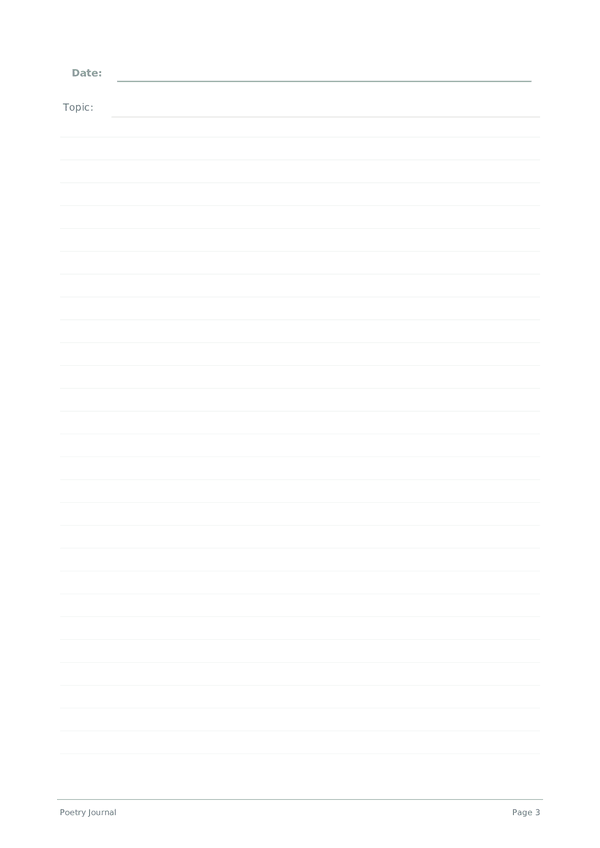
Printable Poetry Journal
Daily poetry writing and creative verse journal
Cultivate a daily poetry practice with a dedicated writing space. Experiment with forms, capture moods, and develop your poetic voice through consistent creative expression.
What is this journal?
A poetry journal is a sanctuary for your verses — a dedicated space to draft, revise, and preserve poems in all their stages. Whether you write polished sonnets or raw free verse, having a single place for your poetic work encourages consistency and makes it easy to revisit earlier drafts and track how your voice evolves over time.
Each page begins with a title header rather than a date, because poems live on their own timeline. The guided prompts — poem form, mood or tone, and a writing prompt — are there to gently nudge you when the blank page feels daunting, but the freeform layout gives you complete freedom to write however the poem wants to come out. Use the lined grid to keep stanzas tidy or let lines wander across the page.
Write a poem a day, a poem a week, or whenever words demand to be arranged. The habit of returning to this journal trains your ear for rhythm and image, and over time you will build a personal anthology that charts your growth as a poet — from first drafts full of crossed-out words to pieces you are genuinely proud of.
Filled example
Here's what a typical entry looks like when filled in:
Tips for success
When and how often to write
Write at least one poem per week, with daily free-writing sessions of five to ten minutes that generate raw material. Poet William Stafford wrote every morning before dawn, proving that routine and inspiration are not enemies. Use the daily sessions to capture images and phrases without pressure to finish a poem. Weekly, select the strongest fragments and develop them into complete pieces. Monthly, reread and revise — many published poems go through a dozen or more revisions. The journal captures the entire lifecycle from impulse to polished work.
Frequently Asked Questions
What is the Poetry Journal designed for?
A lined-page journal for daily poetry practice. Each page has a date-title header and three guided prompts at the bottom (poem form, mood / tone, writing prompt), with lined writing space sized for verse. The format supports any poetic style — sonnets, haiku, free verse, ghazal, prose poetry. The structure builds the daily writing habit that separates practicing poets from occasional ones.
Why fill in the poem form field — does form matter?
Naming form forces a conscious craft choice. 'Free verse' by default is rarely free — it's usually unexamined. Working through specific forms (haiku, sonnet, sestina, prose block) builds the technical vocabulary that, per Stephen King (2000, On Writing, Scribner) and writers across traditions, separates craft from venting. Over weeks, the form field also reveals your defaults and pushes you toward unfamiliar territory.
How do I use the mood / tone and writing prompt fields?
Mood / tone names the emotional register you're aiming for (elegiac, ironic, tender, sharp) — naming it focuses revision. Writing prompt records the seed: a phrase, image, question, or constraint. Lamott (1994, Bird by Bird, Anchor) calls these 'short assignments' and argues they make writing possible by replacing the impossible task ('write a poem') with a finite one ('write about this one image').
Does daily poetry practice actually improve poems?
Yes — when sessions include reflection and varied forms. Ericsson's deliberate practice research (Ericsson et al., 1993, Psychological Review, 100(3), 363-406) shows skill development requires targeted attempts at the edge of ability, not mere repetition. The poem form field nudges variety; daily practice builds the volume needed for selection. Most published poets write far more than they publish, discarding most drafts.
What if a daily poem feels forced or mediocre?
Most daily poems will be — that's the point. Lamott (1994, Bird by Bird, Anchor) called these 'shitty first drafts' and considered them the actual work; finished poems emerge from the volume. The journal is for practice, not publication. Keep them all; one in 20-30 may grow into something. Pressure for daily quality kills the habit faster than honest mediocre drafts ever could.
How is this different from a regular notebook for poems?
A notebook collects drafts; this journal builds practice. The date-title header creates accountability and a visible writing streak. The three prompts force the form/mood/seed choices most beginners skip, which is exactly the level at which craft develops. Use a notebook for revision and finished work; use this journal for daily generative practice. Many poets keep both.
How long should each daily session be?
15-30 minutes covers a first draft of a short poem or solid work on a longer one. Pennebaker's expressive writing research consistently uses 15-20 minute sessions in published studies — long enough for depth, short enough to sustain daily. Aim for one poem-attempt per session, complete or not. Some days will produce a polished draft; most will produce starts you may or may not return to.
How do I review past poems for revision or selection?
Monthly read-through with attention to which entries still resonate. Cepeda et al. (2006, Psychological Bulletin, 132(3), 354-380) describe how spaced re-encounter strengthens both memory and judgment. Mark poems for possible revision and the rest as practice. Most won't become finished work — that's normal. The journal's value is the volume that makes selection possible, not any single page.
You Might Also Like
Scroll to zoom, drag to move