Printable Quote Journal
Daily inspirational quote collection and reflection journal
Build a personal library of meaningful quotes and deepen their impact through reflection. Transform inspiring words into practical wisdom by exploring why they resonate and how to apply them.
Customize fields
Toggle fields on or off. Click the pencil to rename, or add your own fields.
What is this journal?
A quote journal transforms the simple act of collecting quotations into a reflective practice that deepens your thinking. Instead of passively highlighting a line and moving on, each entry asks you to sit with the words — to consider who said them, why they resonate, and how they connect to your own life. This turns scattered bookmarks into a curated library of wisdom that you have actively processed.
Every page captures the quote itself, the author and source, your reflection on why it matters to you, a concrete thought on how it applies to your current situation, and any spark of inspiration it ignites. The structured format ensures you do more than admire a clever sentence — you engage with it, question it, and make it yours.
Add a new entry whenever a quote stops you in your tracks, whether you find it in a book, a podcast, a conversation, or scrolling online. Over months, your journal becomes a personal philosophy book — one where every page carries not just someone else's words, but your own growing understanding of what matters to you.
Filled example
Here's what a typical entry looks like when filled in:
How to fill in each field
Each day you'll find several labeled sections with lines for writing. Here's what each section is for:
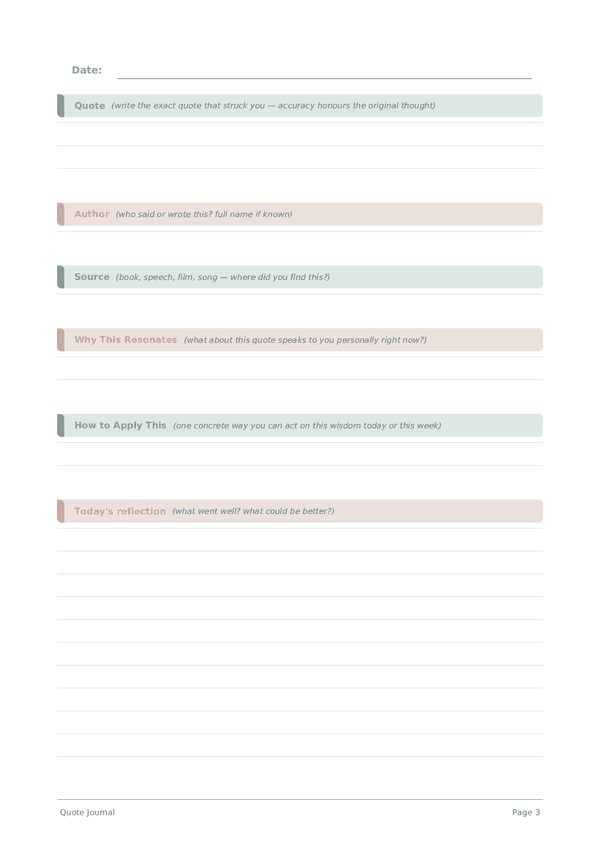
Quote
Write the exact quote that struck you — accuracy honours the original thought
Author
Who said or wrote this? Full name if known
Source
Book, speech, film, song — where did you find this?
Why This Resonates
What about this quote speaks to you personally right now?
How to Apply This
One concrete way you can act on this wisdom today or this week
Today's reflection
Look back at your day honestly. What went well? What could be better? This isn't about judgment — it's about learning and growing.
Tips for success
When and how often to write
Add quotes as you encounter them — there is no benefit to batching. Keep the journal or a capture tool nearby so nothing slips through the cracks. Aim for at least two or three quotes per week; fewer than that and the journal loses momentum, more is fine. Monthly, review your collection and highlight the five quotes that still hit hardest. Over time, these highlighted quotes become a personal manifesto of your deepest values — a resource to revisit during difficult decisions or periods of doubt.
Frequently Asked Questions
What is the Quote Journal designed for?
A structured journal for collecting and reflecting on meaningful quotes. Each entry has six fields: the quote itself (3 lines), author, source, why this resonates (2 lines), how to apply this (2 lines), and broader reflection (3 lines). The structure turns passive quote-saving into an active practice. The same words become useful only when you articulate why they matter and how to use them.
Why record the source of a quote, not just the author?
Source provides verification and context. Many widely shared quotes are misattributed or fabricated, so recording 'book, page, year' (or 'interview, publication') forces you to confirm the quote is real. It also lets you return to the surrounding context, which is often more useful than the isolated line. The author field alone, common on social media, encourages misattribution.
How do I use the 'why it resonates' and 'how to apply' fields together?
Why this resonates is the diagnostic: what current concern or situation does the quote address? How to apply this is the prescription: what behavior or thought would change if you took it seriously? Without both, quote-collecting becomes decoration. Roediger and Karpicke (2006, Psychological Science, 17(3), 249-255) show that elaboration, connecting new material to existing knowledge, is what makes content stick.
Does writing about quotes actually deepen their impact?
Yes. Elaborative encoding, explaining why something matters in your own words, produces stronger memory and behavioral follow-through than re-reading. This is the same mechanism that makes the Feynman technique work for academic learning. The 3-line reflection field is the elaborative work; without it, the quote is essentially a screenshot. Most saved quotes are never re-read; written ones are.
How is this different from saving quotes in Goodreads or a notes app?
Apps save text; this journal forces interpretation. Goodreads collects quotes you highlighted; the six fields here make you do something with them. Handwriting also slows you to the speed of thought, which per multiple cognition studies improves comprehension. Use apps for bulk collection if you wish; use this journal for the quotes worth thinking about.
How often should I add a new quote - daily, weekly?
Quality over frequency. One quote per week that you actually reflect on beats five per day that get logged without thought. The journal works as a slow-drip practice: a quote you choose deliberately and return to in a month often shapes thinking more than any single book. If a quote doesn't deserve six fields of reflection, it probably doesn't deserve a page.
How do I review past entries effectively?
Monthly read-through, with attention to which quotes still feel true and which now seem hollow. The spacing effect (Cepeda et al., 2006, Psychological Bulletin, 132(3), 354-380) makes repeated re-encounter the strongest tool for long-term integration of ideas. Quotes that survive multiple reviews become part of your operating philosophy; those that fade reveal what was fashion rather than insight.
What if I want to disagree with a quote - should I still keep it?
Yes, and the why this resonates and reflection fields are designed exactly for that. A quote you carefully disagree with reveals your own positions more clearly than one you nod along to. Disagreement processed in writing produces stronger reasoning than agreement, per work on argumentation and learning. Mark such entries clearly; they often become the most valuable on later review.
You Might Also Like
Scroll to zoom, drag to move