Printable Addiction Recovery Journal
Track your sobriety and build resilience daily
A structured daily companion for your recovery journey. Track sobriety milestones, monitor cravings and mood patterns, reflect on triggers and coping strategies, celebrate victories, and nurture your support network — all in one place.
Personalizar campos
Activa o desactiva campos. Haz clic en el lápiz para renombrar, o añade tus propios campos.
Beneficios
Cómo Usar
¿Qué es este diario?
An addiction recovery journal is a comprehensive daily tool for supporting your journey out of addiction — any addiction. By tracking sobriety days, cravings, mood, and energy alongside detailed reflections on triggers, coping strategies, and support connections, you create a structured recovery practice that supplements professional treatment.
This journal is for anyone in recovery from substance addiction, behavioral addiction, or compulsive patterns. It is designed to work alongside 12-step programs, therapy, and other recovery frameworks. The structure provides both accountability and a safe space for the complex emotional landscape of recovery.
Clinical research on addiction recovery identifies daily journaling as a powerful relapse prevention tool. The process of writing about cravings and triggers activates the prefrontal cortex — the brain region responsible for impulse control — effectively strengthening the neural infrastructure you need most. Tracking support connections also reinforces the social bonds that are critical to sustained recovery.
Ejemplo completado
Así es como se ve una entrada típica cuando se rellena:
Cómo rellenar cada campo
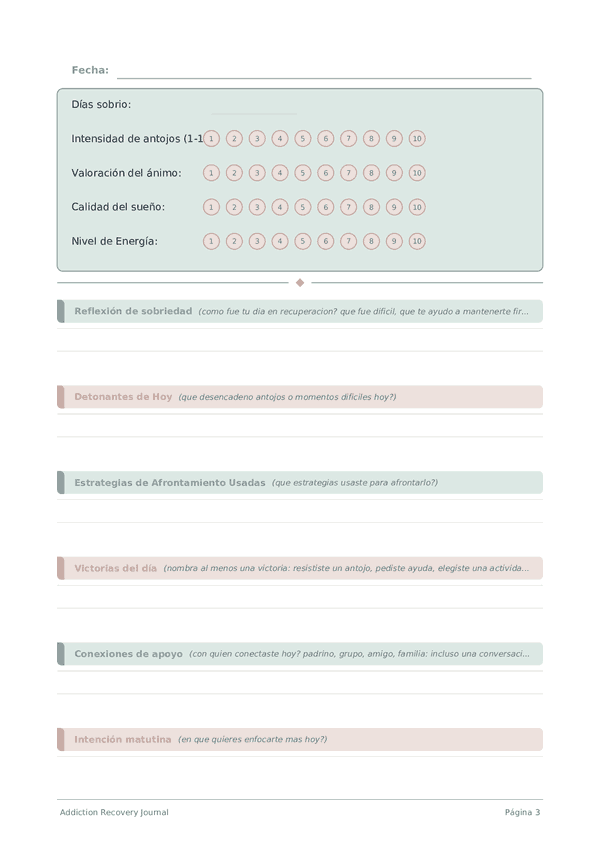
La parte superior de cada pagina tiene campos de llenado rapido (calificaciones, casillas, numeros). Debajo hay una seccion con lineas para escribir. Esto es lo que significa cada campo:
Días sobrio
Registra cuantos dias consecutivos llevas sobrio. Ver crecer este numero es un motivador poderoso. Si reiniciaste, comienza a contar de nuevo sin verguenza.
Intensidad de antojos (1-10)
Que tan fuertes son tus antojos hoy? Califica del 1 (apenas perceptible) al 10 (abrumador)
Valoración del ánimo
Califica tu estado emocional (1-10) para seguir tu trayectoria de sanacion
Calidad del sueño
Califica que tan reparador fue tu sueno. 1 significa terrible y agitado, 5 significa profundo y refrescante. La calidad importa tanto como la cantidad.
Nivel de Energía
Que tan energizado te sientes esta manana? (1=agotado, 5=a tope)
Reflexión de sobriedad
Como fue tu dia en recuperacion? Que fue dificil, que te ayudo a mantenerte firme y como te sientes ahora?
Detonantes de Hoy
Que desencadeno antojos o momentos dificiles hoy?
Estrategias de Afrontamiento Usadas
Que estrategias usaste para afrontarlo?
Victorias del día
Nombra al menos una victoria: resististe un antojo, pediste ayuda, elegiste una actividad saludable
Conexiones de apoyo
Con quien conectaste hoy? Padrino, grupo, amigo, familia: incluso una conversacion breve importa
Intención matutina
En que quieres enfocarte mas hoy?
Por lo que estoy agradecido/a hoy
Enumera de 1 a 3 cosas por las que estas agradecido hoy. Pueden ser grandes o pequenas: una buena comida, una palabra amable, el sol. El diario de gratitud es una de las practicas de bienestar con mayor respaldo cientifico.
Consejos para el exito
Cuando y con que frecuencia escribir
Journal every day, ideally in the evening as part of your recovery routine. In early recovery, write twice daily if possible — morning intentions and evening reflection create bookends of accountability. Log every meeting, every support call, every craving and its resolution. Weekly, review your HALT patterns and identify which state triggered the most difficulty. Monthly, celebrate your progress by re-reading your earliest entries and seeing how far you have come.
Preguntas frecuentes
¿Qué registra diariamente el Diario de Recuperación de la Adicción?
Registra los días de sobriedad, cuatro valoraciones en escala 1–10 (intensidad del deseo, estado de ánimo, calidad del sueño, energía) y siete preguntas reflexivas: intención matutina, reflexión sobre la recuperación, desencadenantes, estrategias de afrontamiento empleadas, victorias diarias, conexiones de apoyo y gratitud. Esta estructura refleja el marco de automonitoreo del NIDA (Principles of Drug Addiction Treatment, 2020). Apoya — pero no sustituye — el cuidado formal de un especialista en adicciones certificado.
¿Cómo formulo una intención matutina útil?
Hágala específica, conductual y vinculada a un riesgo que anticipe ese día: «Rechazar la invitación después del trabajo», «Llamar a mi padrino antes de la cena familiar». Las intenciones de implementación en formato si-entonces tienen respaldo en la investigación sobre cambio de conducta y se alinean con la planificación de prevención de recaídas del NIDA (2020, Principles of Drug Addiction Treatment, 3.ª ed.). Las intenciones vagas como «ser fuerte» generan menor seguimiento que los planes situacionales concretos.
¿En qué se diferencia este diario de un cuaderno de los 12 pasos?
Los cuadernos de AA y Twelve-Step Facilitation estructuran el progreso a través de 12 pasos específicos (Alcoholics Anonymous World Services, metodología del Big Book). Este diario es independiente del programa: captura métricas diarias y reflexiones útiles en cualquier enfoque — AA, SMART Recovery, TCC o tratamiento con medicación. Muchas personas combinan ambos: el cuaderno para la estructura del programa, esta plantilla para los datos diarios de deseo y estado de ánimo que el consejero revisa entre sesiones.
¿Este diario curará mi adicción?
No — no existe un marco de «curación» para el trastorno por uso de sustancias, que el DSM-5-TR (American Psychiatric Association, 2022) clasifica como una condición crónica y recurrente. El manejo eficaz combina medicación cuando esté indicada (buprenorfina, naltrexona, acamprosato — aprobados por la FDA), psicoterapia y apoyo entre pares. El diario apoya la autoconciencia y la comunicación con el clínico. Para orientación, consulte los servicios de drogodependencias de su comunidad o país.
¿Qué evidencia respalda registrar deseos y estado de ánimo juntos?
El afecto negativo es uno de los precipitantes de recaída más documentados en medicina de adicciones, abordado en los modelos cognitivo-conductuales de prevención del SAMHSA TIP 35 (Enhancing Motivation for Change in Substance Use Disorder Treatment, 2019). Registrar el deseo junto al estado de ánimo ayuda a revelar los desencadenantes afectivos. Las revisiones Cochrane de TCC para trastornos por uso de sustancias apoyan el automonitoreo como parte de la terapia estructurada, no como intervención independiente.
¿Cómo uso productivamente el campo de desencadenantes?
Anote la situación, quién estaba presente, la emoción que precedió al deseo y su estado físico (hambre, cansancio, soledad, ira — el acrónimo HALT usado en muchos programas de recuperación). Tras dos semanas, busque patrones repetidos: misma persona, mismo lugar, misma hora. Lleve esta lista al consejero — informa el plan de prevención de recaídas central en el NIDA (Principles of Drug Addiction Treatment, 2020, 3.ª edición).
Si tengo una recaída, ¿debo seguir escribiendo el diario?
Sí. La recaída forma parte del curso reconocido de la enfermedad según el DSM-5-TR (American Psychiatric Association, 2022) y la CIE-11 (WHO, 2022), no es un fracaso personal. Retome los registros al día siguiente — los datos sobre lo que precedió a la recaída se convierten en el mapa de desencadenantes más valioso. Contacte a su terapeuta o médico con prontitud. Si no dispone de uno, busque los servicios de atención a drogodependencias de su país o comunidad.
¿Cuánto tiempo hasta ver patrones útiles?
Dos a cuatro semanas de registros diarios consistentes suelen generar suficientes datos para identificar temas de desencadenantes, momentos de alto riesgo y estrategias de afrontamiento eficaces — un plazo coherente con la práctica de la TCC en entornos de adicciones. El NIDA (2020, Principles of Drug Addiction Treatment) recomienda monitoreo continuo durante al menos 90 días de recuperación temprana, ya que el riesgo de recaída es máximo en los tres primeros meses. Comparta las tendencias con su consejero.
También Te Puede Gustar
Rueda para ampliar, arrastra para mover