Printable Quit Smoking Journal
Daily tracking and reflection for your smoke-free journey
Combine daily tracking with reflective journaling to support your quit smoking journey. Rate cravings, mood, stress, and energy each day, then write about triggers, coping strategies, and personal victories. Research shows that writing down goals and tracking progress significantly increases success rates in smoking cessation.
Personalizar campos
Activa o desactiva campos. Haz clic en el lápiz para renombrar, o añade tus propios campos.
Beneficios
Cómo Usar
¿Qué es este diario?
A quit smoking journal is a daily support tool for your journey to becoming smoke-free. By tracking your smoke-free status, cravings, mood, and stress alongside reflective writing about triggers and what helped, you build a personalized quit strategy based on real data from your own experience.
This journal is for anyone in the process of quitting smoking — whether you are on day one or day one hundred. Quitting is not a single event but a daily practice that requires self-awareness, strategy, and self-compassion. This journal provides all three.
Smoking cessation research identifies self-monitoring as one of the most effective behavioral strategies for quitting. People who track their cravings and triggers are 2x more likely to successfully quit long-term. The journaling component adds emotional processing that reduces the stress response — one of the primary drivers of relapse — while the daily format creates accountability without pressure.
Ejemplo completado
Así es como se ve una entrada típica cuando se rellena:
Cómo rellenar cada campo
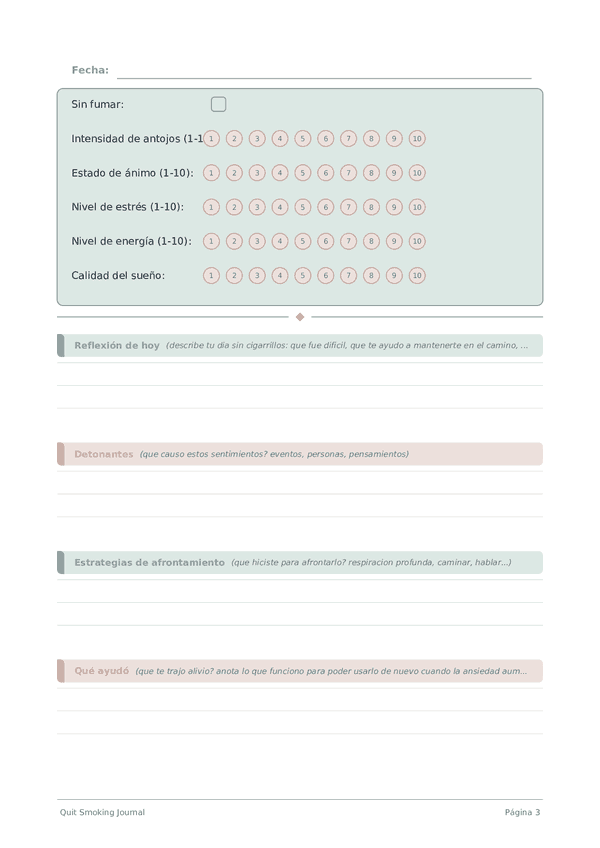
La parte superior de cada pagina tiene campos de llenado rapido (calificaciones, casillas, numeros). Debajo hay una seccion con lineas para escribir. Esto es lo que significa cada campo:
Sin fumar
Marca esto por cada dia que no fumas. Visualizar tu racha de dias sin fumar fortalece tu determinacion.
Intensidad de antojos (1-10)
Que tan fuertes son tus antojos hoy? Califica del 1 (apenas perceptible) al 10 (abrumador)
Estado de ánimo (1-10)
Califica tu estado emocional general del dia. 1 significa muy bajo o deprimido, 10 significa excepcionalmente feliz y positivo. No lo pienses demasiado: ve con tu instinto.
Nivel de estrés (1-10)
Califica tu estres en una escala del 1 al 10. Con el tiempo, identificaras tus patrones de estres y que estrategias de afrontamiento funcionan mejor.
Nivel de energía (1-10)
Califica tu nivel de energia fisica y mental. 1 significa agotado y sin fuerzas, 10 significa totalmente energizado y alerta. Esto te ayuda a identificar que actividades aumentan o agotan tu energia.
Calidad del sueño
Califica que tan reparador fue tu sueno. 1 significa terrible y agitado, 5 significa profundo y refrescante. La calidad importa tanto como la cantidad.
Reflexión de hoy
Mira atras a tu dia con honestidad. Que salio bien? Que podria mejorar? No se trata de juzgar, sino de aprender y crecer.
Detonantes
Identifica que causo tus reacciones emocionales: eventos, personas, pensamientos, entornos. Reconocer los desencadenantes te da el poder de prepararte o evitarlos.
Estrategias de afrontamiento
Que hiciste para afrontarlo? Respiracion profunda, caminar, hablar...
Qué ayudó
Que te trajo alivio? Anota lo que funciono para poder usarlo de nuevo cuando la ansiedad aumente.
Logros
Que lograste hacer hoy? Enumera tareas completadas y avances
Consejos para el exito
Cuando y con que frecuencia escribir
Journal every evening for the first 30 days without exception — this is the critical window where habits form and cravings peak. Log cravings in real-time during the day (even a quick note on your phone to expand later). After the first month, maintain daily entries for at least 3 months total. The craving tracker loses urgency around month 2-3, and that is actually the most dangerous time — keep writing. After 3 months, shift to weekly check-ins to guard against complacency.
Preguntas frecuentes
¿Qué registra a diario el Diario para Dejar de Fumar?
Una casilla de verificación de día sin tabaco y cinco valoraciones 1–10 (intensidad del deseo, estado de ánimo, estrés, energía, calidad del sueño), con preguntas reflexivas sobre desencadenantes, estrategias de afrontamiento, qué ayudó y logros. La estructura se alinea con el automonitoreo descrito en el informe del Surgeon General de EE.UU. Smoking Cessation (2020). Apoya — sin sustituir — métodos basados en evidencia como la terapia sustitutiva de nicotina (TSN), vareniclina o asesoramiento.
¿Cómo registrar los cambios de humor y estrés por la abstinencia?
Valore estado de ánimo y estrés a la misma hora cada día — preferiblemente por la mañana, ya que los síntomas de abstinencia a la nicotina alcanzan su pico en la primera semana y suelen remitir en 2–4 semanas según el Surgeon General de EE.UU. (2020, Smoking Cessation). En la reflexión, anote si las valoraciones se relacionan con desencadenantes concretos (café, después de comer, al conducir) o con la abstinencia general. Los síntomas de estado de ánimo graves justifican consultar al médico.
¿Basta con el diario para dejar de fumar?
El diario solo tiene efectos modestos. El Surgeon General de EE.UU. (2020, Smoking Cessation) y los materiales CDC Tips From Former Smokers muestran que combinar apoyo conductual con farmacoterapia aprobada por la FDA (TSN, vareniclina, bupropión) aproximadamente duplica el éxito frente a la fuerza de voluntad sola. Úselo junto con el asesoramiento de su médico de cabecera o los servicios autonómicos de ayuda para dejar de fumar, disponibles gratuitamente en España y muchos países de Latinoamérica.
¿Para qué sirve la valoración de intensidad del deseo?
Registra la intensidad del deseo más fuerte del día en una escala 0–10. Los deseos suelen alcanzar su máximo en la primera semana de abstinencia y disminuyen a lo largo de 4–12 semanas, según el Surgeon General de EE.UU. (2020, Smoking Cessation). Asociar cada valoración con el desencadenante (lugar, emoción, persona, hora) construye un mapa personal que los clínicos utilizan en el asesoramiento cognitivo-conductual. Las valoraciones decrecientes a lo largo de semanas son una señal documentada de neuroadaptación.
¿En qué se diferencia de una app para dejar de fumar?
Las apps automatizan rachas, dinero ahorrado e hitos de recuperación de la salud; esta plantilla en papel captura contenido reflexivo — desencadenantes, estrategias de afrontamiento usadas, qué funcionó exactamente — que refleja el asesoramiento cognitivo-conductual descrito en los materiales del Surgeon General de EE.UU. (2020, Smoking Cessation). La desventaja: sin notificaciones automáticas. Muchos exfumadores combinan ambos: la app para estadísticas, el diario para los registros que el médico revisa para ajustar la TSN.
¿Puedo usarlo si estoy con terapia sustitutiva de nicotina?
Sí. La TSN (parches, chicles, pastillas) está recomendada por el Surgeon General de EE.UU. (2020, Smoking Cessation) y los servicios sanitarios como apoyo de primera línea. La casilla marca los días completamente sin tabaco; la reflexión recoge el horario de la TSN y los deseos residuales. Comparta estos datos con su médico para ajustar la dosis. Siga siempre el protocolo de TSN prescrito por su clínico — no autoajuste la dosis basándose únicamente en las entradas del diario.
Si fumo un cigarrillo, ¿debo reiniciar todo?
Un desliz no es una recaída completa. Los materiales del CDC y del Surgeon General de EE.UU. (2020) destacan que la mayoría de los exfumadores necesitan varios intentos antes de lograr el abandono definitivo. Deje la casilla en blanco ese día y escriba sobre qué lo desencadenó y qué haría de otra manera. Retome al día siguiente. Si los deslices se vuelven frecuentes, contacte a su médico o al servicio de cesación tabáquica de su comunidad.
¿Cuánto tiempo debería usar el diario tras dejar de fumar?
El riesgo de recaída permanece elevado al menos 12 meses después de la fecha de abandono — el Surgeon General de EE.UU. (2020, Smoking Cessation: A Report of the Surgeon General) documenta que la mayoría de las recaídas ocurren en los tres primeros meses. Las entradas diarias durante las semanas 1–12 son las más valiosas; luego, pase a revisiones semanales hasta el mes 12. Continúe durante más tiempo si se enfrenta a estresores importantes, que son desencadenantes documentados de recaída.
También Te Puede Gustar
Rueda para ampliar, arrastra para mover