Printable Grief Journal
Navigate loss with compassion and courage
A structured companion for the grief journey. Each day you track the intensity of your grief and sleep, write freely about what you feel, honour memories, and practise small acts of self-care. Research shows that directed expressive writing — combining emotional release with meaning-making — supports long-term healing far better than unguided journaling alone.
Personalizar campos
Activa o desactiva campos. Haz clic en el lápiz para renombrar, o añade tus propios campos.
Beneficios
Cómo Usar
¿Qué es este diario?
A grief journal is a gentle daily companion for navigating the landscape of loss. By tracking grief intensity and sleep alongside writing about feelings, memories, and letters to the person you have lost, you create a sacred space where grief can be witnessed, honored, and gradually integrated into your life.
This journal is for anyone moving through grief — the loss of a loved one, a pet, a relationship, a career, or any significant loss that has reshaped your world. Grief does not follow a timeline, and this journal does not ask it to. It simply creates space for whatever is true today.
Bereavement research has moved beyond the outdated "five stages" model to recognize that grief is not linear but wavelike — coming and going with varying intensity. Writing through grief has been shown to reduce complicated grief symptoms, improve physical health markers, and help mourners find meaning in loss. This journal supports the natural rhythm of your grief while ensuring you do not grieve in isolation.
Ejemplo completado
Así es como se ve una entrada típica cuando se rellena:
Cómo rellenar cada campo
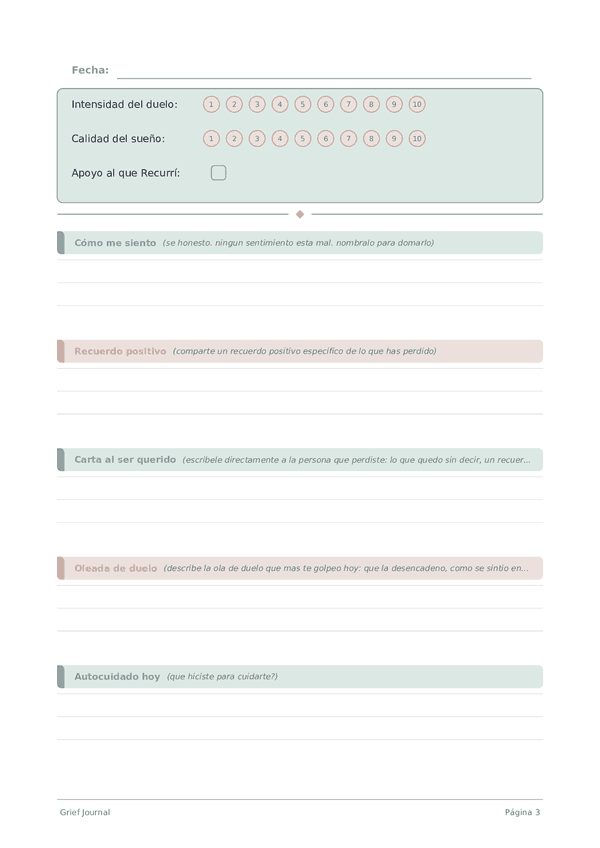
La parte superior de cada pagina tiene campos de llenado rapido (calificaciones, casillas, numeros). Debajo hay una seccion con lineas para escribir. Esto es lo que significa cada campo:
Intensidad del duelo
Que tan intenso es tu duelo ahora? Califica del 1 (dolor suave) al 10 (oleada abrumadora)
Calidad del sueño
Califica que tan reparador fue tu sueno. 1 significa terrible y agitado, 5 significa profundo y refrescante. La calidad importa tanto como la cantidad.
Apoyo al que Recurrí
Llamaste, escribiste o hablaste con alguien: un amigo, padrino, familiar o consejero?
Cómo me siento
Describe como te sientes ahora mismo con tus propias palabras. No hay respuestas incorrectas. Simplemente poner los sentimientos en papel reduce su carga emocional.
Recuerdo positivo
Comparte un recuerdo positivo especifico de lo que has perdido
Carta al ser querido
Escribele directamente a la persona que perdiste: lo que quedo sin decir, un recuerdo, una pregunta o simplemente 'te extrano'
Oleada de duelo
Describe la ola de duelo que mas te golpeo hoy: que la desencadeno, como se sintio en tu cuerpo, cuanto duro
Autocuidado hoy
Que hiciste para cuidarte?
Por lo que estoy agradecido/a hoy
Enumera de 1 a 3 cosas por las que estas agradecido hoy. Pueden ser grandes o pequenas: una buena comida, una palabra amable, el sol. El diario de gratitud es una de las practicas de bienestar con mayor respaldo cientifico.
Consejos para el exito
Cuando y con que frecuencia escribir
There is no "right" frequency for grief journaling — write when you need to. In acute grief (the first weeks and months), daily writing provides essential release. As grief becomes integrated, write whenever a wave hits or a memory surfaces. Always journal on significant dates: birthdays, anniversaries, holidays. Over time, you may notice the journal shifts from processing pain to preserving connection — both are healthy and valuable.
Preguntas frecuentes
¿Qué registra y sobre qué escribe el Diario de Duelo cada día?
Registra la intensidad del duelo (1–10), la calidad del sueño (1–10) y si se buscó apoyo, más siete líneas de escritura libre con preguntas guiadas: emociones, un recuerdo, una carta al ser querido perdido, la descripción de una ola de duelo, autocuidado y gratitud. Esta combinación de seguimiento y escritura expresiva se basa en la investigación de Pennebaker. Es una herramienta de afrontamiento, no terapia — consulte a un psicólogo especializado en duelo si este supera el funcionamiento cotidiano.
¿Cómo escribir productivamente una carta al ser querido perdido?
Diríjase a él o ella por su nombre, escriba como si fuera a leerla, e incluya lo que desearía haber dicho, noticias actuales o sentimientos no resueltos. La escritura de «vínculos continuos» es una intervención reconocida en la práctica contemporánea del duelo, distinta del modelo de «cierre». Mantenga las entradas breves — incluso tres frases son suficientes. Si el duelo se intensifica más allá de los 6–12 meses (criterios de CIE-11 de trastorno por duelo prolongado, WHO 2022), consulte a un especialista.
¿Puede el diario reemplazar la terapia de duelo?
No. La CIE-11 (WHO, 2022) reconoce el trastorno por duelo prolongado cuando el duelo intenso persiste más de 6 meses y deteriora el funcionamiento; el DSM-5-TR (American Psychiatric Association, 2022) lo define de manera similar. El diario apoya el procesamiento cotidiano y ofrece datos para el terapeuta. Si el duelo interrumpe el trabajo, las relaciones o incluye pensamientos de autolesión, contacte a un psicólogo colegiado o, en crisis, al Teléfono de la Esperanza: 717 003 717 (España, gratuito, 24 h).
¿Qué es una ola de duelo y cómo la describo?
Una ola de duelo es una oleada repentina e intensa — a menudo provocada por una canción, un lugar, un aniversario o un estímulo sensorial — que remite en minutos u horas. En la entrada, capture el desencadenante, la sensación corporal (opresión en el pecho, lágrimas, agotamiento) y la duración. Registrar estas olas a lo largo de semanas revela desencadenantes personales, una técnica reconocida en el trabajo de duelo de «vínculos continuos». Los datos de patrones ayudan a anticipar los días difíciles.
¿En qué se diferencia de un cuaderno en blanco habitual?
Un cuaderno en blanco ofrece una liberación no estructurada. Esta plantilla combina el seguimiento (intensidad, sueño, apoyo) con preguntas dirigidas — recuerdo, carta, ola de duelo, autocuidado — que se basan en protocolos de escritura expresiva. La investigación de Pennebaker, ampliamente citada en la literatura sobre duelo y trauma, encontró que la escritura dirigida que combina divulgación emocional con búsqueda de significado produjo beneficios más duraderos que la ventilación no guiada sola.
¿Es normal valorar la intensidad del duelo en 10 semanas o meses después?
Sí. El duelo agudo es muy variable; la intensidad puede dispararse en aniversarios, festividades o ante estresores no relacionados. La CIE-11 (WHO, 2022) y el DSM-5-TR (American Psychiatric Association, 2022) señalan el trastorno por duelo prolongado solo cuando el duelo intenso más la disfunción funcional persisten más de 6–12 meses. El diario le ayuda a usted y al clínico a distinguir olas normales de un patrón que necesita atención especializada.
¿Y si escribir sobre la pérdida me hace sentir peor?
El malestar temporal durante la escritura expresiva está documentado en la investigación de Pennebaker y generalmente se sigue de alivio; sin embargo, si las entradas empeoran consistentemente su estado, intensifican pensamientos intrusivos o provocan disociación, pause las preguntas de escritura y use solo las secciones de seguimiento. Este patrón puede señalar un duelo complicado o un trauma que requiere ayuda profesional. Un psicólogo especializado en duelo puede adaptar las técnicas expresivas de forma segura.
¿Con qué frecuencia y durante cuánto tiempo debo usar el Diario de Duelo?
A diario durante el duelo agudo (los primeros 3–6 meses), pasando a semanal a medida que la intensidad se estabiliza. Los criterios de trastorno por duelo prolongado de la CIE-11 (WHO, 2022) miden la persistencia más allá de 6 meses, por lo que conviene revisar sus valoraciones con un clínico si se mantienen consistentemente altas. Los aniversarios y festividades a menudo justifican retomar temporalmente las entradas diarias. No hay punto final fijo — úselo mientras le ayude.
También Te Puede Gustar
Rueda para ampliar, arrastra para mover