Printable Coffee Journal
Track brews, dial in parameters, and develop your palate
Log every cup with precision: origin, roast level, brew method, grind size, dose, water temperature, brew time, and tasting notes. Build a personal database of brews to refine your technique and discover what makes the perfect cup.
Personalizar campos
Activa o desactiva campos. Haz clic en el lápiz para renombrar, o añade tus propios campos.
Beneficios
Cómo Usar
¿Qué es este diario?
A coffee journal is a structured tasting and brewing log for documenting your coffee explorations. By recording roaster, origin, brew parameters, and detailed flavor notes, you develop your palate and optimize your brewing technique — turning your morning cup from a routine into a craft.
This journal is for coffee lovers who want to go deeper — from home brewers dialing in their pour-over technique to enthusiasts exploring single-origin beans from different regions. Whether you brew with an espresso machine, AeroPress, French press, or pour-over, tracking your variables is the path to consistently excellent coffee.
Specialty coffee professionals emphasize that the difference between good and exceptional coffee often comes down to small adjustments in grind size, water temperature, and brew time. Without records, you cannot replicate your best cups or diagnose your worst. This journal transforms coffee brewing from guesswork into deliberate practice.
Ejemplo completado
Así es como se ve una entrada típica cuando se rellena:
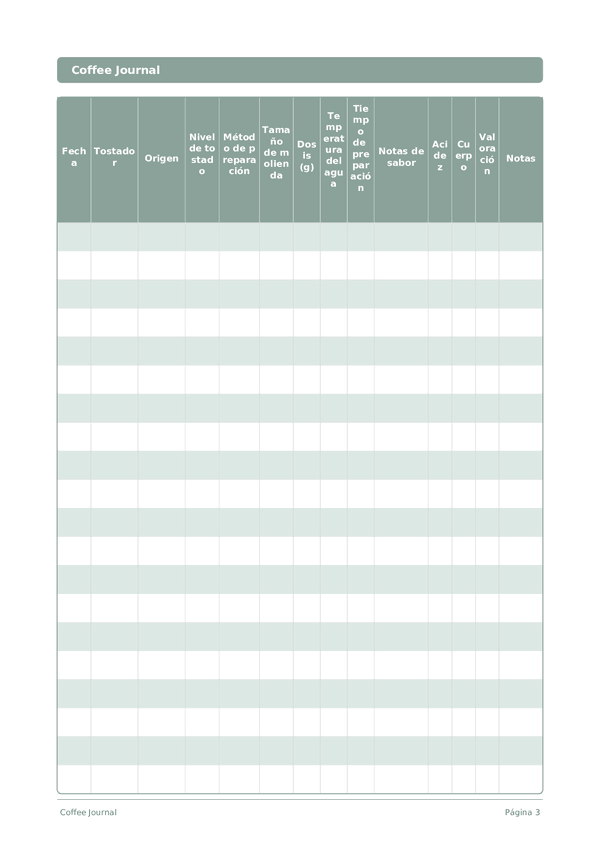
| Fecha | Tostador | Origen | Nivel de tostado | Método de preparación | Tamaño de molienda | Dosis (g) | Temperatura del agua | Tiempo de preparación | Notas de sabor | Acidez | Cuerpo | Valoración | Notas |
|---|---|---|---|---|---|---|---|---|---|---|---|---|---|
| 2025-03-04 | Onyx Coffee Lab | Ethiopia Yirgacheffe, Gedeb station | Light | V60 pour-over | Medium-fine (18 on Comandante) | 18g | 96C | 3:15 | Bright blueberry, jasmine, honey sweetness, clean citrus finish | High, sparkling | Light-medium, tea-like | 9 | Best cup from this bag yet. The slightly coarser grind compared to yesterday reduced astringency. Bloom for 45 seconds was key. |
| 2025-03-04 | Onyx Coffee Lab | Ethiopia Yirgacheffe, Gedeb station | Light | AeroPress | Medium (20 on Comandante) | 15g | 92C | 2:00 | Muted blueberry, more chocolate, heavier body, less floral | Medium, rounded | Medium, syrupy | 7 | Same beans, different method. AeroPress brings out body but loses the delicate florals. Prefer V60 for this origin. |
Cómo rellenar cada campo
Cada pagina es una tabla con columnas. Completa una fila por entrada. Esto es lo que significa cada columna:
Fecha
Escribe la fecha de hoy. Esto ancla tu entrada en el tiempo y ayuda cuando revisas entradas despues.
Tostador
Origen
Nivel de tostado
Método de preparación
Tamaño de molienda
Dosis (g)
Temperatura del agua
Tiempo de preparación
Notas de sabor
Acidez
Cuerpo
Valoración
Calificacion general de la experiencia
Notas
Agrega cualquier contexto o pensamiento adicional. Esta columna general es para cualquier cosa que no encaje en otro lugar pero pueda ser util despues.
Consejos para el exito
Cuando y con que frecuencia escribir
Log every brew that you want to learn from — aim for at least one entry per day if you brew at home. The table format makes this fast: 30 seconds to fill in the parameters, another 30 for flavor notes. When dialing in a new bean, log every attempt until you hit the target flavor profile. Review your logs weekly to identify which variables had the most impact. Over months, your data builds a personal brewing reference that no blog or YouTube video can match.
Preguntas frecuentes
¿Cómo ajusto los parámetros del espresso usando las columnas de dosis, molido, temperatura y tiempo?
La Specialty Coffee Association (SCA, Brewing Standards) define rendimiento de extracción 18-22 % y TDS 1,15-1,35 % como el objetivo Gold Cup para filtro; los parámetros del espresso varían según la receta. Mantén la dosis constante (por ejemplo, 18 g) y ajusta el molido: más fino para shots más lentos, más grueso para más rápidos. Registra cada cambio de una variable a la vez en filas consecutivas. Tras 10-15 entradas, los patrones que relacionan molido, tiempo y sabor se vuelven legibles, un método que la formación Q Grader (Coffee Quality Institute) formaliza.
¿Cómo registrar las notas de sabor correctamente? ¿Debo usar la Coffee Taster's Flavor Wheel?
Sí. La SCA Coffee Taster's Flavor Wheel (2016, revisada con el World Coffee Research Sensory Lexicon) proporciona un vocabulario compartido que va de categorías amplias (afrutado, con nuez, floral) a descriptores específicos (zarzamora, almendra, jazmín). Empieza con términos amplios en las primeras entradas y afínalos a medida que tu paladar se desarrolla. Los protocolos de cata Q Grader requieren descriptores de este léxico. Combina las notas de sabor con los campos de acidez y cuerpo.
¿Cómo puntuar la acidez, el cuerpo y la puntuación general de forma consistente?
El formulario de cata de la SCA valora cada atributo en una escala del 6 al 10: 6 = bueno, 7 = muy bueno, 8 = excelente, 9-10 = sobresaliente. Para la acidez, distingue la calidad (brillante frente a áspera) de la intensidad. El cuerpo se refiere al peso en boca, no a la intensidad del sabor. Mantén la puntuación general a menos de un punto del promedio de atributos: los valores atípicos suelen indicar sesgo de halo. La formación Q Grader enfatiza la calibración mediante muestras de referencia repetidas.
¿Por qué registrar el origen y el nivel de tueste por separado si están relacionados?
El origen y el tueste interactúan pero son variables independientes. El World Coffee Research Arabica Variety Atlas documenta que la misma variedad de Etiopía o Colombia expresa un perfil de sabor distinto, mientras que el nivel de tueste determina cuánto de ese carácter de origen sobrevive. Los tuestes claros preservan la acidez de origen; los oscuros desplazan los sabores hacia notas de tueste. Registrar ambos permite separar «me gusta Etiopía» de «me gustan los tuestes claros».
¿Qué temperatura del agua debo registrar y realmente importa?
Las SCA Brewing Standards especifican 93-96 °C (200-205 °F) para una extracción óptima del café de filtro. Por debajo se produce subextracción —ácido, débil—; por encima se arriesga la amargura. La investigación en Food Research International confirma que la temperatura impulsa la cinética de extracción junto con el molido y el tiempo de contacto. Si preparas por debajo de 90 °C, ajusta hacia molidos más finos o tiempos más largos. Registra la temperatura real, no la configuración de la tetera si difieren.
¿En qué se diferencia este diario en papel de apps de café como Filtru o Beanconqueror?
Las apps automatizan temporizadores y el almacenamiento de recetas, pero alejan la atención de la taza. El papel requiere observación deliberada, la habilidad fundamental que la formación sensorial Q Grader (CQI) enfatiza: la instrumentación no puede reemplazar la cata calibrada. Diez filas por página también facilitan la comparación horizontal entre preparaciones consecutivas, más difícil en pantallas pequeñas. Usa la app para precisión cronométrica si lo deseas, pero registra los datos sensoriales aquí.
¿Cuántas entradas necesito para identificar mis preferencias reales?
Los formadores de World Coffee Research y SCA sugieren en general entre 30 y 50 catas deliberadas antes de que emerjan patrones: orígenes, niveles de tueste y métodos de extracción preferidos. Mantén una variable constante por semana (mismos granos, molido variante) para aislar efectos. Revisa mensualmente la columna de puntuaciones: ¿tus 8+ se agrupan en naturales etíopes, lavados colombianos o determinados tostadores? Tu propio paladar se convierte en la base de datos.
¿Errores comunes de ajuste que arruinan el registro?
Primero, cambiar varias variables entre preparaciones: pierdes el aislamiento. Segundo, puntuar sin oler primero; el aroma aporta el 70-80 % de la percepción del sabor (literatura básica de olfacción resumida en Food Chemistry). Tercero, ignorar el contenido mineral del agua, que las SCA Water Quality Handbook (2009) muestran que afecta materialmente a la extracción. Cuarto, notas de sabor vagas: «con nuez» es menos útil que «almendra, chocolate con leche». Por último, puntuar antes de que la taza se enfríe; muchos sabores solo emergen por debajo de 60 °C.
También Te Puede Gustar
Rueda para ampliar, arrastra para mover