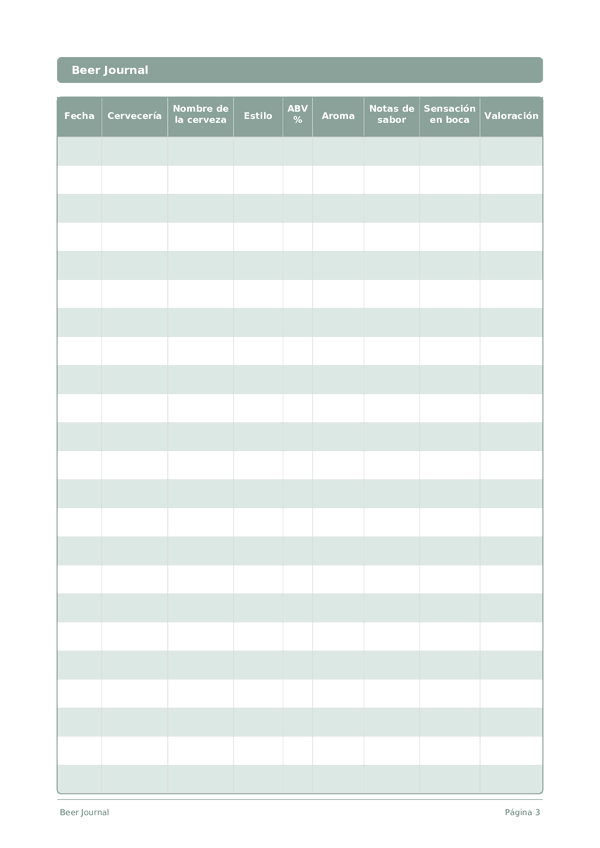
Printable Beer Journal
Track and rate every craft beer you try
A structured tasting log to record every craft beer you encounter — brewery, beer name, style, ABV, aroma, flavor notes, mouthfeel, and your personal rating. Build a personal database of beers you love, discover patterns in your taste preferences, and always remember what you ordered at that amazing taproom.
Personalizar campos
Activa o desactiva campos. Haz clic en el lápiz para renombrar, o añade tus propios campos.
Beneficios
Cómo Usar
¿Qué es este diario?
A beer journal is a tasting log for documenting your explorations of craft beer and beyond. By recording brewery, style, ABV, and detailed notes on aroma, flavor, and mouthfeel, you develop your palate and build a personal reference that guides you toward the styles and breweries you love most.
This journal is for beer enthusiasts who want to be more intentional about their tasting — from craft beer newcomers exploring IPA styles to experienced tasters pursuing rare barrel-aged stouts. It is also valuable for homebrewers who want to study what makes their favorite commercial beers exceptional.
Beer appreciation, like wine, deepens through deliberate tasting and recording. The Cicerone certification program emphasizes that writing tasting notes is the single most effective way to train your palate. By tracking aroma, flavor, and mouthfeel separately, you learn to isolate and identify the individual components that make a beer memorable or forgettable.
Ejemplo completado
Así es como se ve una entrada típica cuando se rellena:
| Fecha | Cervecería | Nombre de la cerveza | Estilo | ABV % | Aroma | Notas de sabor | Sensación en boca | Valoración |
|---|---|---|---|---|---|---|---|---|
| 2025-03-04 | Tree House Brewing | Julius | New England IPA | 6.8 | Tropical fruit explosion — mango, passion fruit, tangerine peel. Slight pine resin. | Juicy mango and peach dominate. Soft citrus bitterness that does not linger. Slight dank hop character in the background. Finishes clean and fruity. | Pillowy soft, medium body, moderate carbonation, creamy | 9 |
| 2025-03-04 | Weihenstephan | Hefe Weissbier | Hefeweizen | 5.4 | Classic banana and clove. Fresh bread dough. Hint of vanilla. | Banana bread with clove spice. Light wheat sweetness. Refreshing and balanced with a clean, dry finish. Effervescent. | Light-medium body, high carbonation, refreshing, slightly creamy from the wheat | 8 |
| 2025-03-04 | Founders Brewing | KBS (Kentucky Breakfast Stout) | Imperial Stout (Bourbon Barrel-Aged) | 12.2 | Rich dark chocolate, espresso, bourbon vanilla, oak, faint maple sweetness. | Decadent — dark chocolate truffle, espresso, caramel, bourbon warmth. Roasted malt backbone. Dried fruit in the background. Long, warming finish. | Full, viscous, low carbonation, warming alcohol, velvety | 9 |
Cómo rellenar cada campo
Cada pagina es una tabla con columnas. Completa una fila por entrada. Esto es lo que significa cada columna:
Fecha
Escribe la fecha de hoy. Esto ancla tu entrada en el tiempo y ayuda cuando revisas entradas despues.
Cervecería
Nombre de la cerveza
Estilo
ABV %
Aroma
Notas de sabor
Sensación en boca
Valoración
Calificacion general de la experiencia
Consejos para el exito
Cuando y con que frecuencia escribir
Log each new beer you try — the table format makes it fast enough to fill in at the bar or brewery. For homebrewers, log every batch with detailed recipe parameters. Aim for 2-4 entries per week if you are actively exploring styles. During brewery visits or festivals, jot quick ratings and expand notes afterward. Monthly, review your entries to map which styles, regions, and breweries consistently score highest on your personal scale.
Preguntas frecuentes
¿Cómo describo el estilo de una cerveza con precisión si no conozco la categoría BJCP?
Empieza por el estilo declarado en la etiqueta y luego compáralo con las BJCP Style Guidelines (edición actual, 2021), que organizan casi 100 categorías, desde American IPA hasta Berliner Weisse. La Brewers Association también publica Beer Style Guidelines anuales usadas en el Great American Beer Festival. Si no estás seguro, anota la coincidencia más cercana seguida de un signo de interrogación: con el tiempo, la alfabetización estilística se acumula y los propios errores de identificación se convierten en una señal de aprendizaje útil.
¿Cuál es la forma correcta de registrar aroma, notas de sabor y sensación en boca por separado?
Las hojas de puntuación del BJCP evalúan aroma, apariencia, sabor, sensación en boca e impresión general como dimensiones distintas por una razón: varían de forma independiente. Aroma: lúpulo (pino, cítricos, tropical), malta (pan, caramelo, chocolate), fermentación (plátano, clavo, pimienta). Sabor: intensidad de amargor, dulzor de malta, defectos (diacetilo, DMS). Sensación: peso corporal, carbonatación, calidez del alcohol, sequedad. El Cicerone Certification Program forma a los evaluadores con esta separación exacta.
¿Cómo leo y registro el ABV, y qué predice sobre la cerveza?
El ABV (alcohol por volumen) aparece en la mayoría de las etiquetas. Las BJCP Style Guidelines (2021) anclan los estilos a rangos de ABV: cervezas de sesión por debajo del 4,5 %, estándar 4,5-6 %, fuerte 6-9 %, muy fuerte 9 %+. Registrar el ABV frente a tu puntuación revela patrones de tolerancia: muchos bebedores prefieren consistentemente 5-7 % y encuentran que el ABV alto fatiga el paladar. El ABV también se correlaciona con la percepción del cuerpo y el dulzor a través de los azúcares residuales.
¿Cómo separo una cervecería que me gusta de una cerveza que me gusta?
Registra cervecería y nombre de la cerveza en columnas separadas deliberadamente. Tras 30-50 entradas, ordena mentalmente por cervecería: ¿la Cervecería X puntúa consistentemente 8+, o solo una lanzamiento emblema? La Brewers Association registra más de 9.000 cervecerías artesanales en EE. UU., por lo que la lealtad a nivel de cervecería sin datos de cervezas específicas desperdicia oportunidades de compra. Por el contrario, identificar una cervecería cuya gama completa puntúa bien es excepcionalmente valioso.
¿Cómo se compara este diario en papel con apps como Untappd?
Untappd es excelente para el descubrimiento social y los registros rápidos, pero sesga las puntuaciones a través de medias comunitarias visibles antes de catar. La evaluación al estilo BJCP y Cicerone requiere un análisis sensorial deliberado y sin sesgos, más fácil en papel sin notificaciones. Las apps también fomentan reacciones de una línea, mientras que las columnas separadas de aroma/sabor/sensación obligan a una evaluación más completa. Usa ambos: la app para el inventario y lo social, el diario para el registro analítico.
¿Es este diario apto para cervezas no artesanales, sidra, hidromiel o cervezas sin alcohol?
Sí. Las columnas —cervecería, nombre, estilo, ABV, aroma, sabor, sensación, puntuación— funcionan para cualquier bebida fermentada. Las directrices BJCP incluyen categorías de sidra e hidromiel con sus propios descriptores. La cerveza artesanal sin alcohol es un segmento en crecimiento según los informes anuales de la Brewers Association; regístrala de forma idéntica. El principio del diario —observación sensorial repetible— trasciende las etiquetas de categoría.
¿Con qué frecuencia debo revisar las entradas antiguas y qué debo buscar?
La revisión mensual ayuda a detectar la evolución del paladar. El Cicerone Certification Program subraya que la percepción del sabor cambia con la exposición: las cervezas que puntuabas 6 hace un año pueden obtener un 8 ahora que conoces el estilo. Ordena por puntuación y estilo: ¿tiendes hacia estilos lupulados, maltosos o ácidos? Los datos de la Brewers Association muestran que las IPA dominan el volumen artesanal, pero la preferencia personal a menudo diverge. La revisión anual revela la identidad estilística.
¿Errores comunes que perjudican la precisión de la cata?
Primero, puntuar desde la botella sin una copa adecuada: los volátiles aromáticos necesitan superficie, según el protocolo de juicio BJCP. Segundo, comer alimentos picantes o de sabor fuerte justo antes. Tercero, el sesgo de halo por marcas muy publicitadas. Cuarto, puntuar tras un solo sorbo: el sabor y el retrogusto necesitan un mínimo de 2-3 sorbos. Quinto, ignorar los defectos por cortesía; el Cicerone Off-Flavor Kit entrena específicamente la identificación de diacetilo, acetaldehído, DMS y el sabor a sol.
También Te Puede Gustar
Rueda para ampliar, arrastra para mover