Printable Tea Journal
Track every cup — from leaf to last sip
A structured log for tea enthusiasts who want to deepen their tasting practice. Record brewing parameters, aroma, flavor notes, and ratings to build a personal reference of your favorite teas. Whether you explore single-origin loose-leaf or seasonal herbals, this journal helps you brew better with every session.
Personalizar campos
Activa o desactiva campos. Haz clic en el lápiz para renombrar, o añade tus propios campos.
Beneficios
Cómo Usar
¿Qué es este diario?
A tea journal is a tasting and steeping log for documenting your exploration of tea. By recording tea type, origin, steeping parameters, and detailed sensory notes, you deepen your appreciation of one of the world's most nuanced beverages and learn to brew each tea at its best.
This journal is for tea enthusiasts who want to move beyond tea bags into the rich world of loose-leaf tea — from delicate white teas and complex oolongs to robust pu-erhs and fragrant jasmine greens. It is equally valuable whether you practice gongfu cha or Western-style brewing.
Tea masters emphasize that the same leaf can produce dramatically different cups depending on water temperature, steeping time, and leaf-to-water ratio. This journal helps you find the optimal parameters for each tea and track how teas evolve across multiple infusions — a journey that transforms tea drinking from a casual habit into a mindful practice with centuries of wisdom behind it.
Ejemplo completado
Así es como se ve una entrada típica cuando se rellena:
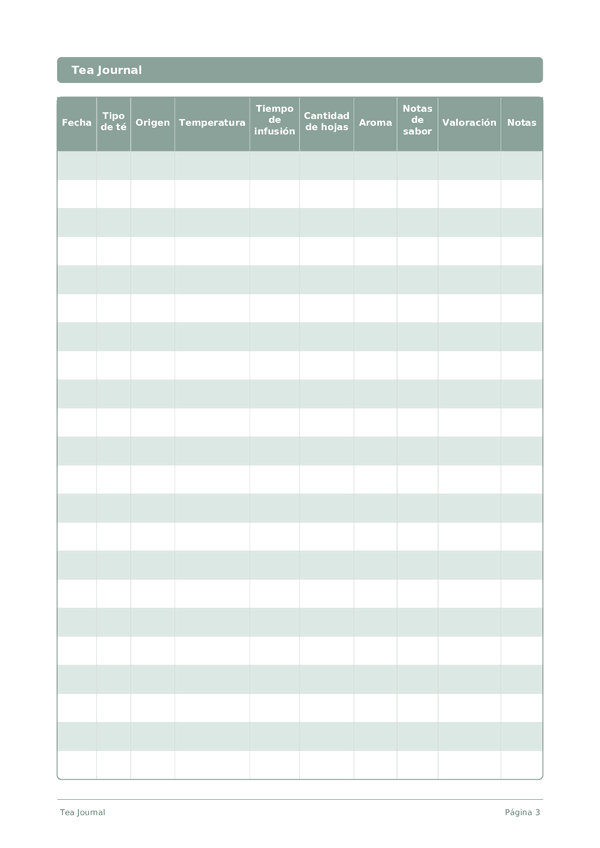
| Fecha | Tipo de té | Origen | Temperatura | Tiempo de infusión | Cantidad de hojas | Aroma | Notas de sabor | Valoración | Notas |
|---|---|---|---|---|---|---|---|---|---|
| 2025-03-04 | Oolong — Tieguanyin | Anxi, Fujian, China | 90 | 30s / 45s / 60s / 90s | 7g / 100ml gaiwan | Orchid, fresh cream, hint of roasted grain | 1st steep: bright floral, buttery. 2nd: orchid deepens, light honey. 3rd: toasted grain emerges, mineral finish. 4th: gentle, sweet, lingering. | 8 | Excellent Tieguanyin — opened beautifully over 4 steeps. The leaves unfurled into full, intact leaves. Best at 2nd and 3rd steep. Gongfu style brings out complexity. |
| 2025-03-04 | Green — Gyokuro | Uji, Kyoto, Japan | 60 | 90s / 60s / 30s | 5g / 60ml kyusu | Intense umami, seaweed, sweet grass, ocean breeze | 1st steep: rich umami bomb, sweet marine, buttery. 2nd: lighter, more vegetal, asparagus. 3rd: delicate, sweet, refreshing. | 9 | This Gyokuro is exceptional. Low temperature is essential — anything above 65C brings bitterness. The umami is almost broth-like. Paired well with mild white fish for lunch. |
Cómo rellenar cada campo
Cada pagina es una tabla con columnas. Completa una fila por entrada. Esto es lo que significa cada columna:
Fecha
Escribe la fecha de hoy. Esto ancla tu entrada en el tiempo y ayuda cuando revisas entradas despues.
Tipo de té
Origen
Temperatura
Registra tu temperatura basal corporal. Los cambios de temperatura ayudan a rastrear la ovulacion y la salud general del ciclo.
Tiempo de infusión
Cantidad de hojas
Aroma
Notas de sabor
Valoración
Calificacion general de la experiencia
Notas
Agrega cualquier contexto o pensamiento adicional. Esta columna general es para cualquier cosa que no encaje en otro lugar pero pueda ser util despues.
Consejos para el exito
Cuando y con que frecuencia escribir
Log each tea session as you brew — the table format is designed for quick capture while the kettle cools. If you drink 2-3 teas daily, log the one you want to remember or improve. When exploring a new tea type (say, transitioning from black to pu-erh), log every session for at least two weeks to build baseline understanding. Monthly, review your entries to see which teas you rated highest and which brewing parameters consistently produce your best cups.
Preguntas frecuentes
¿Qué temperatura del agua debo registrar para el té verde, el oolong, el negro y el pu-erh?
El Specialty Tea Institute y las principales referencias de producción de té coinciden en rangos amplios: verde 70-80 °C, blanco 75-85 °C, oolong 85-95 °C, negro y pu-erh 95-100 °C. Los estudios en el Journal of Agricultural and Food Chemistry sobre la extracción de catequinas confirman que la temperatura impulsa la liberación de polifenoles: demasiado calor extrae amargor, demasiado frío produce un té aguado. Registra la temperatura real, no solo la configuración de la tetera, ya que los vertidos y los gaiwan pueden enfriar el agua entre 5 y 10 °C.
¿Cuánto tiempo debo infusionar los distintos tipos de té y cómo registro varias infusiones?
Las pautas del Specialty Tea Institute sugieren: verde 1-3 min, negro 3-5 min, oolong 1-5 min (aumentando por infusión), pu-erh 30 s-3 min en estilo gongfu. El té suelto de calidad admite entre 3 y 7 infusiones; regístralas como filas separadas con tiempo de infusión «30 s, 45 s, 1 min». La investigación en Food Chemistry sobre la cinética de infusión del té muestra que el perfil de extracción de compuestos varía entre infusiones: las primeras liberan aminoácidos, las posteriores taninos.
¿Qué vocabulario aromático debo usar en la columna de aroma?
Toma prestado del trabajo sensorial establecido: floral (jazmín, orquídea), herbáceo (hierba recién cortada, espinaca), con nuez (castaña, almendra), terroso (bosque húmedo, madera mojada), ahumado, marino, a miel, mineral. El Specialty Tea Institute enseña tres evaluaciones distintas: aroma de la hoja seca, de la hoja mojada tras el aclarado y de la infusión. Sé específico: «floral» por sí solo pierde valor analítico a lo largo de cientos de entradas.
¿Qué precisión debe tener cantidad de hojas y por qué importa tanto?
Registra gramos por 100 ml de agua, no solo cucharaditas, ya que la densidad de la hoja varía enormemente entre las hojas planas del té verde y el oolong enrollado. Los parámetros de elaboración del Specialty Tea Institute se centran habitualmente en 2-3 g por 200 ml al estilo occidental, 5-7 g por 100 ml en gongfu. La proporción impulsa la fuerza de extracción independientemente del tiempo de infusión. Una báscula de cocina pequeña se amortiza rápidamente aquí.
¿Es este diario apto para infusiones de hierbas, matcha y tés en bolsita, no solo para hoja suelta?
Sí. Las columnas funcionan para cualquier infusión: tipo de té recoge matcha, hierbas, rooibos o manzanilla; temperatura, tiempo de infusión y cantidad de hoja siguen siendo aplicables. Las entradas de matcha registran el estilo del batidor en lugar del tiempo de infusión. El té en bolsita también es válido: la ITF (International Tea Federation) lo sigue como la mayoría del consumo mundial. El valor del diario reside en la observación repetible, no en el esnobismo de formato.
¿En qué se diferencia registrar el té del café o el vino?
El té es único porque admite varias infusiones de la misma carga de hojas, por lo que una sola «sesión» puede llenar varias filas. A diferencia del vino, los parámetros del té (temperatura, tiempo, proporción) son activamente variables, más como el café. A diferencia del café, la proporción cafeína/L-teanina cambia la experiencia cognitiva: la investigación en Food Chemistry documenta el perfil calmante del aminoácido L-teanina. Reserva la columna de notas para el contexto no sensorial: hora del día, estado de ánimo, comida acompañante.
¿Cuántas sesiones necesito para encontrar mis orígenes y tipos de té preferidos?
Planifica entre 30 y 50 sesiones registradas antes de que emerjan patrones claros. Filtra tus entradas por tipo de té y columna de puntuación: ¿tus 8+ se agrupan en oolong Dan Cong, Darjeeling de primera cosecha o negro de Yunnan? El origen también importa: los cursos del Specialty Tea Institute establecen paralelismos con el terroir vinícola. Tras 50 sesiones, también podrás identificar qué parámetros de preparación rinden sistemáticamente peor.
¿Errores comunes que arruinan la calidad de los datos en el diario de té?
Primero, calcular la cantidad de hoja a ojo en lugar de pesarla: anula la variable de proporción. Segundo, registrar solo la primera infusión cuando se prepararon varias. Tercero, aromas vagos como «huele bien»: usa las familias de descriptores de la ITF o del Specialty Tea Institute. Cuarto, puntuar inmediatamente, cuando muchos tés revelan su complejidad al enfriarse. Quinto, ignorar la fuente del agua: la investigación en Food Chemistry muestra que el contenido mineral altera significativamente la extracción, igual que con el café.
También Te Puede Gustar
Rueda para ampliar, arrastra para mover