Printable Poetry Journal
Daily poetry writing and creative verse journal
Cultivate a daily poetry practice with a dedicated writing space. Experiment with forms, capture moods, and develop your poetic voice through consistent creative expression.
¿Qué es este diario?
A poetry journal is a sanctuary for your verses — a dedicated space to draft, revise, and preserve poems in all their stages. Whether you write polished sonnets or raw free verse, having a single place for your poetic work encourages consistency and makes it easy to revisit earlier drafts and track how your voice evolves over time.
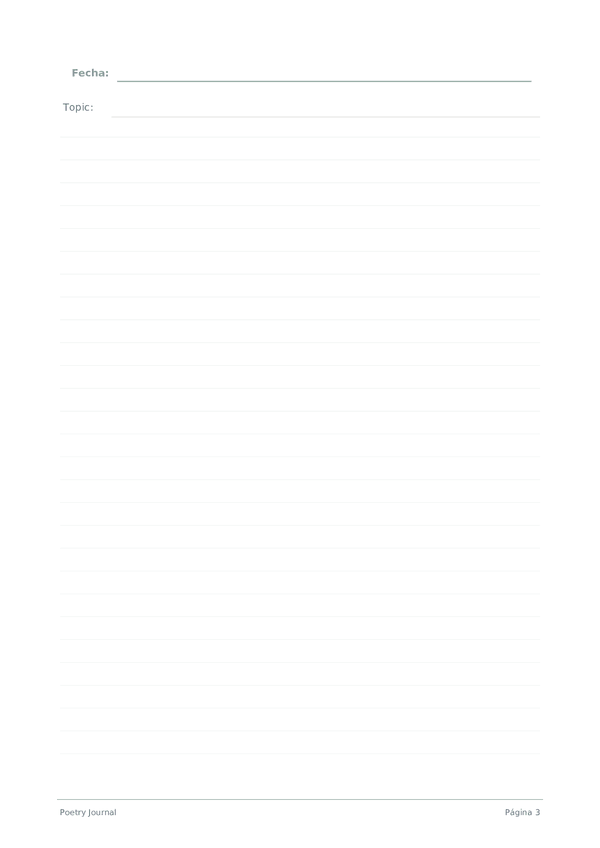
Each page begins with a title header rather than a date, because poems live on their own timeline. The guided prompts — poem form, mood or tone, and a writing prompt — are there to gently nudge you when the blank page feels daunting, but the freeform layout gives you complete freedom to write however the poem wants to come out. Use the lined grid to keep stanzas tidy or let lines wander across the page.
Write a poem a day, a poem a week, or whenever words demand to be arranged. The habit of returning to this journal trains your ear for rhythm and image, and over time you will build a personal anthology that charts your growth as a poet — from first drafts full of crossed-out words to pieces you are genuinely proud of.
Ejemplo completado
Así es como se ve una entrada típica cuando se rellena:
Consejos para el exito
Cuando y con que frecuencia escribir
Write at least one poem per week, with daily free-writing sessions of five to ten minutes that generate raw material. Poet William Stafford wrote every morning before dawn, proving that routine and inspiration are not enemies. Use the daily sessions to capture images and phrases without pressure to finish a poem. Weekly, select the strongest fragments and develop them into complete pieces. Monthly, reread and revise — many published poems go through a dozen or more revisions. The journal captures the entire lifecycle from impulse to polished work.
Preguntas frecuentes
¿Para qué está diseñado el Diario de Poesía?
Un diario de páginas rayadas para la práctica poética diaria. Cada página tiene un encabezado de fecha-título y tres indicaciones guiadas en la parte inferior (forma del poema, estado de ánimo/tono, indicación de escritura), con espacio de escritura rayado optimizado para el verso. El formato admite cualquier estilo poético — sonetos, haiku, verso libre, ghazal, poesía en prosa. La estructura construye el hábito de escritura diaria que distingue a los poetas que practican de los ocasionales.
¿Por qué completar el campo de forma del poema — ¿importa la forma?
Nombrar la forma fuerza una elección consciente del oficio. El «verso libre» por defecto rara vez es libre — suele ser sin examinar. Trabajar con formas específicas (haiku, soneto, sextina, bloque de prosa) construye el vocabulario técnico que, según Stephen King (2000, On Writing, Scribner) y escritores de diversas tradiciones, distingue el oficio del desahogo. Con el tiempo, el campo de forma también revela sus valores predeterminados y le empuja hacia territorio desconocido.
¿Cómo uso los campos de estado de ánimo/tono e indicación de escritura?
Estado de ánimo/tono nombra el registro emocional al que apunta (elegíaco, irónico, tierno, agudo) — nombrarlo enfoca la revisión. La indicación de escritura registra la semilla: una frase, imagen, pregunta o restricción. Lamott (1994, Bird by Bird, Anchor) llama a estas «tareas breves» y argumenta que hacen posible la escritura al reemplazar la tarea imposible («escribir un poema») con una finita («escribir sobre esta única imagen»).
¿La práctica poética diaria realmente mejora los poemas?
Sí — cuando las sesiones incluyen reflexión y formas variadas. La investigación de práctica deliberada de Ericsson et al. (1993, Psychological Review, 100(3), 363-406) muestra que el desarrollo de habilidades requiere intentos dirigidos al borde de la capacidad, no mera repetición. El campo de forma del poema fomenta la variedad; la práctica diaria construye el volumen necesario para la selección. La mayoría de los poetas publicados escriben mucho más de lo que publican.
¿Qué pasa si un poema diario se siente forzado o mediocre?
La mayoría lo serán — ese es el punto. Lamott (1994, Bird by Bird, Anchor) llamó a estos «primeros borradores pésimos» y los consideró el trabajo real; los poemas terminados emergen del volumen. El diario es para la práctica, no para la publicación. Guárdelos todos; uno de cada 20-30 puede crecer en algo. La presión por la calidad diaria mata el hábito más rápido que los borradores honestos y mediocres.
¿En qué se diferencia de un cuaderno normal para poemas?
Un cuaderno recopila borradores; este diario construye la práctica. El encabezado de fecha-título crea responsabilidad y una racha de escritura visible. Las tres indicaciones fuerzan las elecciones de forma/estado de ánimo/semilla que la mayoría de los principiantes omite, que es precisamente el nivel en el que se desarrolla el oficio. Use un cuaderno para la revisión y el trabajo terminado; use este diario para la práctica generativa diaria. Muchos poetas mantienen ambos.
¿Cuánto debe durar cada sesión diaria?
15-30 minutos cubre un primer borrador de un poema corto o trabajo significativo en uno más largo. La investigación de escritura expresiva de Pennebaker usa consistentemente sesiones de 15-20 minutos en estudios publicados — lo suficientemente profundo, lo suficientemente corto para sostener lo diario. Apunte a un intento de poema por sesión, completo o no. Algunos días producirán un borrador pulido; la mayoría producirán comienzos a los que puede o no volver.
¿Cómo reviso los poemas pasados para revisión o selección?
Lectura mensual con atención a cuáles entradas siguen resonando. Cepeda et al. (2006, Psychological Bulletin, 132(3), 354-380) describen cómo el reencuentro espaciado fortalece tanto la memoria como el juicio. Marque los poemas para posible revisión y el resto como práctica. La mayoría no se convertirán en trabajo terminado — eso es normal. El valor del diario es el volumen que hace posible la selección, no ninguna página individual.
También Te Puede Gustar
Rueda para ampliar, arrastra para mover