Printable Writer's Journal
Daily creative writing practice & craft development
A structured daily journal for writers of all levels. Each page combines quick satisfaction and creativity trackers with generous writing space for freewriting, character sketches, story seeds, and craft reflection. Whether you write fiction, poetry, memoir, or essays — this journal builds the daily habit that transforms aspiring writers into practicing ones.
Personalizar campos
Activa o desactiva campos. Haz clic en el lápiz para renombrar, o añade tus propios campos.
Beneficios
Cómo Usar
¿Qué es este diario?
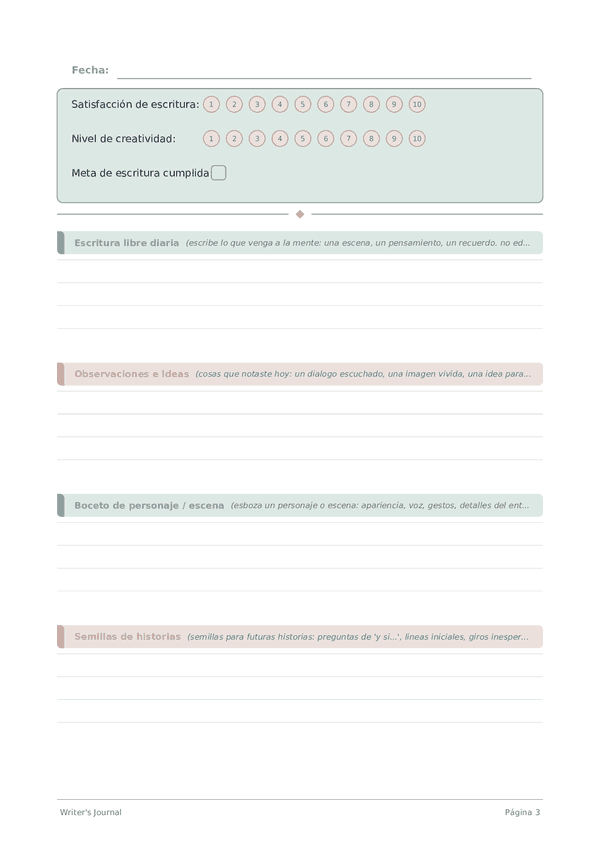
A Writer's Journal is a hybrid tool that pairs daily writing metrics with creative reflection. The top section tracks your writing satisfaction, creativity level, and whether you met your writing goal. The bottom section provides generous space for freewriting, capturing observations and ideas, sketching characters or scenes, planting story seeds, and reflecting on your writing practice. It is both a log and a creative incubator.
Every published author will tell you that consistency matters more than inspiration. This journal supports that consistency by making your writing practice visible and measurable. The tracker section takes the guesswork out of progress — you can see at a glance whether your satisfaction and creativity are trending up or down over weeks. The writing sections keep your creative muscles engaged even on days when the main project feels stuck.
Use the freewrite section first thing each morning to warm up your writing brain. Do not edit, do not censor — just let words flow for ten minutes. Then fill in observations, character sketches, or story seeds throughout the day as they occur to you. At the end of the day, complete the tracker and write a brief reflection on what worked and what did not. Over months, this journal becomes a goldmine of raw material for your larger projects.
Ejemplo completado
Así es como se ve una entrada típica cuando se rellena:
Cómo rellenar cada campo
La parte superior de cada pagina tiene campos de llenado rapido (calificaciones, casillas, numeros). Debajo hay una seccion con lineas para escribir. Esto es lo que significa cada campo:
Satisfacción de escritura
Que tan satisfecho estas con lo que escribiste hoy? 1=frustrado, 10=profundamente realizado
Nivel de creatividad
Que tan creativo te sentiste hoy? 1=completamente bloqueado, 10=ideas fluyendo libremente
Meta de escritura cumplida
Cumpliste tu meta de escritura hoy: conteo de palabras, tiempo o paginas? Si, no o parcialmente
Escritura libre diaria
Escribe lo que venga a la mente: una escena, un pensamiento, un recuerdo. No edites, solo deja que las palabras fluyan
Observaciones e ideas
Cosas que notaste hoy: un dialogo escuchado, una imagen vivida, una idea para una historia
Boceto de personaje / escena
Esboza un personaje o escena: apariencia, voz, gestos, detalles del entorno
Semillas de historias
Semillas para futuras historias: preguntas de 'y si...', lineas iniciales, giros inesperados
Reflexión de escritura
Que aprendiste sobre tu escritura hoy? Que funciono, donde te atascaste?
Consejos para el exito
Cuando y con que frecuencia escribir
Write daily, ideally at the same time to build a routine. Morning pages work best for clearing mental clutter; evening sessions suit reflective and narrative writing. Aim for a minimum of 15-20 minutes or 300 words — enough to warm up and produce something real. Weekly, reread the week’s entries and highlight any phrases, ideas, or scenes worth developing. Monthly, review your word count trends and satisfaction ratings to see if your practice is growing or stagnating, and adjust your routine accordingly.
Preguntas frecuentes
¿Qué es el Diario del Escritor y para quién es?
Es un diario diario para escritores de cualquier nivel — ficción, poesía, memorias, ensayos. Cada página combina un rastreador breve (satisfacción con la escritura, nivel de creatividad, casilla de objetivo cumplido) con diez líneas para escritura libre diaria, observaciones, bocetos de personajes o escenas, semillas de historias y reflexión sobre el oficio. El objetivo es construir la práctica constante que Anne Lamott (1994, Bird by Bird, Anchor) y Stephen King (2000, On Writing, Scribner) describen como el trabajo real de escribir.
¿Cuánto tiempo debo escribir libremente en cada página?
Quince a veinte minutos es la práctica estándar — suficiente para superar los pensamientos superficiales. Los protocolos de escritura expresiva de Pennebaker (usados en docenas de estudios sobre escritura y bienestar) utilizan consistentemente sesiones de 15-20 minutos. Escriba sin detenerse ni editar; si se bloquea, repita su última frase. Las diez líneas dan aproximadamente ese volumen en letra a mano.
¿Cómo uso eficazmente las valoraciones de satisfacción y creatividad?
Valore inmediatamente después de escribir, no antes. Con el tiempo, las dos puntuaciones revelan cuándo trabaja mejor — hora del día, nivel de sueño, después de ejercicio, antes del correo. Csikszentmihalyi (1990, Flow, Harper) enfatizó que los creadores no tienen flujo constante; el seguimiento expone las condiciones que lo producen. La casilla de objetivo cumplido separa el esfuerzo del resultado: cumplir un objetivo diario importa más que sentirse brillante.
¿La práctica diaria de escritura realmente mejora el oficio?
Sí — los principios de práctica deliberada de Ericsson, Krampe y Tesch-Römer (1993, Psychological Review, 100(3), 363-406) se transfieren a la escritura cuando las sesiones incluyen objetivos específicos y reflexión. El Diario del Escritor construye ese ciclo: un objetivo claro al inicio, práctica enfocada en la escritura libre y reflexión sobre el oficio al final. El libro de Ericsson Peak (2016, Houghton Mifflin Harcourt) extiende esto a los dominios creativos.
¿Qué va en la sección de boceto de personaje o escena?
Un párrafo breve — detalle físico, voz, gesto, una acción reveladora. Lamott (1994, Bird by Bird, Anchor) llama a estos «tareas breves» y argumenta que así se escriben los libros: no en arcos sino en pequeñas piezas concretas. Use detalles sensoriales sobre abstracciones. El boceto de dos líneas de hoy puede convertirse en el capítulo de mañana, pero su primer trabajo es entrenar el ojo para el detalle.
¿En qué se diferencia de las páginas matutinas o las apps de diario?
Las páginas matutinas (tres páginas de flujo de conciencia) despejan el desorden mental; este diario es para el oficio. El rastreador impone la medición, las preguntas adicionales (semillas de historias, boceto de personaje) fuerzan la producción generativa y la línea de reflexión construye metacognición sobre su propia escritura. Las apps carecen de la fricción que, según Zinsser (2006, On Writing Well, Harper Perennial), fuerza el pensamiento más claro.
¿Qué escribir si tengo bloqueo de escritor?
Use las preguntas en orden: observaciones de hoy, una frase escuchada, un detalle sensorial, el gesto de un personaje. El bloqueo normalmente significa intentar escribir lo incorrecto — Lamott (1994, Bird by Bird, Anchor) recomienda el enfoque del «marco de una pulgada»: escriba solo lo que cabe en una escena diminuta. La sección de escritura libre está diseñada exactamente para esto — generación sin riesgo, no prosa terminada.
¿Cuánto tiempo hasta ver una mejora real con el diario diario?
Espere cambios notables en 8-12 semanas de práctica constante y crecimiento measurable en el oficio en 6-12 meses. La investigación de Ericsson (Ericsson et al., 1993, Psychological Review, 100(3)) muestra que la práctica enfocada y reflexiva — no las horas brutas — produce ganancias. Veinte minutos diarios con el rastreador de satisfacción y las preguntas de reflexión es más eficaz que dos horas sin foco a la semana.
También Te Puede Gustar

Rueda para ampliar, arrastra para mover