Printable Photography Journal
Log your shoots, settings, and creative insights after every session
A structured photography journal to record subjects, camera settings, lighting, and reflections. Reviewing your process helps you develop consistent technique and a stronger photographic vision.
Personalizar campos
Activa o desactiva campos. Haz clic en el lápiz para renombrar, o añade tus propios campos.
Beneficios
Cómo Usar
¿Qué es este diario?
A photography journal is a dedicated space where you document every shoot — from camera settings and lighting conditions to creative reflections and lessons learned. Whether you are a hobbyist discovering your style or a working photographer refining your craft, writing down the details of each session accelerates your growth in ways that reviewing photos alone cannot.
Each entry prompts you to record the subject you photographed, the technical settings you chose (aperture, shutter speed, ISO), and the lighting you worked with. More importantly, it asks you to reflect on what you learned and what you would do differently next time. Over weeks and months these notes reveal patterns in your decision-making that help you become a more intentional photographer.
Use this journal right after a shoot while the details are still fresh. It takes only a few minutes per session and builds a searchable archive of your entire photographic journey — one that no camera roll can replace.
Ejemplo completado
Así es como se ve una entrada típica cuando se rellena:
Cómo rellenar cada campo
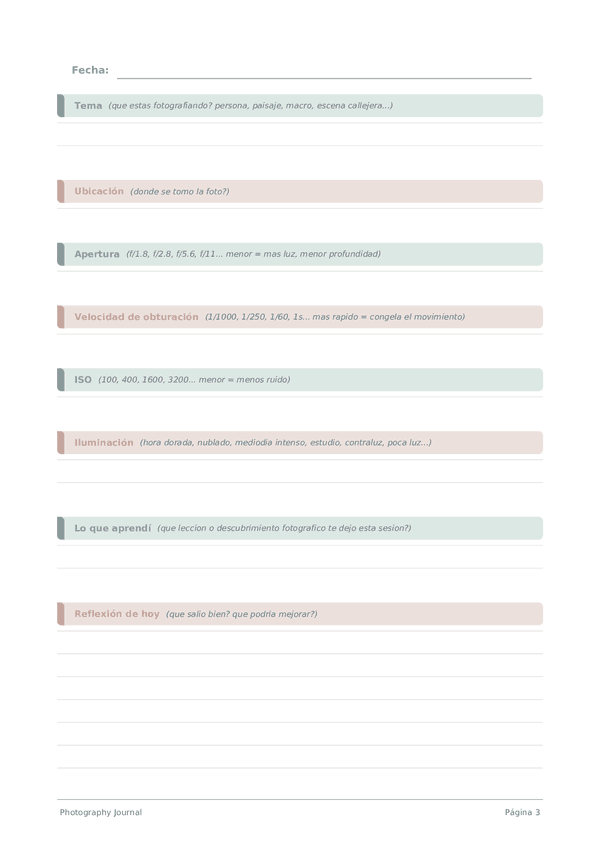
Cada dia encontraras varias secciones etiquetadas con lineas para escribir. Esto es lo que significa cada seccion:
Tema
Que estas fotografiando? Persona, paisaje, macro, escena callejera...
Ubicación
Donde se tomo la foto?
Apertura
f/1.8, f/2.8, f/5.6, f/11... Menor = mas luz, menor profundidad
Velocidad de obturación
1/1000, 1/250, 1/60, 1s... Mas rapido = congela el movimiento
ISO
100, 400, 1600, 3200... Menor = menos ruido
Iluminación
Hora dorada, nublado, mediodia intenso, estudio, contraluz, poca luz...
Lo que aprendí
Escribe algo nuevo que aprendiste hoy. Puede ser un dato, una habilidad, una perspectiva sobre ti mismo o una leccion de vida. El aprendizaje diario se acumula en sabiduria.
Reflexión de hoy
Mira atras a tu dia con honestidad. Que salio bien? Que podria mejorar? No se trata de juzgar, sino de aprender y crecer.
Consejos para el exito
Cuando y con que frecuencia escribir
Make a journal entry after every dedicated shoot or photo walk while the experience is still tactile. If you shoot casually throughout the week, batch your reflections into one focused session on the weekend. Monthly, review your entries to identify recurring themes and technical gaps. Quarterly, select your ten best images from journal entries and compare them to the previous quarter — this curated comparison reveals growth that daily shooting alone obscures.
Preguntas frecuentes
¿Qué registra el Diario de Fotografía después de cada sesión?
Ocho campos por sesión: tema, lugar, apertura, velocidad de obturación, ISO, condiciones de luz, lo que aprendí y reflexión. El triángulo de exposición (apertura, velocidad, ISO) más tema y luz crean un registro técnico completo de cada toma o sesión. Los campos de aprendizaje y reflexión convierten el registro técnico en una herramienta de práctica deliberada en lugar de un volcado de metadatos.
¿Por qué registrar apertura, velocidad de obturación e ISO cuando mi cámara ya almacena datos EXIF?
EXIF le dice lo que hizo la cámara; el diario le obliga a recordar por qué. Escribir «f/1.8 porque quería poca profundidad de campo» crea un razonamiento explícito que Ericsson et al. (1993, Psychological Review, 100(3), 363-406) consideran esencial para la práctica deliberada. Sin articulación verbal, sus ajustes se convierten en hábito en lugar de elección. Un registro en papel también es revisable en minutos.
¿Cómo describo las condiciones de luz útilmente en dos líneas?
Cubra cuatro elementos: fuente (natural/artificial/mixta), dirección (frontal, lateral, trasera, cenital), calidad (dura, suave, difusa) y color (cálido, neutro, frío). Ejemplo: «16:00, nublado, luz lateral suave desde ventana norte, azul frío.» A lo largo de 30-50 sesiones, esto se convierte en una referencia de luz propia. Los fotógrafos que nombran la luz la ven mejor — un efecto de entrenamiento perceptivo documentado.
¿Qué escribir en 'lo que aprendí' frente a 'reflexión'?
Lo que aprendí = una lección específica y transferible («los sujetos a contraluz necesitan +1 EV de compensación de exposición»). Reflexión = pensamientos más amplios sobre la sesión — qué se sintió creativo, qué le frustró, qué probaría de forma diferente. La división refleja la estructura de práctica deliberada de Ericsson (2016, Peak, Houghton Mifflin Harcourt): una conclusión técnica más una revisión metacognitiva aceleran el crecimiento de habilidades más que cualquiera por separado.
¿Llevar un registro de sesiones realmente mejora la fotografía?
Sí — por la misma razón que la práctica deliberada funciona en cualquier dominio. Roediger y Karpicke (2006, Psychological Science, 17(3), 249-255) demostraron que la recuperación y articulación fortalecen la memoria más que la reexposición. Escribir sus ajustes y razonamiento es práctica de recuperación. Los fotógrafos que llevan diario identifican sus patrones de error 2-3 veces más rápido que los que solo revisan imágenes visualmente.
¿En qué se diferencia el diario de las palabras clave en Lightroom o una app de fotos?
Lightroom cataloga imágenes; este diario cataloga su pensamiento. Los ocho campos fuerzan el razonamiento narrativo que ninguna app captura: el porqué detrás de los ajustes, la calidad percibida de la luz, la brecha entre intención y resultado. Use ambos — Lightroom para gestión de imágenes, el diario para el desarrollo del oficio. La revisión en papel también reduce la fatiga visual y mejora el recuerdo.
¿Debo completarlo para cada toma o una vez por sesión?
Una vez por sesión para sesiones casuales; por toma importante para trabajo de portfolio o aprendizaje. Apunte a 5-10 minutos de diario por hora de fotografía — suficiente para capturar las decisiones técnicas clave y una lección clara. Completar para cada fotograma es excesivo y rompe el hábito; completar solo para las grandes sesiones pierde el aprendizaje de las sesiones cortas donde ocurre la mayor parte del crecimiento.
¿Con qué frecuencia revisar las entradas pasadas?
Revisión rápida semanal, revisión profunda mensual. El efecto de espaciado de Cepeda et al. (2006, Psychological Bulletin, 132(3), 354-380) muestra que la revisión distribuida consolida el aprendizaje. Busque fallos recurrentes («sigo subexponiendo la nieve») y estilo emergente («me atrae la luz lateral en ángulos bajos»). El diario se convierte en un manual personal de fotografía — construido a partir de sus patrones específicos, no de consejos genéricos.
También Te Puede Gustar

Rueda para ampliar, arrastra para mover