Printable Art Journal
Document your creative process and artistic growth
A structured art journal that combines quick session tracking with reflective writing. Log your medium, technique, time spent, and satisfaction for each creative session, then reflect on what you created, the colors you used, and what you learned. Perfect for artists, illustrators, and anyone exploring visual expression.
Personalizar campos
Activa o desactiva campos. Haz clic en el lápiz para renombrar, o añade tus propios campos.
Beneficios
Cómo Usar
¿Qué es este diario?
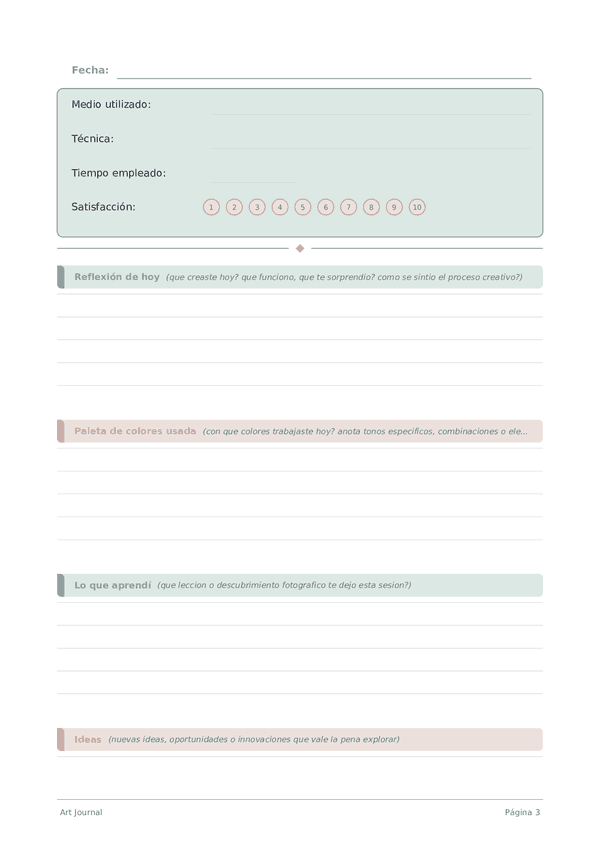
An Art Journal is a hybrid reflection tool for visual artists who want to grow intentionally. The top section tracks the medium used, technique practiced, time spent, and your satisfaction with the session. The bottom section provides space for written reflection, documenting your color palette, noting what you learned, and capturing ideas for future work. Together, they create a complete record of your artistic development.
Making art is inherently experiential, and much of what you learn in a session gets lost if you do not take a moment to articulate it. This journal bridges the gap between doing and understanding. When you write about why a certain color combination worked or why a technique felt awkward, you accelerate your learning in ways that practice alone cannot achieve.
Fill in the tracker immediately after each art session while the experience is still vivid. In the reflection section, write honestly about what went well and what frustrated you. Document the specific colors you mixed and the techniques you tried. Over months, this journal becomes an invaluable reference — a personal art education textbook written by the only teacher who knows exactly what you need to learn next: yourself.
Ejemplo completado
Así es como se ve una entrada típica cuando se rellena:
Cómo rellenar cada campo
La parte superior de cada pagina tiene campos de llenado rapido (calificaciones, casillas, numeros). Debajo hay una seccion con lineas para escribir. Esto es lo que significa cada campo:
Medio utilizado
Con que medio trabajaste hoy? ej. acuarela, oleo, lapiz, carbon, digital
Técnica
En que tecnica te enfocaste o experimentaste? ej. pincel seco, capas, sombreado cruzado
Tiempo empleado
Cuanto tiempo estudiaste?
Satisfacción
Que tan satisfecho estas con la sesion de hoy? (1=frustrado, 5=muy satisfecho)
Reflexión de hoy
Mira atras a tu dia con honestidad. Que salio bien? Que podria mejorar? No se trata de juzgar, sino de aprender y crecer.
Paleta de colores usada
Con que colores trabajaste hoy? Anota tonos especificos, combinaciones o elecciones que se sintieron bien
Lo que aprendí
Escribe algo nuevo que aprendiste hoy. Puede ser un dato, una habilidad, una perspectiva sobre ti mismo o una leccion de vida. El aprendizaje diario se acumula en sabiduria.
Ideas
Captura tus ideas antes de que desaparezcan. Ninguna idea es demasiado pequena o tonta. Algunos de los mejores avances comienzan como pensamientos toscos y a medio formar.
Consejos para el exito
Cuando y con que frecuencia escribir
Aim for two to three sessions per week, each 20 to 45 minutes. Daily practice is wonderful but can create pressure that kills spontaneity — art journaling thrives on desire, not obligation. Keep your journal accessible (on your desk, not in a drawer) so you can grab it whenever inspiration strikes. Once a month, flip through the entire journal without judgment, just noticing which pages pull your eye. This review often sparks new ideas and reminds you how far your visual vocabulary has come.
Preguntas frecuentes
¿Qué registra el Diario de Arte?
Cada página registra una sesión creativa: soporte utilizado, técnica, tiempo empleado (hasta 480 minutos) y satisfacción (0-10), con ocho líneas de reflexión — paleta de colores usada, lo que aprendió e ideas. Es para artistas, ilustradores y cualquiera que documente la práctica visual. A diferencia de un portfolio, captura el proceso: elecciones, errores y pequeños descubrimientos que se acumulan en estilo a lo largo de meses.
¿Cómo uso los campos de soporte y técnica de forma significativa?
Sea específico — «acuarela, técnica húmedo sobre húmedo» supera a «pintura». El marco de práctica deliberada de Ericsson et al. (1993, Psychological Review, 100(3), 363-406) requiere identificar la habilidad exacta que se está entrenando. Las entradas específicas de soporte y técnica le permiten responder después: «¿Qué técnica valoro más alto?» o «¿Qué nunca he probado?» Tras tres meses, el campo se convierte en un currículo propio de fortalezas y lagunas.
¿Por qué valorar la satisfacción después de cada sesión?
La valoración crea un ciclo de retroalimentación que vincula esfuerzo, condiciones y resultado. Csikszentmihalyi (1990, Flow, Harper) encontró que los artistas que reflexionan sobre la calidad de la sesión entran en estados de flujo de manera más fiable. Valore inmediatamente después — la memoria infla las sesiones buenas y borra las mediocres. Los patrones emergen en 4-6 semanas: las sesiones de alta satisfacción a menudo comparten condiciones comunes que puede recrear deliberadamente.
¿Mantener un diario de arte realmente mejora mi trabajo?
La reflexión más la práctica deliberada sí. Ericsson (2016, Peak, Houghton Mifflin Harcourt) muestra que los artistas que articulan qué funcionó y qué falló progresan más rápido que los que solo producen. El campo de lo que aprendí es el componente de práctica deliberada; el rastreador de satisfacción es la señal de retroalimentación. Sin reflexión, las horas producen repetición en lugar de mejora.
¿En qué se diferencia de mantener un cuaderno de bocetos?
Un cuaderno guarda el trabajo; este diario guarda el proceso detrás del trabajo. Los campos estructurados le obligan a nombrar su soporte, técnica y paleta — un hábito metacognitivo que, según la investigación sobre «dificultades deseables» de Bjork (Bjork & Bjork, 2011, Psychology and the Real World, Worth Publishers), fortalece la retención y la transferencia. Puede mantener ambos: bocetos allí, registro aquí.
¿Qué escribir en la sección de paleta de colores?
Liste los pigmentos reales o los códigos hexadecimales usados (p. ej., «azul ultramar, siena tostada, blanco titanio»). A lo largo de 30-50 entradas, verá su paleta habitual y los colores no explorados. Esto convierte el diario en una biblioteca personal de referencia de color. Anote qué combinaciones funcionaron y cuáles resultaron lodosas — captura el conocimiento tácito que los artistas normalmente desarrollan mediante ensayo y error durante años.
¿Con qué frecuencia llevar el diario — cada sesión o solo los proyectos grandes?
Cada sesión, incluso las de 10 minutos. El efecto de espaciado documentado por Cepeda et al. (2006, Psychological Bulletin, 132(3), 354-380) muestra que las entradas frecuentes y breves superan a las largas y poco frecuentes para la retención. Las sesiones cortas son también donde ocurren la mayoría de los microdescubrimientos — un truco de pincel, una mezcla de color, una observación de luz. Omitirlas pierde los datos granulares que luego permiten encontrar patrones.
No soy un artista «real» — ¿el diario sigue siendo útil?
Sí — el diario es para la práctica, no para las credenciales. La investigación sobre mentalidad de Dweck (Mindset, 2006, Random House) muestra que centrarse en el proceso y la mejora (mentalidad de crecimiento) en lugar del talento innato (mentalidad fija) predice el desarrollo de habilidades a largo plazo. La valoración de satisfacción y las preguntas de lo que aprendí están diseñadas para medir el crecimiento, no la calidad del resultado. Los principiantes se benefician más porque la reflexión temprana previene que se formen malos hábitos.
También Te Puede Gustar

Rueda para ampliar, arrastra para mover