Printable Journal TDAH
Votre compagnon quotidien structuré pour la concentration, le calme et l'élan
A daily journal designed specifically for people with ADHD. Each page helps you cut through the mental noise — track your focus and energy, capture the brain dump, set a clear intention, and prioritise what actually matters. Built around neurodivergent needs: minimal structure, maximum clarity.
Personnaliser les champs
Activez ou désactivez les champs. Cliquez sur le crayon pour renommer, ou ajoutez vos propres champs.
Avantages
Comment utiliser
Qu'est-ce que ce journal ?
An ADHD journal is a daily support tool designed specifically for the ADHD brain. By tracking focus, mood, energy, and medication alongside writing about intentions, priorities, and brain dumps, you externalize the mental clutter and create a system that works with your neurology rather than against it.
This journal is for adults and teens with ADHD — diagnosed or suspected — who struggle with executive function, focus, time blindness, and emotional regulation. It is built to be quick and low-friction, because an elaborate journaling system that requires too much executive function defeats its own purpose.
ADHD coaching research shows that external accountability systems dramatically improve follow-through for ADHD brains. The brain dump section is particularly powerful — getting racing thoughts onto paper frees up working memory that ADHD brains need for task execution. Tracking patterns in focus and energy helps identify optimal windows for different types of work, turning self-knowledge into a productivity advantage.
Exemple rempli
Voici à quoi ressemble une entrée typique une fois remplie :
Comment remplir chaque champ
Le haut de chaque page comporte des champs à remplissage rapide (évaluations, cases à cocher, chiffres). En dessous se trouve une section lignée pour écrire. Voici ce que signifie chaque champ :
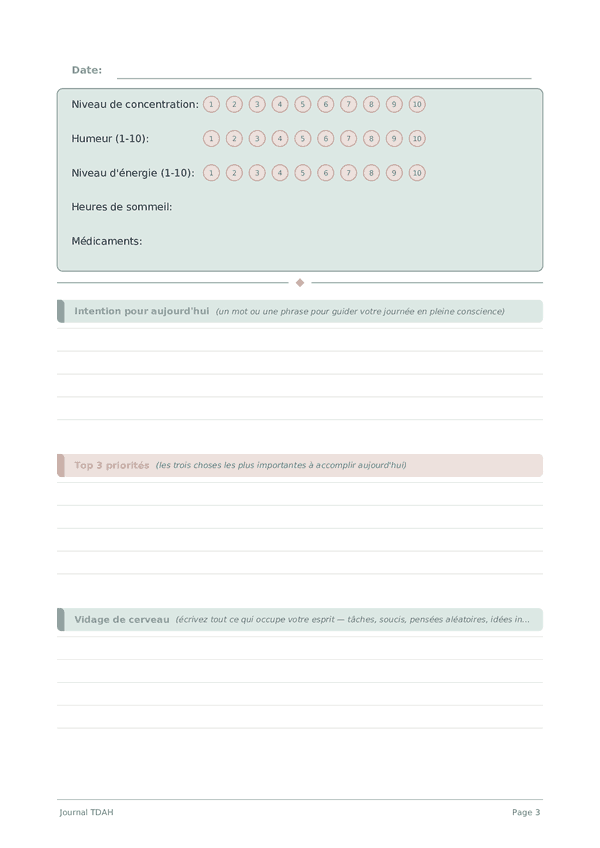
Niveau de concentration
À quel point arrivez-vous à vous concentrer en ce moment ? Notez de 1 (dispersé) à 10 (concentration totale)
Humeur (1-10)
Évaluez votre état émotionnel général de la journée. 1 signifie très bas ou déprimé, 10 signifie exceptionnellement heureux et positif. Ne réfléchissez pas trop — fiez-vous à votre instinct.
Niveau d'énergie (1-10)
Évaluez votre niveau d'énergie physique et mentale. 1 signifie épuisé et vidé, 10 signifie plein d'énergie et alerte. Cela vous aide à identifier quelles activités stimulent ou drainent votre énergie.
Heures de sommeil
Notez combien d'heures vous avez réellement dormi (pas seulement le temps passé au lit). Suivre cela en parallèle de l'humeur et de l'énergie révèle souvent des connexions puissantes.
Médicaments
Enregistrez les médicaments pris, y compris le nom et le dosage. Un suivi régulier vous aide, vous et votre médecin, à évaluer l'efficacité du traitement.
Intention pour aujourd'hui
Un mot ou une phrase pour guider votre journée en pleine conscience
Top 3 priorités
Les trois choses les plus importantes à accomplir aujourd'hui
Vidage de cerveau
Écrivez tout ce qui occupe votre esprit — tâches, soucis, pensées aléatoires, idées inachevées. Libérez de l'espace
Réflexion du jour
Revenez sur votre journée honnêtement. Qu'est-ce qui s'est bien passé ? Qu'est-ce qui pourrait être amélioré ? Il ne s'agit pas de juger — il s'agit d'apprendre et de grandir.
Conseils pour réussir
Quand et à quelle fréquence écrire
Write twice daily: a 2-minute evening entry (what worked today, what didn\u2019t, tomorrow\u2019s top 3) and a 1-minute morning check-in (energy level, medication, today\u2019s anchor task). Keep the journal next to where you actually sit — if it requires getting up to find it, ADHD friction will win. Weekly, spend 10 minutes reviewing patterns: which days were productive and why, which strategies helped, which times of day were your cognitive peaks. This journal works best when it is short, consistent, and immediately accessible.
Questions fréquentes
Pourquoi ce journal est-il conçu spécifiquement pour le TDAH plutôt que la productivité générale ?
Le cerveau TDAH se bat contre la surcharge de mémoire de travail, la perception du temps et la friction de démarrage. Ce modèle répond avec une structure délibérément minimale : cinq éléments tracker (focus, humeur, énergie, heures sommeil, médication) et quatre questions (intention du jour, top priorités, vidage de cerveau, réflexion). Moins de champs, hiérarchie plus claire, et une section vidage de cerveau explicite ciblent directement les défis exécutifs qui font dérailler les systèmes de productivité standard pour les utilisateurs neurodivergents.
Qu'est-ce qu'un brain dump et pourquoi est-il central dans ce journal ?
Un brain dump est le déchargement non structuré de chaque pensée, tâche et inquiétude sur papier. Pour les cerveaux TDAH, maintenir plusieurs boucles ouvertes en mémoire de travail crée une surcharge cognitive et une paralysie décisionnelle. Getting Things Done de David Allen (Penguin, 2001 ; révisé 2015) a construit toute sa méthodologie autour de la capture pour cette raison. Le champ vidage de cerveau offre une soupape de décompression quotidienne avant de pouvoir fixer clairement les priorités.
Pourquoi seulement trois priorités et une intention ?
Le TDAH produit souvent des listes de 20 items qui paralysent plutôt que guident. Limiter à trois priorités et une intention quotidienne impose une sélection impitoyable, correspondant aux limites de la mémoire de travail. Essentialism de McKeown (Crown Business, 2014) et The 7 Habits de Covey (Free Press, 1989) défendent tous deux un rétrécissement radical — particulièrement précieux quand le cerveau génère naturellement plus d'éléments « urgents » qu'une journée ne peut en contenir.
Ce journal remplace-t-il les médicaments ou la thérapie pour le TDAH ?
Non. Le TDAH est une condition neurodéveloppementale ; ce journal est un outil de soutien à l'autogestion, pas un traitement. Le champ tracker de médication existe pour t'aider, toi et ton clinicien, à voir comment les médicaments corrèlent avec la concentration et l'humeur — pas pour remplacer les soins cliniques. Veuillez consulter un psychiatre qualifié ou un spécialiste du TDAH pour le diagnostic et le traitement.
En quoi diffère-t-il d'un planificateur ou d'un bullet journal ordinaire ?
Les planificateurs standard supposent une fonction exécutive neurotypique — que tu te souviendras de les consulter, établiras les priorités de manière cohérente et résisteras à la dérive en hyperfocus. Le tracker de ce modèle prend moins de deux minutes, le brain dump supprime l'état « trop submergé pour planifier », et l'intention unique contourne la paralysie du choix. La structure est délibérément sobre car les pages encombrées déclenchent elles-mêmes l'évitement TDAH.
Pourquoi suivre médication et heures sommeil en plus de focus et humeur ?
La concentration TDAH varie fortement avec le sommeil et le timing des médicaments — schémas invisibles sans données enregistrées. La revue hebdomadaire de l'observance des médicaments, des heures sommeil et des trois évaluations 1-10 révèle quelles combinaisons produisent les meilleures journées de concentration. Partage les schémas avec ton prescripteur pour les ajustements de médicaments. C'est de l'observation, pas de l'autodiagnostic : seul un clinicien qualifié interprète les données.
Combien de temps avant que le journal m'aide à voir mes meilleures fenêtres de travail ?
La plupart des utilisateurs TDAH voient des schémas clairs de focus et d'humeur après deux à trois semaines d'entrées régulières dans le tracker. Croise les évaluations niveau de concentration avec l'heure du jour, les heures sommeil et le timing des médicaments. Cal Newport dans Deep Work (Grand Central, 2016) recommande de planifier les tâches exigeantes dans ta fenêtre de plus haute concentration — pour le TDAH, cette fenêtre peut être étroite mais est identifiable par les données.
Quelle est l'erreur la plus fréquente des utilisateurs TDAH avec ce journal ?
Essayer de le remplir parfaitement chaque jour, puis l'abandonner après une semaine manquée. Le journal est conçu pour une utilisation imparfaite — saute un jour, remplis seulement le tracker, écris un brain dump d'une ligne. The Four Tendencies de Gretchen Rubin (Harmony, 2017) et Atomic Habits de James Clear (Avery, 2018) avertissent tous deux que le perfectionnisme tue les habitudes plus vite que les dérapages. Vise la présence, pas la complétion.
Vous aimerez aussi
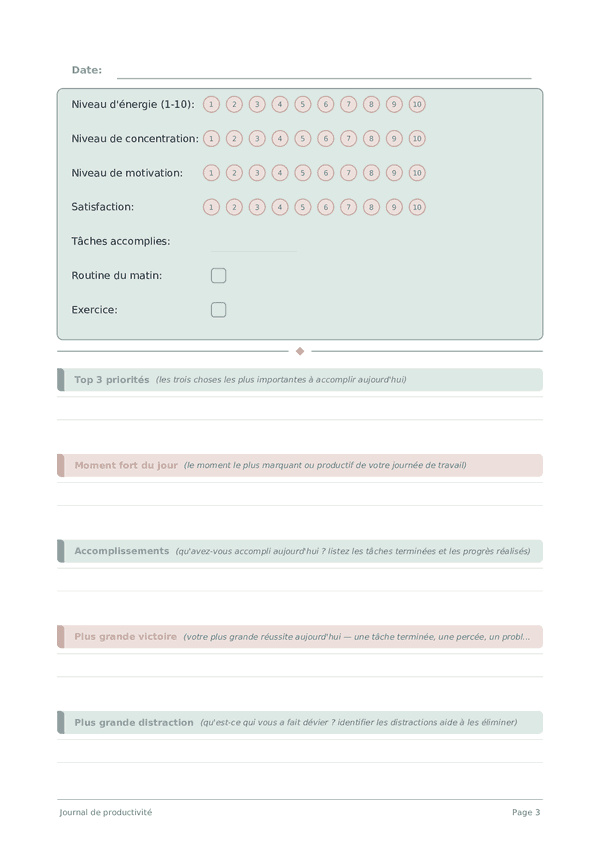
Journal de productivité
Suivez l'énergie, la concentration et le rendement quotidien pour des habitudes de haute performance
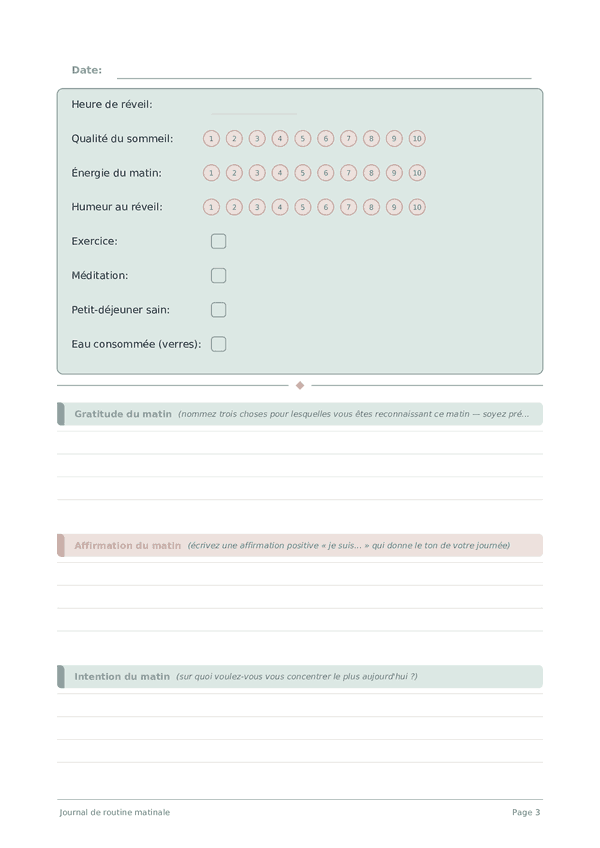
Journal de routine matinale
Commencez chaque journée avec clarté, gratitude et intention
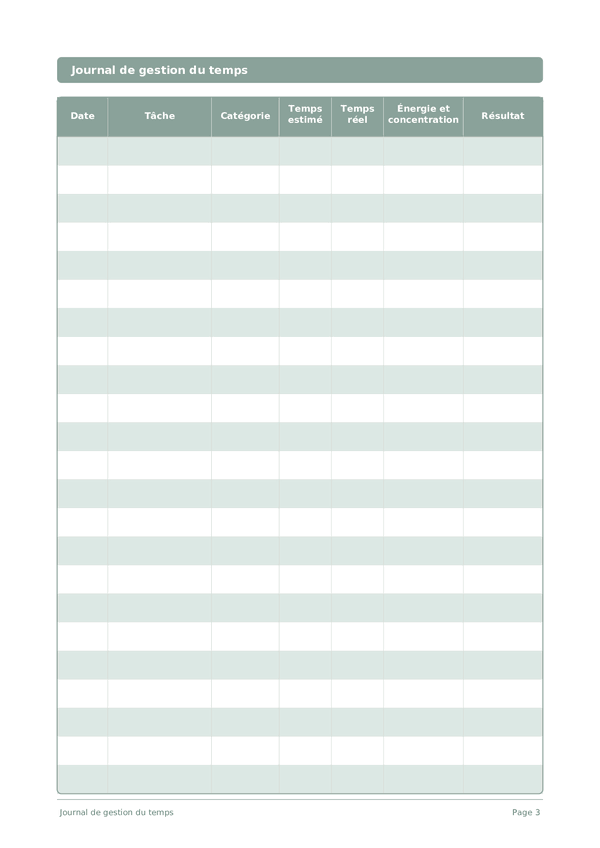
Journal de gestion du temps
Suivez les tâches, le temps et l'énergie pour reprendre le contrôle de votre journée
Bullet journal
Carnet quotidien structuré pour la prise de notes rapide
Molette pour zoomer, glisser pour déplacer