Printable Bullet journal
Carnet quotidien structuré pour la prise de notes rapide
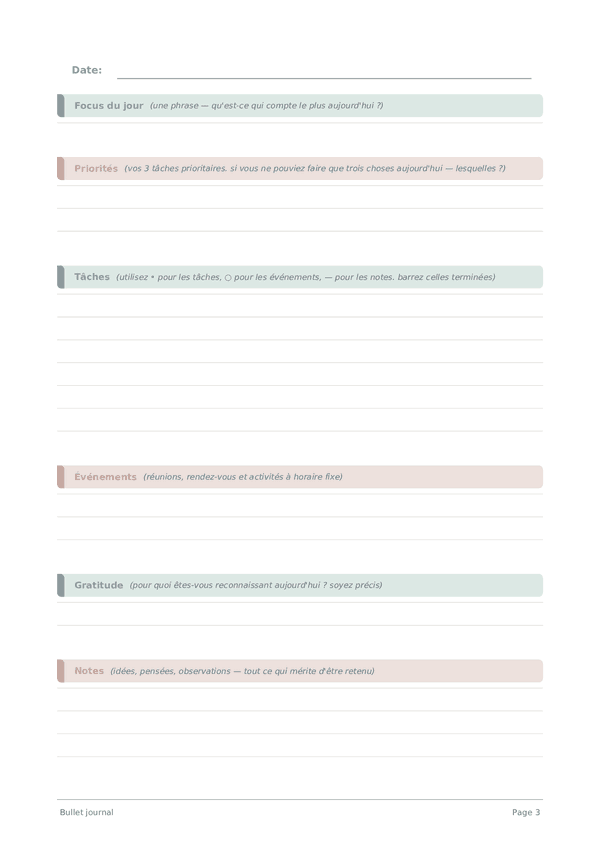
A structured daily spread based on the Bullet Journal method. Each page includes sections for focus, priorities, tasks, events, gratitude, and notes — everything you need for productive rapid logging.
Personnaliser les champs
Activez ou désactivez les champs. Cliquez sur le crayon pour renommer, ou ajoutez vos propres champs.
Avantages
Comment utiliser
Qu'est-ce que ce journal ?
A bullet journal is a rapid-logging system that combines task management, event tracking, and personal reflection in one streamlined daily entry. Using short, focused bullet points, you capture priorities, tasks, events, and thoughts without the pressure of writing full paragraphs.
This journal is for people who think in lists and bullet points — organizers, planners, and anyone who wants the benefits of journaling with the efficiency of a to-do list. Inspired by Ryder Carroll's Bullet Journal method, this digital adaptation preserves the core principles of rapid logging and intentional organization.
The bullet journal method has gained millions of practitioners because it bridges the gap between planning and reflecting. Research on task management shows that writing down tasks increases completion rates by 33%, while the gratitude and notes sections add the reflective depth that transforms a planner into a genuine journal. It is productivity and mindfulness in one practice.
Exemple rempli
Voici à quoi ressemble une entrée typique une fois remplie :
Comment remplir chaque champ
Chaque jour, vous trouverez plusieurs sections étiquetées avec des lignes pour écrire. Voici à quoi sert chaque section :
Focus du jour
Une phrase — qu'est-ce qui compte le plus aujourd'hui ?
Priorités
Vos 3 tâches prioritaires. Si vous ne pouviez faire que trois choses aujourd'hui — lesquelles ?
Tâches
Utilisez • pour les tâches, ○ pour les événements, — pour les notes. Barrez celles terminées
Événements
Réunions, rendez-vous et activités à horaire fixe
Gratitude
Pour quoi êtes-vous reconnaissant(e) aujourd'hui ? Nommez une personne, un moment ou une chose précise
Notes
Ajoutez tout contexte ou réflexion supplémentaire. Cette colonne fourre-tout est pour tout ce qui ne rentre pas ailleurs mais pourrait être utile plus tard.
Conseils pour réussir
Quand et à quelle fréquence écrire
Set up your daily spread each morning in 2\u20133 minutes: write the date, list your priorities and tasks, and note any scheduled events. Throughout the day, log tasks, events, and notes as they happen using rapid logging. Each evening, spend 3 minutes reviewing: migrate unfinished tasks, check off completions, and add a line of gratitude or reflection. Weekly, review your week and set up the next. This morning-evening-weekly rhythm is the heartbeat of the bullet journal method.
Questions fréquentes
Qu'est-ce que le rapid logging et comment ce gabarit quotidien le soutient-il ?
Le rapid logging est la technique centrale du Bullet Journal : courtes entrées sous forme de puces avec une notation simple — puces pour les tâches, cercles pour les événements, tirets pour les notes. Ce gabarit propose six sections dédiées (focus, priorités, tâches, événements, gratitude, notes) pour capturer l'information rapidement sans perdre la structure. Le résultat est une page qui fonctionne simultanément comme liste de tâches, calendrier et carnet.
En quoi ce gabarit diffère-t-il d'un carnet BuJo vierge ?
Le BuJo original nécessite de dessiner son gabarit quotidien — 5 à 10 minutes par page. Ce modèle pré-imprime les six sections essentielles : focus du jour (1 ligne), priorités (3), tâches (7), événements (3), gratitude (2), notes (5) — pour conserver la clarté de la méthode sans la mise en page. Utile quand la régularité compte plus que la personnalisation esthétique.
Pourquoi limiter les priorités à trois et les tâches à sept lignes ?
La contrainte des trois priorités impose une sélection impitoyable des tâches à fort effet de levier — un principe de l'Essentialism de Greg McKeown (Crown Business, 2014) et des 7 Habits de Covey (Free Press, 1989). Sept lignes de tâches accueillent les petits éléments du jour sans créer un excès. Ensemble, ils reproduisent le tri de la matrice d'Eisenhower : important-et-urgent en haut, le reste en dessous.
Comment fonctionne la migration des tâches avec ce gabarit ?
Raye les tâches terminées. Pour les inachevées, dessine une flèche (>) et réécris-les sur le gabarit du jour suivant — c'est la technique de migration BuJo. Examiner ce qui migre en permanence révèle les tâches pas vraiment urgentes ni importantes. Getting Things Done de David Allen (Penguin, 2001 ; révisé 2015) utilise un principe de révision hebdomadaire similaire : les éléments inachevés sont faits, abandonnés ou reportés consciemment.
La section gratitude est-elle nécessaire ou peut-on la sauter ?
Elle est optionnelle, mais mérite d'être conservée. Deux lignes de gratitude comptent parmi les interventions de psychologie positive les plus répliquées, et les associer à un gabarit de productivité équilibre orientation résultat et orientation sens. Les sauter occasionnellement est acceptable ; les abandonner entièrement transforme la page en simple to-do, perdant l'intention originale BuJo d'autosuivi attentif.
Combien de temps prend le rapid logging quotidien avec ce gabarit ?
Remplir les six sections prend généralement 5 à 10 minutes le matin et 3 à 5 minutes pour la révision du soir. La structure pré-imprimée supprime entièrement le temps de mise en page. BJ Fogg dans Tiny Habits (2019) suggère d'ancrer la pratique à une routine existante — café, trajet, coucher — pour la durabilité. Sauter la révision quotidienne est le point de défaillance le plus fréquent.
À qui ce gabarit Bullet Journal convient-il le mieux ?
Aux personnes qui aiment la méthode BuJo mais trouvent fastidieux de dessiner les gabarits quotidiens, et aux débutants qui souhaitent une structure avant la personnalisation. Les grands personnalisateurs qui traitent leur journal comme un projet artistique préféreront probablement des carnets pointillés vierges. Les sections pré-imprimées conviennent aux journées à forte charge de tâches, au freelance et à tous ceux qui reviennent du numérique au papier pour des raisons de concentration.
Puis-je le combiner avec un planificateur hebdomadaire ou mensuel séparé ?
Oui — c'est d'ailleurs ainsi que fonctionne la méthode Bullet Journal originale. Le gabarit quotidien capture l'exécution ; les journaux hebdomadaires et mensuels capturent la planification et la révision. Getting Things Done de David Allen (Penguin, 2001 ; révisé 2015) utilise des horizons similaires imbriqués : les actions quotidiennes s'agrègent en projets et objectifs. Utilise ce gabarit pour les 24 prochaines heures, un outil de révision séparé pour les horizons plus longs.
Vous aimerez aussi
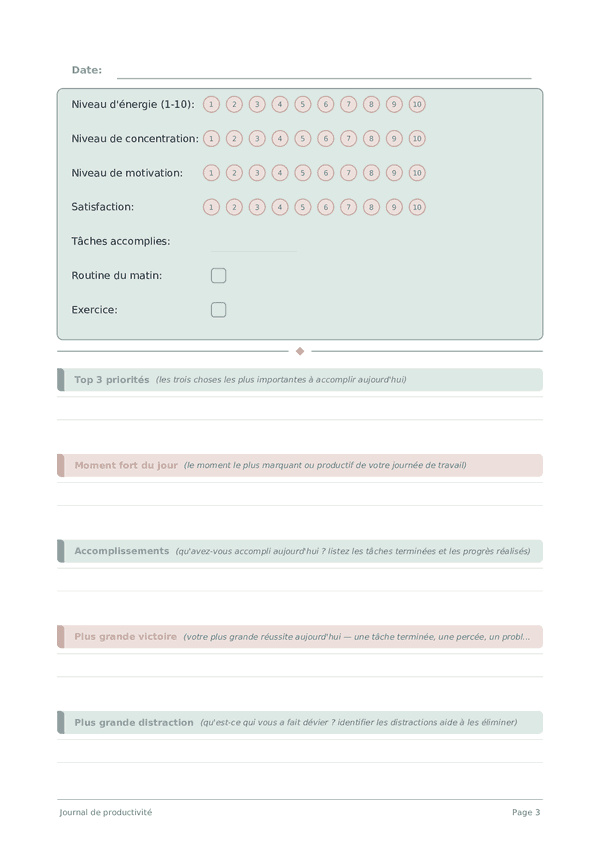
Journal de productivité
Suivez l'énergie, la concentration et le rendement quotidien pour des habitudes de haute performance
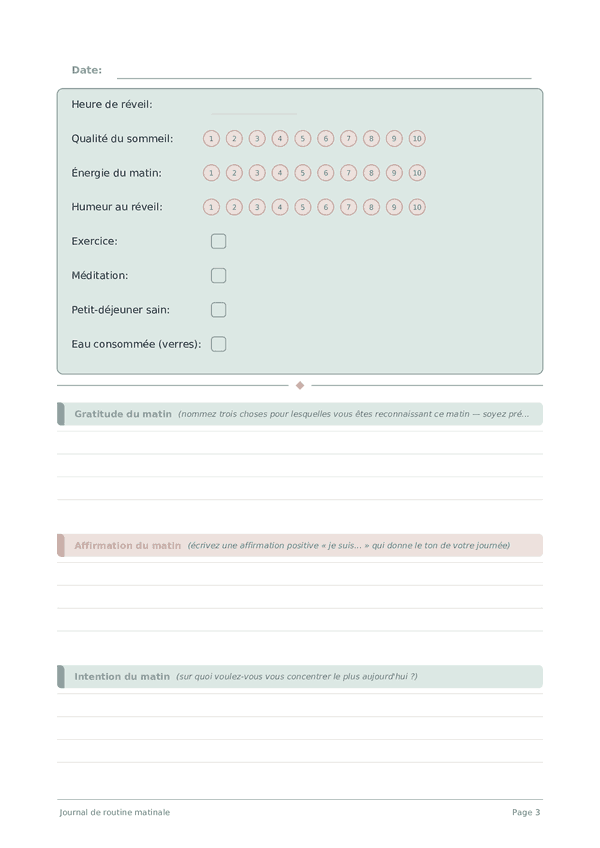
Journal de routine matinale
Commencez chaque journée avec clarté, gratitude et intention
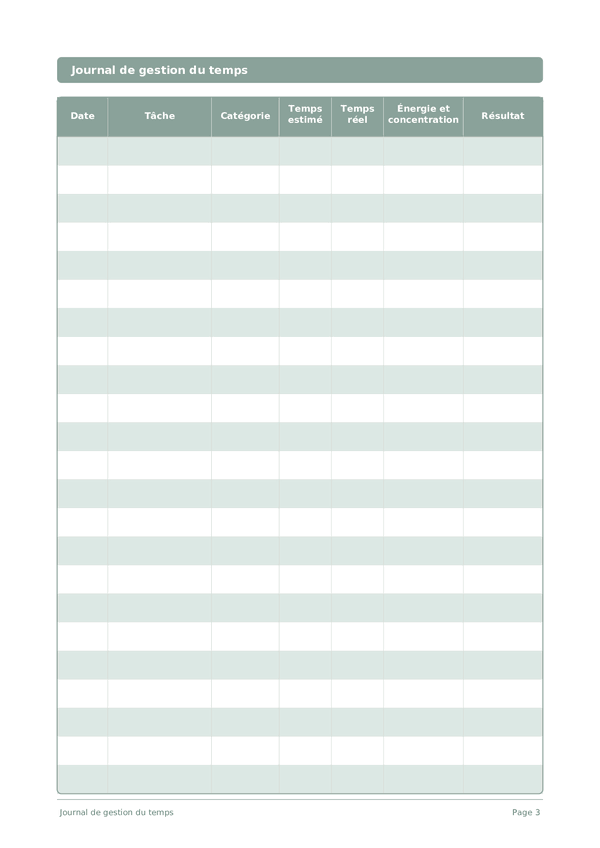
Journal de gestion du temps
Suivez les tâches, le temps et l'énergie pour reprendre le contrôle de votre journée
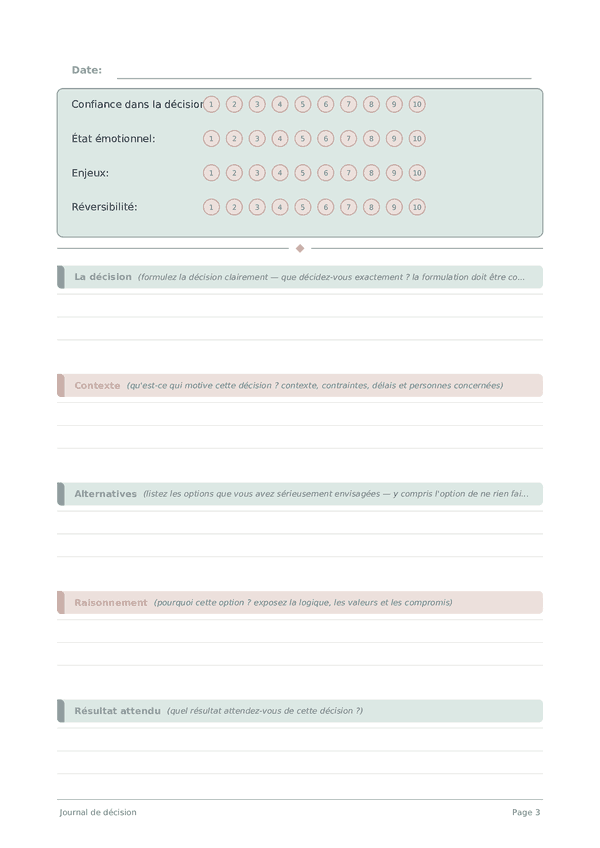
Journal de décision
Réfléchissez clairement, décidez avec confiance, apprenez de chaque choix
Molette pour zoomer, glisser pour déplacer