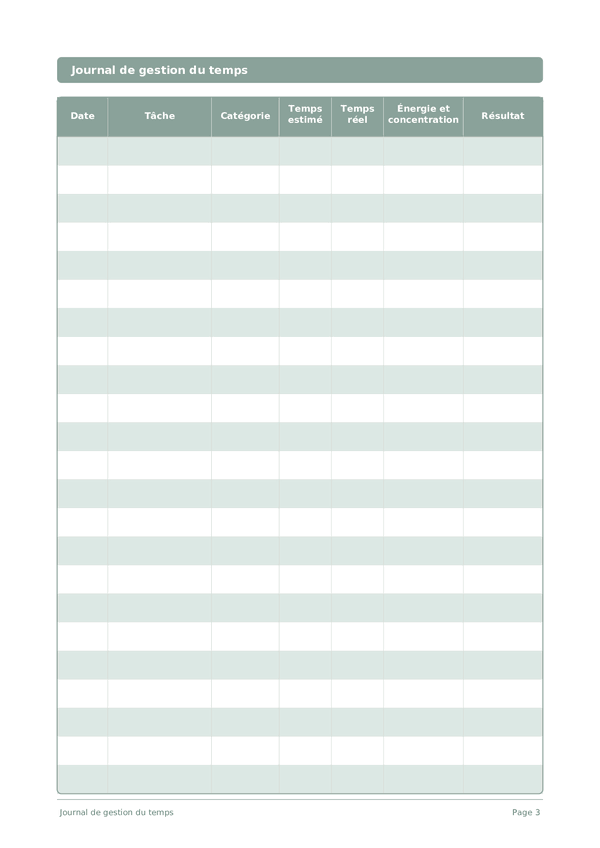
Printable Journal de gestion du temps
Suivez les tâches, le temps et l'énergie pour reprendre le contrôle de votre journée
A structured time log for recording what you work on, how long it takes, and how focused you feel. By tracking estimated vs. actual duration and energy levels, you reveal where your time really goes — and when you do your best work.
Personnaliser les champs
Activez ou désactivez les champs. Cliquez sur le crayon pour renommer, ou ajoutez vos propres champs.
Avantages
Comment utiliser
Qu'est-ce que ce journal ?
A time management journal is a structured log for tracking how you actually spend your time versus how you plan to. By recording tasks alongside their estimated and actual durations, energy required, and outcomes, you develop an increasingly accurate understanding of where your time really goes.
This journal is for anyone who feels like the day disappears without enough to show for it. It is especially powerful for freelancers, remote workers, students, and anyone whose time is self-directed. The gap between how we think we spend time and how we actually spend it is typically 30-50% — this journal closes that gap.
Time perception research reveals that humans are notoriously poor at estimating how long tasks take — a phenomenon called the "planning fallacy." By consistently recording actual durations alongside estimates, you calibrate your internal clock, improve your ability to plan realistic schedules, and identify the time sinks that silently consume your most productive hours.
Exemple rempli
Voici à quoi ressemble une entrée typique une fois remplie :
| Date | Tâche | Catégorie | Temps estimé | Temps réel | Énergie et concentration | Résultat |
|---|---|---|---|---|---|---|
| 2025-03-04 | Write Q1 strategy document | Deep work | 2 hours | 2h 45m | High energy, peak focus | Completed first draft. Quality exceeded expectations. Best to schedule deep work before 11am. |
| 2025-03-04 | Email triage and responses | Admin | 30 min | 55 min | Low energy needed | Cleared inbox but took longer than expected. 3 emails required research. Batch email at set times. |
| 2025-03-04 | Design mockup review | Collaboration | 1 hour | 1h 20m | Medium energy, attention to detail | Approved 4 of 6 mockups. Remaining 2 need color revisions. Faster in person than async. |
| 2025-03-04 | Team 1-on-1 meeting | Management | 30 min | 45 min | Medium energy, empathetic listening | Productive conversation about career goals. Went over time but worth it. |
| 2025-03-04 | Social media scrolling | Distraction | 0 | 35 min | Zero — mindless | Unplanned. Noticed I reach for phone when transitioning between tasks. Set up app timer. |
Comment remplir chaque champ
Chaque page est un tableau avec des colonnes. Remplissez une ligne par entrée. Voici à quoi sert chaque colonne :
Date
Inscrivez la date du jour. Cela ancre votre entrée dans le temps et aide lors de la relecture ultérieure.
Tâche
Catégorie
Attribuez une catégorie à cette entrée (par ex., alimentation, transport, loisirs). Des catégories cohérentes facilitent l'analyse de vos données.
Temps estimé
Temps réel
Énergie et concentration
Résultat
Que s'est-il réellement passé au final ?
Conseils pour réussir
Quand et à quelle fréquence écrire
Log each task as you start and finish it throughout the day \u2014 real-time tracking is far more accurate than end-of-day reconstruction. At the end of the day, review your log and note the gap between estimated and actual time for each task. Weekly, calculate total time spent per category to see where your hours actually go. Monthly, use this data to restructure your schedule, placing high-focus work during your proven peak hours.
Questions fréquentes
Que capture la structure à sept colonnes de ce journal de gestion du temps ?
Chaque ligne enregistre date, tâche, catégorie, durée estimée, durée réelle, énergie/concentration et résultat — 14 lignes par page. Cela reflète la discipline de suivi de The Effective Executive de Peter Drucker (HarperBusiness, 1967), où Drucker insistait que les dirigeants doivent d'abord savoir où va réellement leur temps avant de pouvoir le gérer. Les colonnes estimé/réel exposent le biais de planification dans ton propre travail.
En quoi consigner la durée estimée et réelle est-il utile en pratique ?
La plupart des gens sous-estiment systématiquement la durée des tâches — c'est le biais de planification bien documenté dans les travaux sur le jugement de Kahneman. Suivre les deux colonnes sur deux à quatre semaines construit la calibration : tu découvres, par exemple, que les réunions « d'une heure » durent 90 minutes préparation comprise. Cal Newport dans Deep Work (Grand Central, 2016) note que cette métacognition, pas les données brutes, est ce qui améliore les futurs plannings.
En quoi diffère-t-il d'applications comme Toggl ou Clockify ?
Les apps automatisent la mesure ; le journal force une réflexion délibérée. Écrire à la main la colonne énergie/concentration et le résultat te fait remarquer quand tu as travaillé à faible capacité, ce qui a bloqué, et ce à reporter — contexte que les apps ne peuvent pas capturer. Cal Newport dans Deep Work (Grand Central, 2016) argue que cette couche métacognitive, pas les données de temps brutes, est ce qui convertit le suivi en meilleurs plannings.
Quelle granularité de catégories est la bonne — large ou étroite ?
Utilise cinq à huit catégories : trop peu cache les schémas, trop fragmente les données. Exemples : travail profond, admin, réunions, communication, apprentissage, repos profond. The 7 Habits de Covey (Free Press, 1989) et la matrice d'Eisenhower qu'il a popularisée suggèrent aussi de trier par importance et urgence. Après deux semaines, les totaux hebdomadaires par catégorie révèlent où vont réellement les heures versus où tu supposais.
Combien de temps avant que les schémas du journal soient utiles ?
Deux à quatre semaines de consignation régulière font émerger les fenêtres de pic d'énergie et les types de tâches surestimés. Mark, Gudith et Klocke (2008, CHI conference) ont constaté que le changement de tâche coûte environ 23 minutes de récupération — la colonne énergie/concentration du journal te permet de voir comment les journées fragmentées corrèlent avec des scores bas. Dès la troisième semaine, tu as assez de données pour remodeler ton calendrier.
Dois-je consigner chaque tâche ou seulement les principales ?
Consigne les blocs de travail significatifs — tout ce qui dure 15 minutes ou plus — et regroupe les vraiment petits éléments sous « admin » ou « communication ». Consigner chaque email de deux minutes détruit le système ; manquer des blocs de 90 minutes en annule l'intérêt. Getting Things Done de David Allen (Penguin, 2001 ; révisé 2015) utilise une règle des deux minutes similaire : les micro-tâches se font, ne se consignent pas.
Quelle est l'erreur la plus fréquente avec ce journal ?
Consigner les tâches uniquement après les avoir finies, de mémoire, plutôt qu'écrire les estimations avant de commencer. Sans vraie prédiction, tu ne peux pas mesurer le biais de planification ni améliorer la calibration. La colonne « durée estimée » doit être remplie avant de commencer. Sophie Leroy (2009, Organizational Behavior and Human Decision Processes, 109(2)) sur l'attention résiduelle suggère aussi de noter le contexte avant de changer de tâche.
Le journal peut-il me montrer mes meilleures heures pour le travail profond ?
Oui — c'est son utilisation la plus forte. Croise les évaluations élevées d'énergie/concentration avec l'heure du jour et le type de tâche. En deux à trois semaines, ta fenêtre de concentration de meilleure qualité devient évidente. Cal Newport dans Deep Work (Grand Central, 2016) recommande de planifier le travail cognitivement exigeant dans cette fenêtre et de la protéger des réunions. Les données, pas les conseils génériques, te disent si tu travailles mieux le matin ou l'après-midi.
Vous aimerez aussi
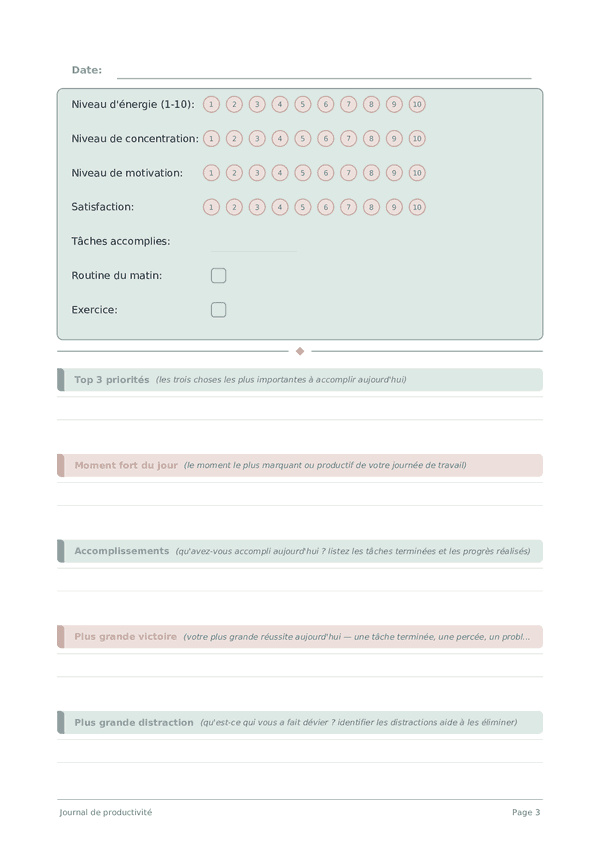
Journal de productivité
Suivez l'énergie, la concentration et le rendement quotidien pour des habitudes de haute performance
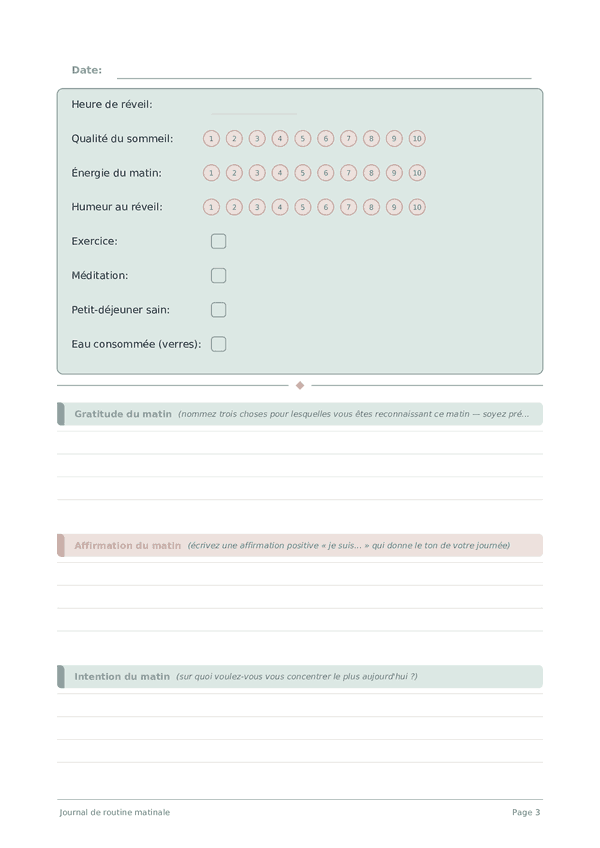
Journal de routine matinale
Commencez chaque journée avec clarté, gratitude et intention
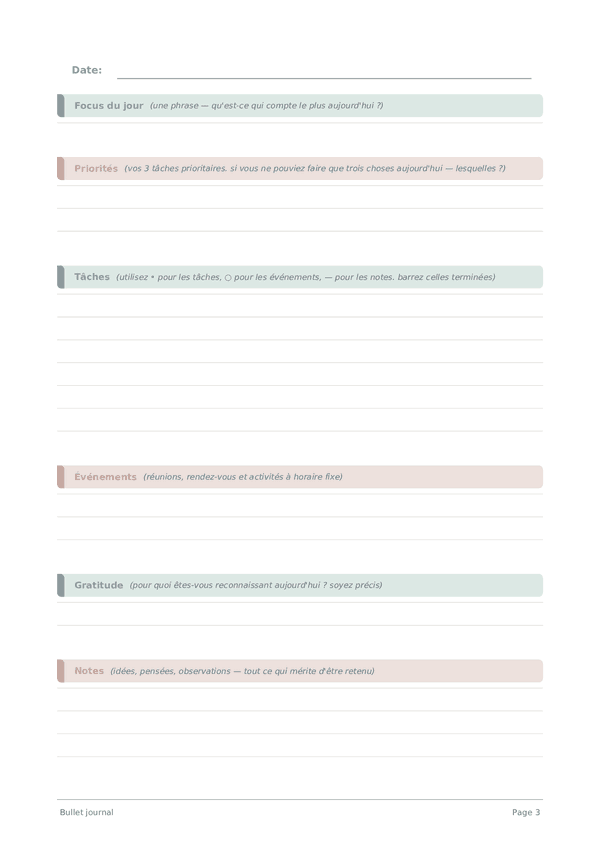
Bullet journal
Carnet quotidien structuré pour la prise de notes rapide
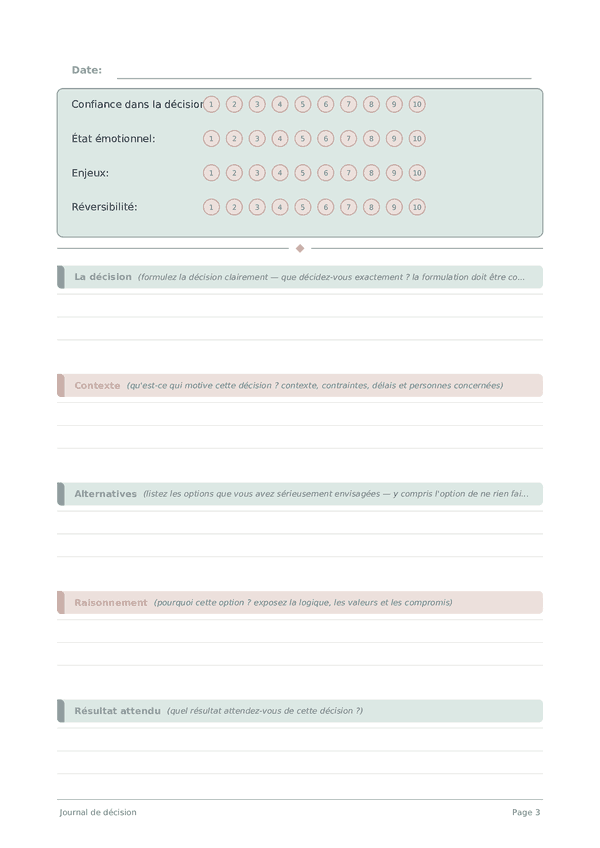
Journal de décision
Réfléchissez clairement, décidez avec confiance, apprenez de chaque choix
Molette pour zoomer, glisser pour déplacer