Printable Journal de décision
Réfléchissez clairement, décidez avec confiance, apprenez de chaque choix
A structured decision log that captures your reasoning, confidence, emotional state, and outcome for every important choice. Revisiting past entries reveals patterns, reduces hindsight bias, and sharpens your judgment over time.
Personnaliser les champs
Activez ou désactivez les champs. Cliquez sur le crayon pour renommer, ou ajoutez vos propres champs.
Avantages
Comment utiliser
Qu'est-ce que ce journal ?
A decision journal is a structured practice for recording important decisions at the moment you make them — before you know how they turn out. By capturing your reasoning, alternatives considered, emotional state, and expected outcomes, you create an honest record that lets you evaluate your decision-making process over time, separate from results.
This journal is for leaders, entrepreneurs, investors, and anyone who makes consequential decisions and wants to improve their judgment. It is based on the principle that good decisions can have bad outcomes and bad decisions can have good outcomes — the only way to improve is to evaluate the process, not just the result.
Decision science research, popularized by Annie Duke and Daniel Kahneman, shows that "resulting" — judging decisions solely by their outcomes — is one of the biggest obstacles to better judgment. This journal creates a time-stamped record of your reasoning that you can revisit months later, helping you distinguish between genuine skill and luck in your decision-making.
Exemple rempli
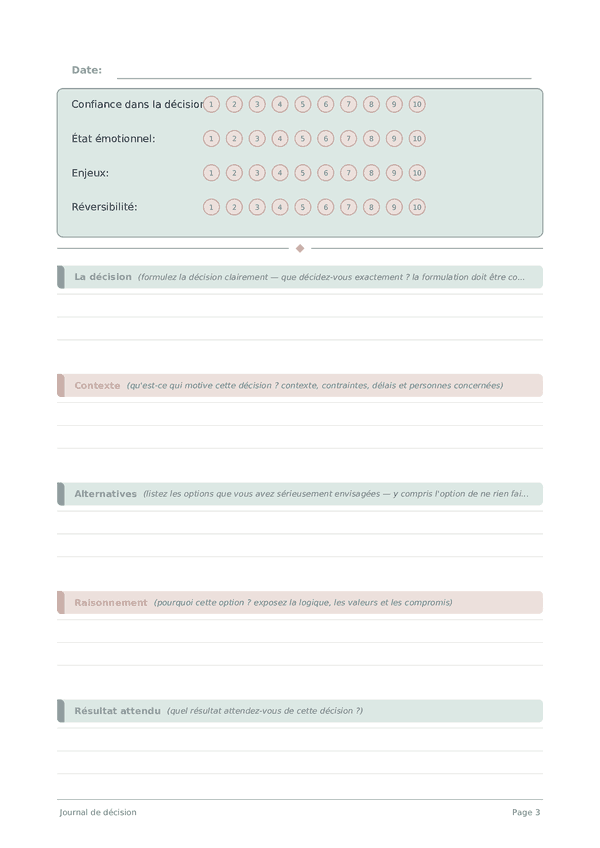
Voici à quoi ressemble une entrée typique une fois remplie :
Comment remplir chaque champ
Le haut de chaque page comporte des champs à remplissage rapide (évaluations, cases à cocher, chiffres). En dessous se trouve une section lignée pour écrire. Voici ce que signifie chaque champ :
Confiance dans la décision
À quel point êtes-vous confiant que c'est le bon choix ? Notez de 1 (très incertain) à 10 (certain)
État émotionnel
Avez-vous les idées claires en ce moment ? Notez de 1 (dispersé) à 10 (très lucide)
Enjeux
Quelle est l'importance des conséquences si cela tourne mal ? Notez de 1 (mineur) à 10 (bouleversant)
Réversibilité
Pouvez-vous facilement changer de cap si nécessaire ? Notez de 1 (irréversible) à 10 (facilement réversible)
La décision
Formulez la décision clairement — que décidez-vous exactement ? La formulation doit être compréhensible même pour un enfant
Contexte
Qu'est-ce qui motive cette décision ? Contexte, contraintes, délais et personnes concernées
Alternatives
Listez les options que vous avez sérieusement envisagées — y compris l'option de ne rien faire
Raisonnement
Pourquoi cette option ? Exposez la logique, les valeurs et les compromis
Résultat attendu
Quel résultat attendez-vous de cette décision ?
Résultat
Que s'est-il réellement passé au final ?
Leçons apprises
Avec le recul : votre raisonnement était-il juste ? Que feriez-vous différemment la prochaine fois ?
Conseils pour réussir
Quand et à quelle fréquence écrire
Write an entry for every significant decision: career moves, large purchases, relationship choices, health changes, and strategic pivots. Minor daily decisions do not need logging, but any choice you might second-guess later deserves an entry. At the decision point, spend 10\u201315 minutes writing your reasoning and confidence. Set calendar reminders to revisit at 30, 90, and 365 days. Quarterly, review your decision history to identify recurring biases.
Questions fréquentes
Que capture le Journal des décisions au-delà de la décision elle-même ?
Le tracker évalue la confiance, l'état émotionnel, les enjeux et la réversibilité (chacun sur 1-10). La section écrite capture la décision, le contexte, les alternatives considérées, le raisonnement, le résultat attendu, le résultat réel et les leçons tirées. Cette structure t'oblige à écrire le raisonnement avant de connaître le résultat — attaquant directement le biais rétrospectif, où la mémoire réécrit la logique pré-décisionnelle pour correspondre à ce qui s'est passé.
Pourquoi évaluer la réversibilité et les enjeux séparément ?
Jeff Bezos a popularisé la distinction porte à sens unique/porte à double sens pour des raisons similaires : les décisions irréversibles à enjeux élevés méritent beaucoup plus de délibération que les décisions réversibles à faibles enjeux. Évaluer la réversibilité (1-10) et les enjeux (1-10) prévient la sur-réflexion des choix triviaux et la sous-réflexion des choix majeurs. The Effective Executive de Drucker (HarperBusiness, 1967) soulignait qu'une décision efficace adapte la profondeur de la délibération à ses conséquences.
En quoi diffère-t-il de simples notes sur des choix ?
Les notes informelles dérivent vers la justification ; ce gabarit impose alternatives, résultats attendus et évaluations de confiance — les éléments que tu veux le plus comparer à la réalité plus tard. Les champs résultat attendu et résultat créent une boucle de rétroaction que ton cerveau ne peut pas falsifier rétrospectivement. Sans cette structure, tu te souviens d'avoir eu plus raison que tu ne l'avais eu — biais documenté dans la recherche sur le jugement.
À quelle fréquence écrire des entrées — pour chaque décision ou seulement les grandes ?
Utilise-le pour toute décision notée 5 ou plus en enjeux ou réversibilité. Consigner chaque choix de café détruit le signal ; consigner seulement les évidentes rate les décisions moyennes où la calibration s'améliore le plus. Essentialism de McKeown (Crown Business, 2014) suggère de traiter la capacité décisionnelle comme finie — réserve le journal aux décisions qui méritent une trace documentée du raisonnement.
Quel est l'intérêt d'évaluer l'état émotionnel avant de décider ?
L'état émotionnel façonne la tolérance au risque et la clarté. Un état émotionnel de 3/10 combiné à des enjeux élevés est un signal fort de reporter la décision si possible. Cette vérification anti-biais apparaît dans toute la littérature sur le jugement. Le journal la rend explicite : si tu te notes 1-3, l'entrée elle-même devient un signal — dormir dessus, rassembler plus de données, ou chercher un avis avant de s'engager.
Combien de temps pour voir une amélioration de la prise de décision ?
La calibration s'améliore de façon mesurable après environ 20 à 30 décisions consignées avec les résultats remplis, typiquement trois à six mois pour les choix à enjeux moyens. La boucle de rétroaction — comparer résultat attendu et résultat — est ce qui entraîne le jugement. Locke & Latham (2002, American Psychologist, 57(9)) ont montré que le retour d'information améliore la performance des objectifs ; la même chose s'applique à la qualité des décisions.
Quelle est l'erreur la plus fréquente avec un journal des décisions ?
Ne jamais revenir remplir les champs résultat et leçons tirées. Sans l'entrée post-résultat, le journal devient un registre unilatéral d'optimisme, pas un outil de calibration. Mets une rappel calendrier deux semaines après les entrées importantes. La section leçons tirées est l'endroit où le jugement personnel s'améliore réellement — la sauter supprime toute la boucle de croissance pour laquelle le journal a été conçu.
Ce journal peut-il aider pour des décisions d'équipe ou d'entreprise, pas seulement personnelles ?
Oui. La même structure sous-tend les pratiques de révision des décisions dans MIT Sloan Management Review et Harvard Business Review sur la qualité des décisions managériales. Pour une utilisation en équipe, remplis alternatives et raisonnement collaborativement avant de s'engager, puis examine les résultats en rétrospective. Les quatre évaluations donnent au groupe un vocabulaire partagé pour la confiance et les enjeux.
Vous aimerez aussi
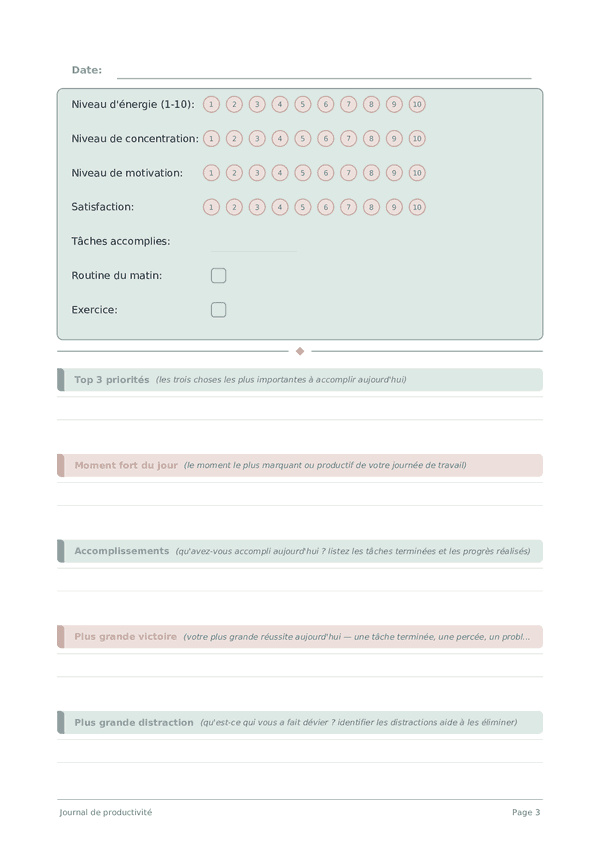
Journal de productivité
Suivez l'énergie, la concentration et le rendement quotidien pour des habitudes de haute performance
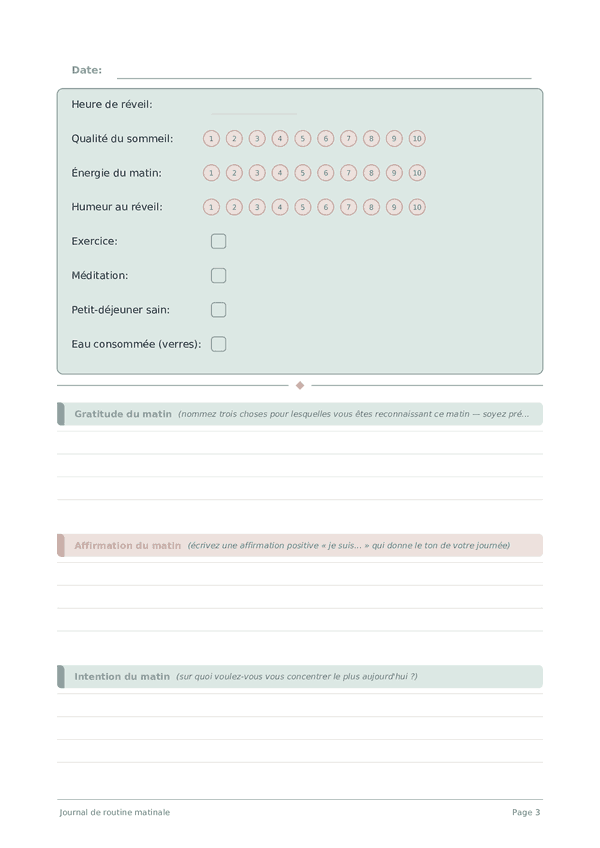
Journal de routine matinale
Commencez chaque journée avec clarté, gratitude et intention
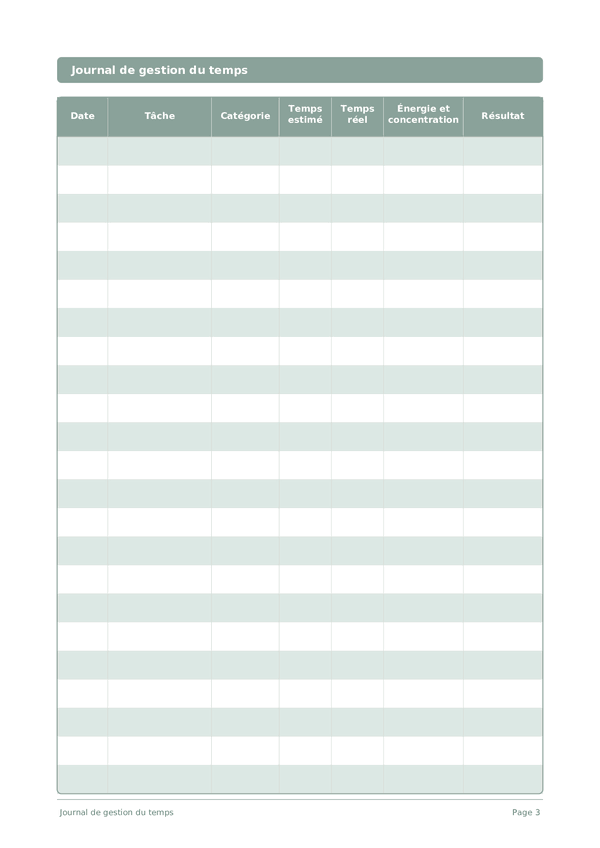
Journal de gestion du temps
Suivez les tâches, le temps et l'énergie pour reprendre le contrôle de votre journée
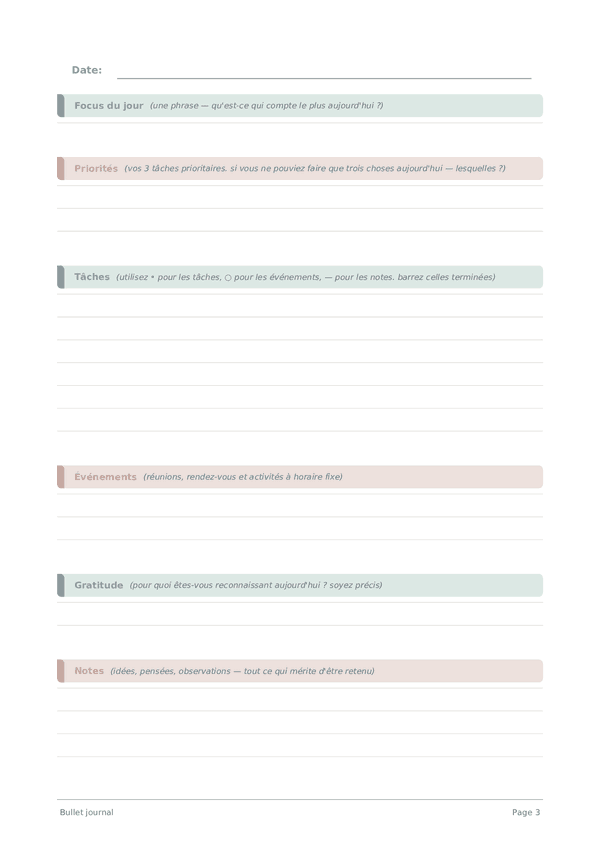
Bullet journal
Carnet quotidien structuré pour la prise de notes rapide
Molette pour zoomer, glisser pour déplacer