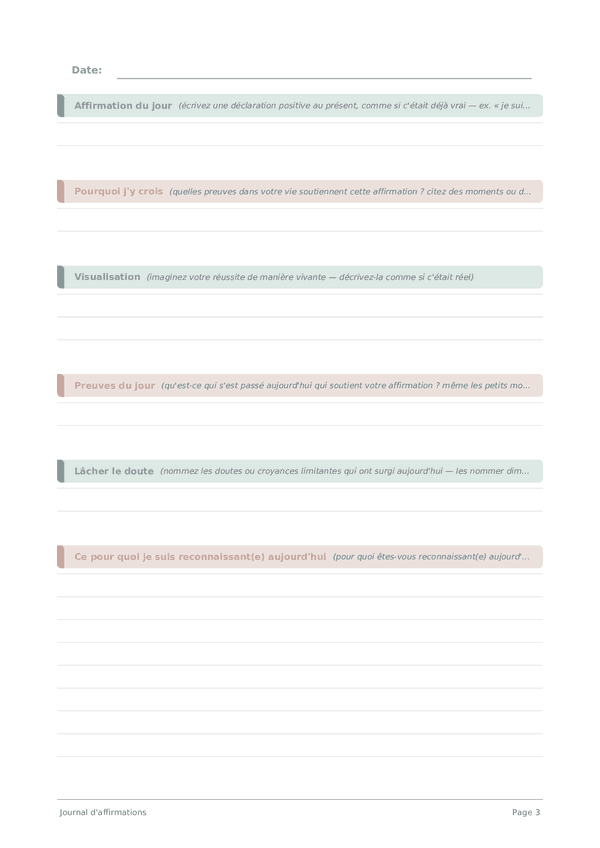
Printable Journal d'affirmations
Pratique quotidienne d'affirmations et de croyances positives
Reinforce positive beliefs and rewire your mindset with daily affirmations. Visualize your goals, gather evidence for your beliefs, and release limiting doubts through guided reflection.
Personnaliser les champs
Activez ou désactivez les champs. Cliquez sur le crayon pour renommer, ou ajoutez vos propres champs.
Qu'est-ce que ce journal ?
An affirmation journal is a daily practice of consciously reprogramming your inner dialogue through positive, present-tense statements about yourself and your life. Rooted in cognitive behavioral therapy and neuroscience, affirmations work by gradually replacing negative thought patterns with constructive ones — not through denial, but through evidence-based self-belief.
Research shows that self-affirmation activates the brain's reward centers and reduces the stress response. The key to effective affirmations is not just repeating words, but building genuine belief through evidence and visualization. That is exactly what this journal's structure facilitates.
Each day, you write your chosen affirmation, explain why you believe it, visualize it in action, find real evidence from your day, practice releasing doubt, and anchor it all in gratitude. This six-step process transforms affirmations from empty mantras into deeply felt truths that reshape how you see yourself.
Exemple rempli
Voici à quoi ressemble une entrée typique une fois remplie :
Comment remplir chaque champ
Chaque jour, vous trouverez plusieurs sections étiquetées avec des lignes pour écrire. Voici à quoi sert chaque section :
Affirmation du jour
Écrivez une déclaration positive au présent, comme si c'était déjà vrai — ex. « Je suis confiant(e) et capable »
Pourquoi j'y crois
Expliquez pourquoi votre affirmation est vraie. Listez les preuves de votre vie qui la soutiennent. Cela transforme les affirmations de mots vides en croyances fondées.
Visualisation
Imaginez votre réussite de manière vivante — décrivez-la comme si c'était réel
Preuves du jour
Qu'est-ce qui s'est passé aujourd'hui qui soutient votre affirmation ? Même les petits moments comptent
Lâcher le doute
Nommez les doutes ou croyances limitantes qui ont surgi aujourd'hui — les nommer diminue leur emprise
Ce pour quoi je suis reconnaissant(e) aujourd'hui
Listez 1 à 3 choses pour lesquelles vous êtes reconnaissant aujourd'hui. Elles peuvent être grandes ou minuscules — un bon repas, un mot gentil, du soleil. Le journal de gratitude est l'une des pratiques de bien-être les plus soutenues scientifiquement.
Conseils pour réussir
Quand et à quelle fréquence écrire
Write every morning as part of your first-10-minutes routine. Morning affirmation practice primes your reticular activating system (the brain's filter) to notice evidence supporting your affirmation throughout the day. In the evening, fill in the 'evidence today' section to close the loop. This morning-and-evening rhythm is what makes affirmation practice truly transformative.
Questions fréquentes
Les affirmations fonctionnent-elles selon la recherche ?
La théorie de l'auto-affirmation (Steele, 1988 ; Cohen et Sherman, 2014, Annual Review of Psychology, 65) montre qu'affirmer des valeurs fondamentales réduit les réponses défensives et améliore les performances sous menace. Cependant, Wood, Perunovic et Lee (2009, Psychological Science, 20(7)) ont constaté que des déclarations de soi trop positives (« je suis une personne aimable ») produisaient l'effet inverse pour les personnes ayant une faible estime de soi. Adapte l'affirmation à ce que tu peux crédiblement accepter.
Comment « pourquoi j y crois » améliore-t-il une affirmation ?
Cela ancre la déclaration dans des preuves plutôt que dans la pensée wishful. Wood et al. (2009, Psychological Science, 20(7)) ont constaté que les affirmations positives génériques échouaient pour les participants ayant une faible estime de soi en partie parce que l'écart entre la déclaration et le sentiment ressenti créait de la résistance. Deux lignes de preuves personnelles — de vraies raisons que tu peux accepter — ferment cet écart.
Que mettre dans « preuves aujourd hui » ?
Écris le moment spécifique d'aujourd'hui qui a soutenu l'affirmation. Cela applique la technique de collecte de preuves de la TCC — Beck (Cognitive Therapy and the Emotional Disorders, 1976) et les manuels TCC contemporains utilisent la collecte de preuves pour affaiblir les croyances de base négatives. Deux lignes pour une observation, pas une liste. Répété quotidiennement, cela construit une base de preuves que ton esprit ne peut facilement rejeter.
Les affirmations doivent-elles être au présent ?
Oui, mais seulement si crédibles. La formulation « je suis » s'appuie sur la recherche sur la motivation basée sur l'identité (Oyserman, 2009, Journal of Consumer Psychology, 19(3)) mais Wood et al. (2009, Psychological Science, 20(7)) ont montré que les déclarations « je suis » grandioses produisent l'effet inverse quand elles sont crues fausses. Mieux : « je suis le genre de personne qui se présente de façon cohérente » — vérifiable à travers tes preuves aujourd hui.
La visualisation n'est-elle que de la pensée wishful ?
La visualisation de résultats purs peut réduire l'effort. Pham et Taylor (1999, Personality and Social Psychology Bulletin, 25(2)) ont montré que les étudiants qui visualisaient l'atteinte d'un objectif performaient moins bien que ceux qui visualisaient le processus. Utilise la section de visualisation pour le processus — ce que tu feras, comment tu agiras — pas seulement le prix. C'est la version que la recherche soutient.
En quoi « libérer le doute » est-il différent de la suppression ?
La suppression cache ; libérer reconnaît et laisse passer. Gross (2002, Psychophysiology, 39(3)) a constaté que la suppression expressive aggrave les résultats émotionnels. L'ACT (Hayes, Strosahl, Wilson) et la TCD (Linehan) traitent toutes deux l'acknowledgment du doute comme préférable à le combattre. Deux lignes suffisent pour nommer clairement le doute et le poser consciemment, sans prétendre qu'il n'existe pas.
Quelle fréquence et quelle durée ?
Quotidien mais bref. Cohen et al. (2009, Science, 324(5925)) ont montré que de brèves interventions structurées d'auto-affirmation produisaient des effets durant des années. Le format compact en six sections prend des minutes quand il est honnête. Sherman et al. (2013, JPSP, 104(4)) ont constaté que les effets d'affirmation se renforcent avec la répétition alignée sur des menaces pertinentes — quotidien pendant les périodes de stress, moins fréquent en temps stables.
Les affirmations aideront-elles avec une faible estime de soi ?
Avec soin. Wood et al. (2009, Psychological Science, 20(7)) ont montré que pour les personnes ayant une faible estime de soi, répéter des déclarations positives auxquelles elles ne croyaient pas aggravait l'humeur. Les champs « pourquoi j y crois » et « preuves aujourd hui » sont protecteurs : ils ancrent les affirmations dans la réalité. Si les problèmes d'estime de soi sont persistants, consulte un professionnel de santé mentale agréé — la thérapie de schéma et la TCC traitent les croyances de base directement.
Vous aimerez aussi
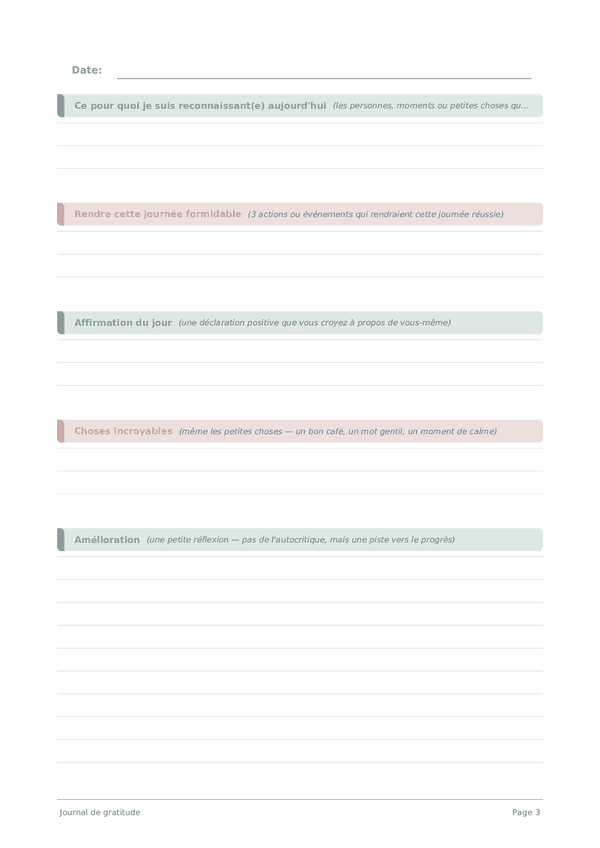
Journal de gratitude
Cultivez la reconnaissance et la positivité au quotidien
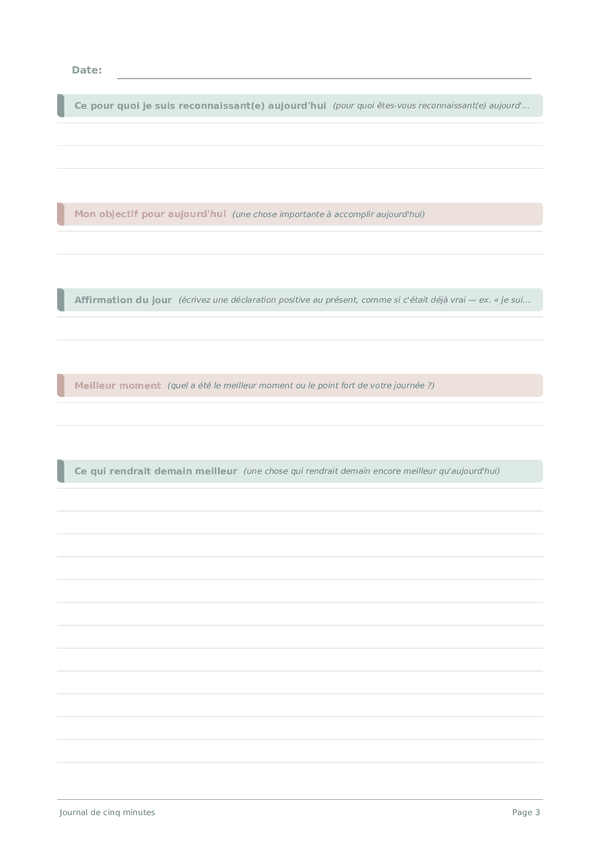
Journal de cinq minutes
Journal quotidien de gratitude et de réflexion en cinq minutes
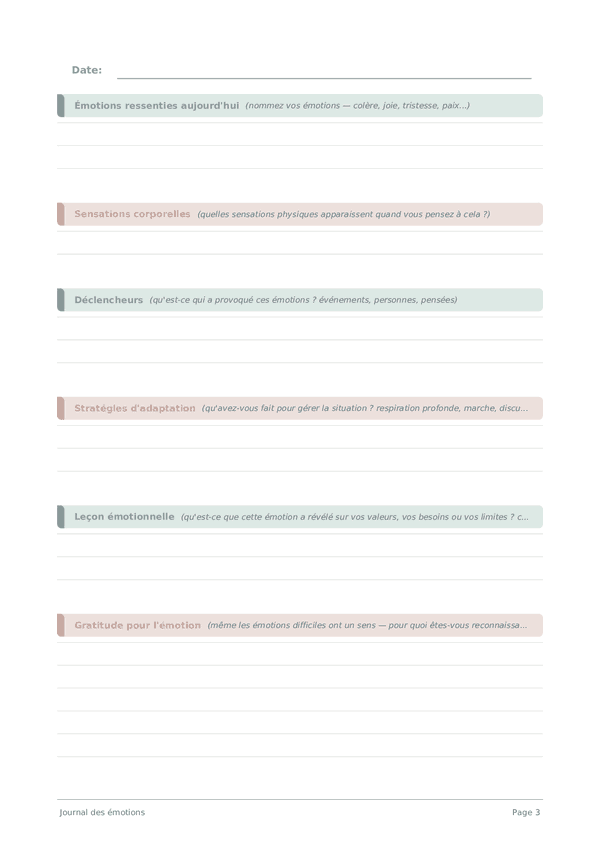
Journal des émotions
Comprenez, traitez et grandissez à travers vos émotions
Suivi d'habitudes
Construisez de meilleures habitudes jour après jour
Molette pour zoomer, glisser pour déplacer