Printable Suivi d'habitudes
Construisez de meilleures habitudes jour après jour
Track up to five custom habits plus water intake and exercise in a clean grid layout. Visualize your streaks and build momentum toward lasting behavior change.
Personnaliser les champs
Activez ou désactivez les champs. Cliquez sur le crayon pour renommer, ou ajoutez vos propres champs.
Avantages
Comment utiliser
Qu'est-ce que ce journal ?
A habit tracker is a visual accountability tool that turns abstract intentions into concrete daily actions. By marking off habits each day on a grid, you create a chain of consistency that becomes increasingly motivating to maintain — a concept known as the "don't break the chain" method, popularized by Jerry Seinfeld.
Habit tracking works because it leverages several psychological principles at once: visual progress creates dopamine rewards, the fear of breaking a streak provides gentle accountability, and the act of marking a checkbox shifts your identity from "someone trying to build a habit" to "someone who does this every day."
This tracker lets you monitor up to five custom habits alongside water intake, exercise, sleep hours, and morning/evening routines. The weekly grid format gives you an instant visual snapshot of your consistency, making it easy to spot which habits stick and which need a different approach.
Exemple rempli
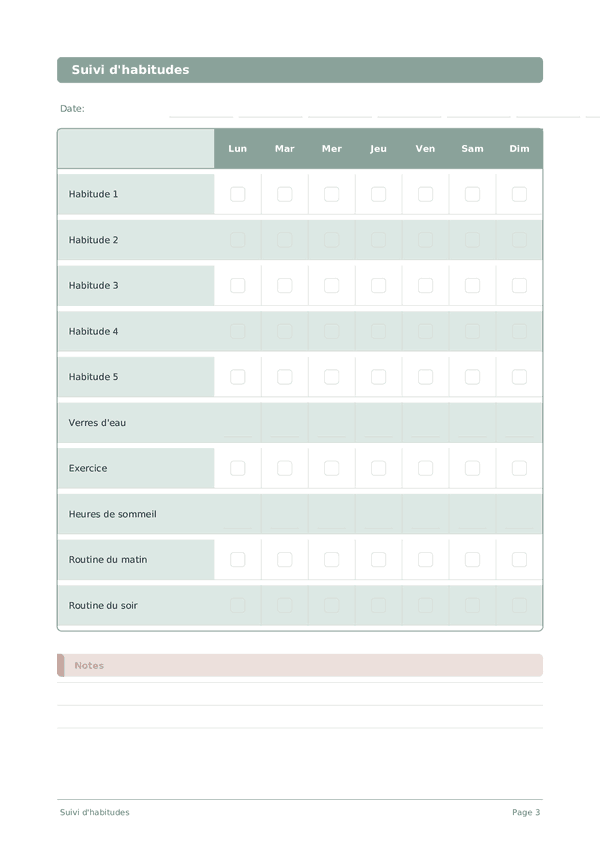
Voici à quoi ressemble une entrée typique une fois remplie :
| Mon | Tue | Wed | Thu | Fri | Sat | Sun | |
|---|---|---|---|---|---|---|---|
| Habitude 1 | ✓ | ✓ | ✓ | ✓ | ✓ | ✓ | |
| Habitude 2 | ✓ | ✓ | ✓ | ✓ | ✓ | ||
| Habitude 3 | ✓ | ✓ | ✓ | ✓ | ✓ | ||
| Habitude 4 | ✓ | ✓ | ✓ | ✓ | ✓ | ✓ | |
| Habitude 5 | ✓ | ✓ | ✓ | ✓ | ✓ | ||
| Verres d'eau | 8 | 6 | 7 | 8 | 5 | 7 | 9 |
| Exercice | ✓ | ✓ | ✓ | ✓ | |||
| Heures de sommeil | 7.5 | 6 | 7 | 8 | 6.5 | 8 | 9 |
| Routine du matin | ✓ | ✓ | ✓ | ✓ | ✓ | ||
| Routine du soir | ✓ | ✓ | ✓ | ✓ | ✓ |
Comment remplir chaque champ
Chaque page est une grille hebdomadaire. Les lignes sont vos éléments de suivi, les colonnes sont les jours de la semaine. Voici ce que signifie chaque élément :
Habitude 1
Cochez cette habitude pour la journée. La régularité est plus importante que la perfection — même un accomplissement partiel compte.
Habitude 2
Cochez cette habitude pour la journée. La régularité est plus importante que la perfection — même un accomplissement partiel compte.
Habitude 3
Cochez cette habitude pour la journée. La régularité est plus importante que la perfection — même un accomplissement partiel compte.
Habitude 4
Cochez cette habitude pour la journée. La régularité est plus importante que la perfection — même un accomplissement partiel compte.
Habitude 5
Cochez cette habitude pour la journée. La régularité est plus importante que la perfection — même un accomplissement partiel compte.
Verres d'eau
Suivez votre consommation d'eau quotidienne. La plupart des gens ont besoin de 6 à 8 verres. Cocher les verres tout au long de la journée vous aide à rester hydraté.
Exercice
Cochez si vous avez fait de l'exercice aujourd'hui. Même une marche de 10 minutes compte. L'objectif est de prendre conscience de vos habitudes d'activité.
Heures de sommeil
Notez combien d'heures vous avez réellement dormi (pas seulement le temps passé au lit). Suivre cela en parallèle de l'humeur et de l'énergie révèle souvent des connexions puissantes.
Routine du matin
Avez-vous suivi votre routine matinale aujourd'hui ? Notez ce que vous avez fait ou sauté
Routine du soir
Conseils pour réussir
Quand et à quelle fréquence écrire
Mark off each habit as you complete it throughout the day. For morning habits, check them off right after your morning routine. For evening habits, fill them in before bed. On Sunday evening, take 5 minutes to review the whole week — which habits stuck, which slipped, and why. After a month, replace any habit you've mastered with a new challenge.
Questions fréquentes
Combien d'habitudes suivre sur cette grille ?
Commence avec une à trois, pas tous les cinq emplacements. BJ Fogg (Tiny Habits, Houghton Mifflin Harcourt, 2019) et Wood et Neal (2007, Psychological Review, 114(4)) sur l'automaticité des habitudes recommandent d'empiler de petits comportements sur des routines existantes plutôt que de surcharger. Utilise habitude 4 et habitude 5 seulement quand tes premières habitudes fonctionnent en pilote automatique — généralement après plusieurs semaines de coches régulières.
Combien de temps avant qu'une habitude devienne automatique ?
Lally, van Jaarsveld, Potts et Wardle (2010, European Journal of Social Psychology, 40(6)) ont constaté que la formation d'habitude prenait une médiane de 66 jours, avec une fourchette de 18 à 254 jours selon la complexité du comportement. La disposition en sept jours de la grille te donne des séries visibles pendant que tu construis l'automaticité ; manquer un jour dans leurs données ne perturbait pas la courbe de formation.
Que mettre dans « verres d eau » versus « heures de sommeil » ?
Verres d eau est un comptage jusqu'à 12 — une sortie comportementale que tu contrôles. Heures de sommeil jusqu'à 24 est un résultat en partie hors de ton contrôle. Utilise le premier pour la responsabilisation, le second comme données de contexte. Les recommandations de l'OMS sur la santé mentale et de la Sleep Foundation préconisent 7 à 9 heures de sommeil par nuit pour les adultes ; les consigner à côté des habitudes montre comment le sommeil affecte l'observance.
Faut-il cocher uniquement en cas de complétion totale ?
Utilise une règle tout-ou-rien pour habitude 1 à habitude 5. Charles Duhigg (The Power of Habit, Random House, 2012) et James Clear (Atomic Habits, Avery, 2018) soulignent tous deux la complétion binaire pour construire des habitudes de niveau identitaire. Un crédit partiel brouille la série et affaiblit la boucle signal-routine-récompense documentée dans la recherche sur la formation d'habitude.
Et si je rate un jour — la série compte-t-elle ?
Ne laisse pas un manqué en devenir deux. Lally et al. (2010, European Journal of Social Psychology, 40(6)) ont trouvé qu'un seul jour manqué ne remettait pas significativement à zéro la trajectoire de formation. La grille de sept jours est conçue pour rendre les cellules manquantes visibles sans catastrophiser. Note le contexte à côté du vide pour traiter les déclencheurs situationnels, pas seulement la volonté.
En quoi est-ce différent d'une appli de suivi d'habitudes ?
Le papier supprime la boucle de récompense variable que les applis créent avec les notifications et la gamification. Sellen et Harper (The Myth of the Paperless Office, MIT Press, 2003) et les recherches sur l'attention montrent que le papier supporte une révision concentrée sans les coûts de changement de contexte. La densité visuelle de la grille te laisse repérer les schémas hebdomadaires d'un coup d'œil, ce que le défilement dans l'historique d'une appli cache souvent.
« Routine matin » et « routine soir » doivent-elles être une grande habitude unique ?
Oui — c'est pourquoi ce sont des cases à cocher uniques. Ancrer plusieurs comportements à un bloc de routine est une technique d'empilement que BJ Fogg (Tiny Habits, 2019) appelle l'ancrage. Définis ta routine matin comme une séquence fixe (ex. : faire le lit, eau, étirements). Une coche confirme le bloc entier, entraînant la chaîne comportementale comme une unité.
Le suivi d'habitudes changera-t-il vraiment mon comportement ?
L'auto-surveillance est l'une des techniques de changement de comportement les plus constamment efficaces. Harkin et al. (2016, Psychological Bulletin, 142(2)) ont méta-analysé 138 études et ont constaté que le suivi du progrès améliorait significativement l'atteinte des objectifs, avec des effets plus forts lorsque le suivi était enregistré physiquement et rapporté publiquement. Les coches quotidiennes remplissent les deux critères avec un partenaire de responsabilisation.
Vous aimerez aussi
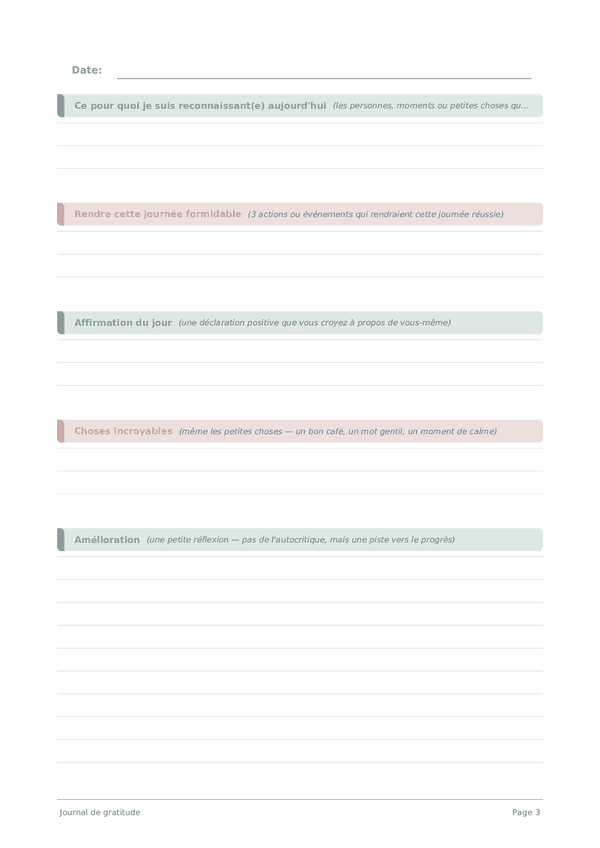
Journal de gratitude
Cultivez la reconnaissance et la positivité au quotidien
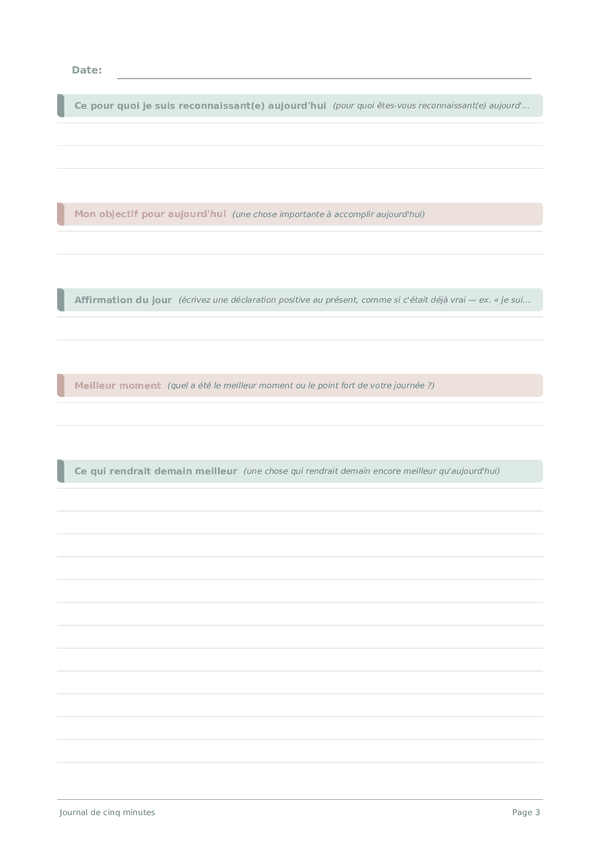
Journal de cinq minutes
Journal quotidien de gratitude et de réflexion en cinq minutes
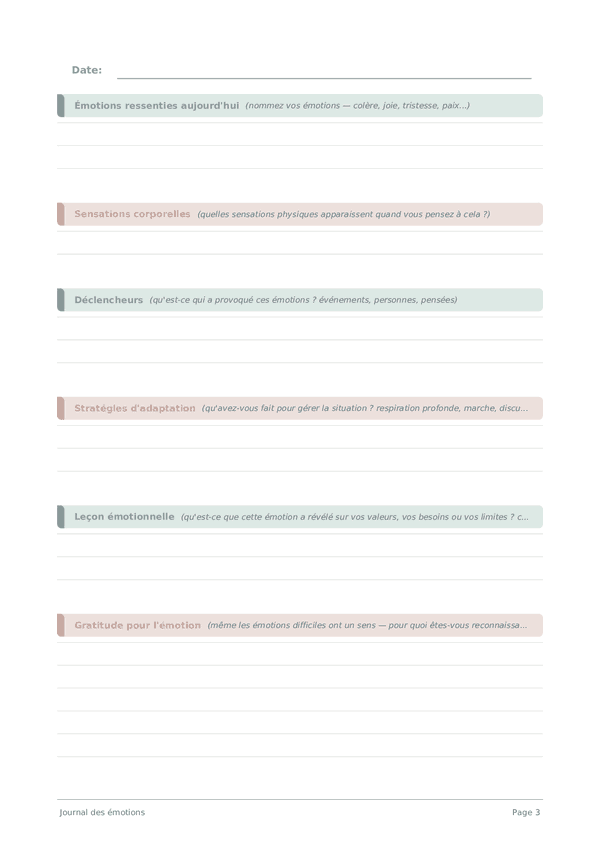
Journal des émotions
Comprenez, traitez et grandissez à travers vos émotions
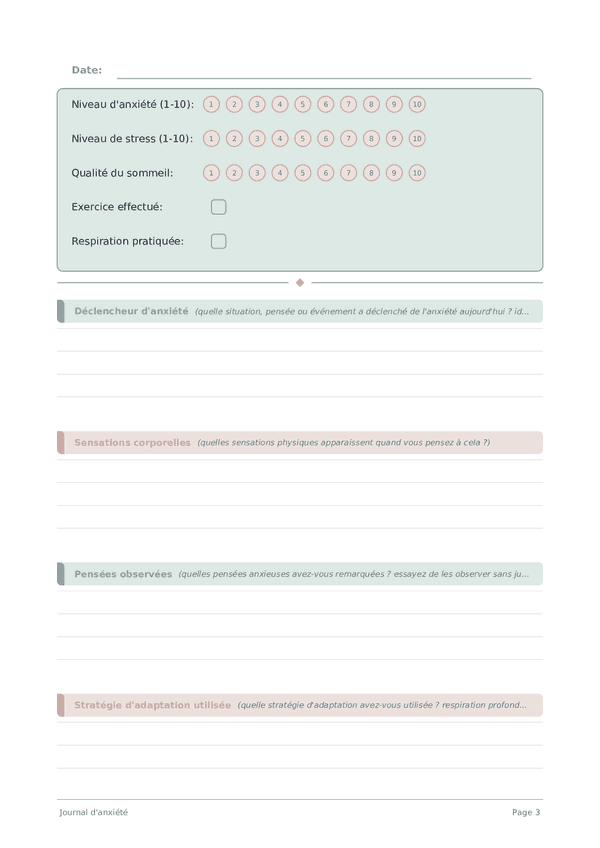
Journal d'anxiété
Suivi quotidien de l'anxiété et réflexion basée sur les TCC
Molette pour zoomer, glisser pour déplacer