Printable Journal d'anxiété
Suivi quotidien de l'anxiété et réflexion basée sur les TCC
Manage anxiety with evidence-based daily tracking and reflection. Identify triggers, notice body sensations, challenge anxious thoughts, and document what coping strategies actually work for you.
Personnaliser les champs
Activez ou désactivez les champs. Cliquez sur le crayon pour renommer, ou ajoutez vos propres champs.
Qu'est-ce que ce journal ?
An anxiety journal is a therapeutic self-monitoring tool specifically designed to help you understand, manage, and gradually reduce anxiety. By combining daily anxiety ratings with structured writing about triggers, body sensations, thought patterns, and coping strategies, you create a personal anxiety management system backed by cognitive behavioral therapy principles.
Anxiety often feels overwhelming because it operates in the background of your mind — vague, persistent, and hard to pin down. This journal brings anxiety into the light where it becomes manageable. Research shows that the simple act of writing about anxious thoughts reduces their intensity by up to 47%. Tracking your anxiety numerically also helps you see that it fluctuates — it is not permanent, even when it feels that way.
The hybrid format combines quick daily ratings (anxiety level, stress, sleep quality, exercise, breathing practice) with guided writing prompts that help you identify triggers, notice physical sensations, examine your thoughts, document what coping strategies you used, and reflect on what actually helped. Over time, this builds a personalized toolkit for managing anxiety.
Exemple rempli
Voici à quoi ressemble une entrée typique une fois remplie :
Comment remplir chaque champ
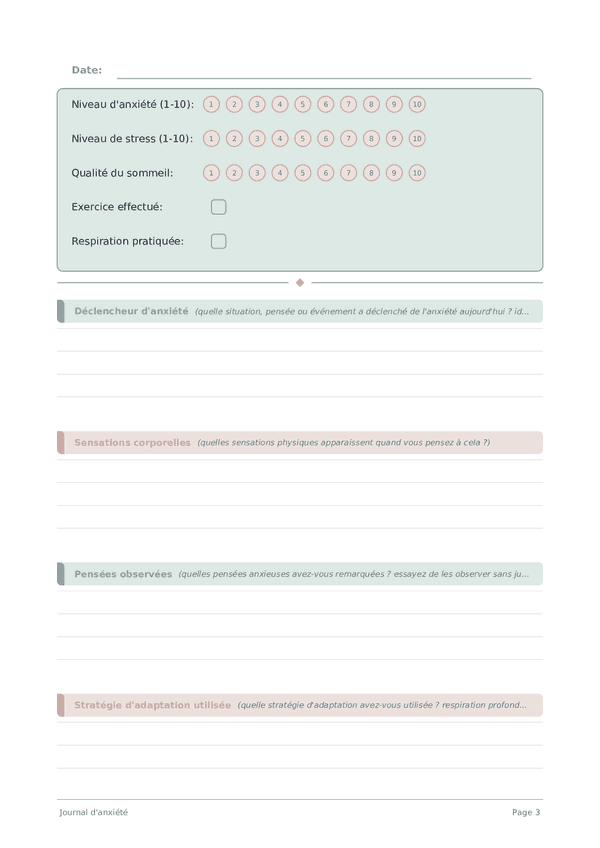
Le haut de chaque page comporte des champs à remplissage rapide (évaluations, cases à cocher, chiffres). En dessous se trouve une section lignée pour écrire. Voici ce que signifie chaque champ :
Niveau d'anxiété (1-10)
Évaluez votre niveau d'anxiété aujourd'hui. Mettre un chiffre dessus rend le sentiment plus gérable et traçable.
Niveau de stress (1-10)
Évaluez votre stress sur une échelle de 1 à 10. Avec le temps, vous identifierez vos schémas de stress et les stratégies d'adaptation qui fonctionnent le mieux.
Qualité du sommeil
Évaluez la qualité reposante de votre sommeil. 1 signifie terrible et agité, 5 signifie profond et réparateur. La qualité compte autant que la quantité.
Exercice effectué
Avez-vous fait de l'exercice aujourd'hui ? Même une courte marche compte. Le mouvement est l'un des réducteurs naturels d'anxiété les plus efficaces.
Respiration pratiquée
Avez-vous pratiqué la respiration consciente aujourd'hui ? La respiration diaphragmatique active le système nerveux parasympathique et apaise l'anxiété.
Déclencheur d'anxiété
Quelle situation, pensée ou événement a déclenché de l'anxiété aujourd'hui ? Identifier les déclencheurs est la première étape de la gestion de l'anxiété basée sur la TCC.
Sensations corporelles
Quelles sensations physiques apparaissent quand vous pensez à cela ?
Pensées observées
Quelles pensées anxieuses avez-vous remarquées ? Essayez de les observer sans jugement — les pensées ne sont pas des faits.
Stratégie d'adaptation utilisée
Quelle stratégie d'adaptation avez-vous utilisée ? Respiration profonde, ancrage, recadrage, marche, parler à quelqu'un — qu'est-ce qui a aidé ?
Ce qui a aidé
Qu'est-ce qui a apporté du soulagement ? Notez ce qui a fonctionné pour pouvoir le réutiliser quand l'anxiété monte.
Conseils pour réussir
Quand et à quelle fréquence écrire
Fill in the tracker daily, even on calm days — data from low-anxiety days is just as valuable for understanding your patterns. When anxiety spikes during the day, do a quick 'thought dump' in the writing section as soon as possible. Full evening reflection should take 5–10 minutes. Over time, this journal becomes your personal CBT workbook.
Questions fréquentes
Pourquoi noter l'anxiété, le stress et le sommeil séparément ?
Ces construits se chevauchent mais sont distincts. L'APA définit l'anxiété comme une inquiétude anticipatoire, le stress comme une réponse à une demande, et la qualité du sommeil comme un facteur physiologique qui modère les deux. Les recommandations du NIMH sur les troubles anxieux les traitent comme des éléments liés mais mesurables séparément. Trois notes de 0 à 10 te permettent de repérer quelle dimension provoque une mauvaise journée plutôt que de les réduire à un seul chiffre.
Comment remplir « pensées remarquées » en suivant les principes de la TCC ?
Écris la pensée automatique mot pour mot — exactement la phrase dans ta tête — puis nomme toute distorsion cognitive présente. Aaron Beck (Cognitive Therapy and the Emotional Disorders, 1976) a catalogué des schémas comme la catastrophisation, la lecture dans les pensées et la pensée tout-ou-rien. Nommer la distorsion est la première étape de la restructuration cognitive avant d'écrire « ce qui a aidé ». Sois précis : « je vais échouer », pas « je me suis senti mal ».
À quoi sert de consigner les « sensations corporelles » pour l'anxiété ?
L'anxiété produit des signaux somatiques — cœur qui s'emballe, poitrine serrée, respiration superficielle — que le travail d'exposition intéroceptive (Protocole Unifié de Barlow ; Barlow et al., 2017, Behaviour Research and Therapy, 88) cible directement. Enregistrer les sensations développe la conscience nécessaire pour distinguer un pic de panique d'une ligne de base élevée stable, et pour appliquer la respiration ou l'ancrage avant une escalade.
Pourquoi y a-t-il une case à cocher « respiration pratiquée » ?
La respiration lente et rythmée active le tonus vagal et réduit l'excitation physiologique. Laborde et al. (2022, Neuroscience and Biobehavioral Reviews, 138) ont examiné les protocoles de respiration lente et trouvé des effets aigus consistants sur la VFC et l'anxiété auto-rapportée. La case à cocher renforce l'habitude de pratique ; sur plusieurs semaines tu peux corréler les jours avec respiration pratiquée=vrai avec les notes d'anxiété.
Ce journal remplace-t-il la thérapie si j'ai un trouble anxieux ?
Non. Le journal soutient le traitement fondé sur des preuves mais ne le remplace pas. Le NIMH et l'APA recommandent la TCC, la thérapie d'exposition ou la pharmacothérapie pour les troubles anxieux diagnostiqués. Si tu as un trouble anxieux clinique — anxiété généralisée, panique, anxiété sociale — consulte un professionnel de santé mentale agréé. Ce journal fonctionne bien comme outil de devoirs entre les séances.
Comment interpréter plusieurs semaines de notes ?
Cherche des corrélations, pas des jours isolés. Après deux semaines, observe si anxiété_niveau augmente quand qualité_sommeil baisse, ou diminue les jours où exercice fait est coché. Hofmann et al. (2012, Cognitive Therapy and Research, 36(5)) ont méta-analysé la TCC pour l'anxiété et trouvé que le suivi des symptômes améliorait la réponse au traitement en clarifiant les déclencheurs. Apporte les schémas en thérapie le cas échéant.
Que faire si je ne peux pas identifier un « déclencheur d anxiété » clair ?
C'est courant avec l'anxiété généralisée où l'inquiétude est diffuse. Le modèle d'évitement de l'inquiétude de Borkovec (1994) et Behar et al. (2009, Journal of Anxiety Disorders, 23(8)) décrivent l'inquiétude comme supprimant des images concrètes redoutées. Écris ce que tu faisais, avec qui tu étais et à quel point ton corps était tendu — le déclencheur peut se manifester comme contexte somatique, pas comme un événement clair.
En quoi est-ce différent d'un journal d'humeur générique ?
Il est structuré autour du format de registre de pensées TCC : situation, pensées automatiques, sensations corporelles, coping utilisé et ce qui a aidé. Cette séquence — plus proche du registre de pensées quotidien de Beck — cible spécifiquement la restructuration cognitive. Un journal d'humeur consigne les sentiments ; ce journal travaille sur les évaluations qui les produisent, ce qui est l'ingrédient actif dans les méta-analyses TCC de Hofmann.
Vous aimerez aussi
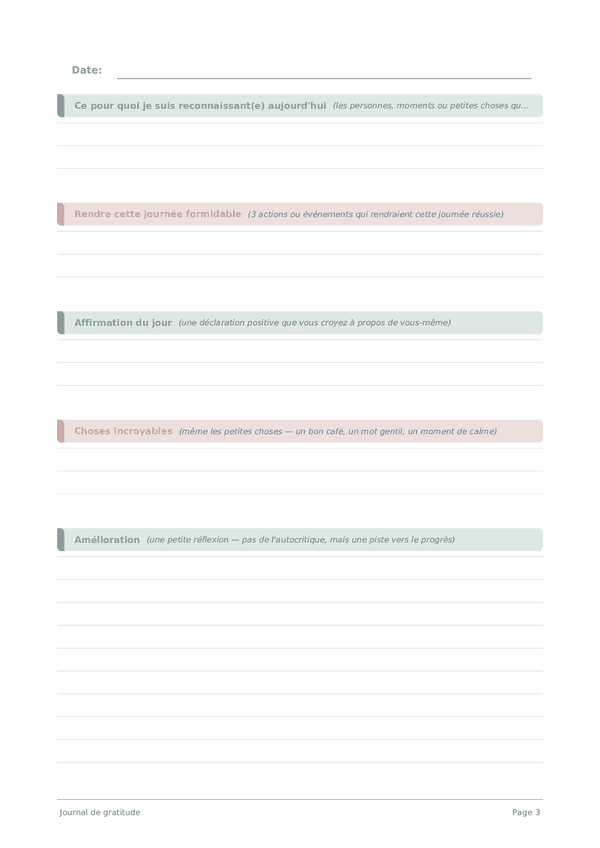
Journal de gratitude
Cultivez la reconnaissance et la positivité au quotidien
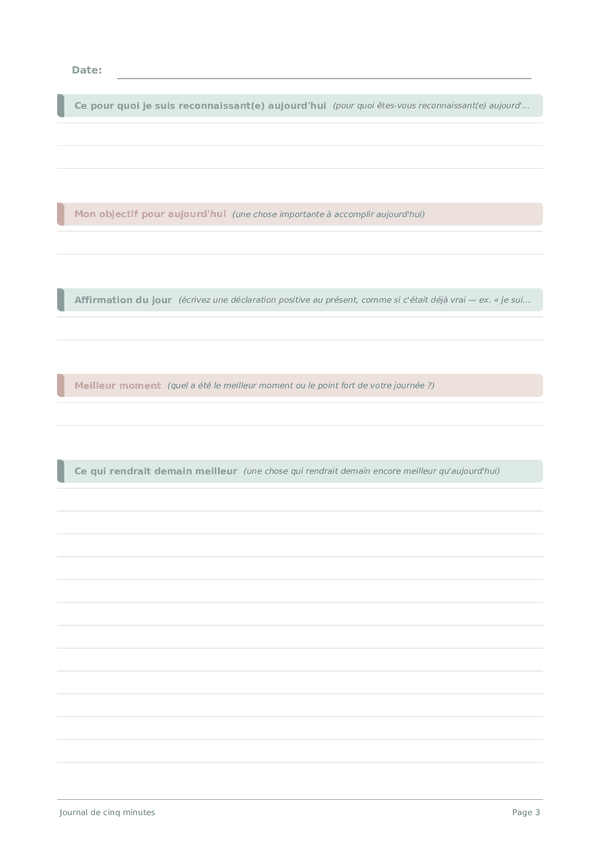
Journal de cinq minutes
Journal quotidien de gratitude et de réflexion en cinq minutes
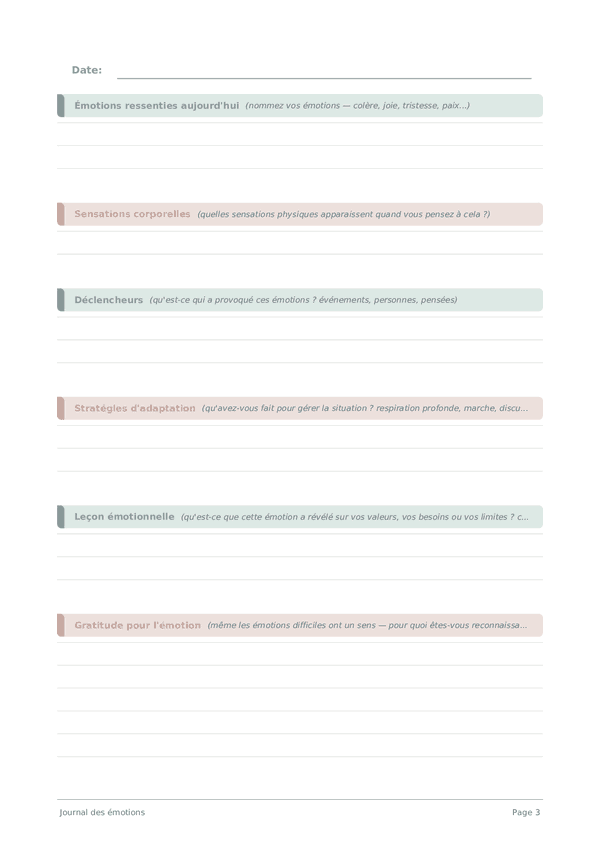
Journal des émotions
Comprenez, traitez et grandissez à travers vos émotions
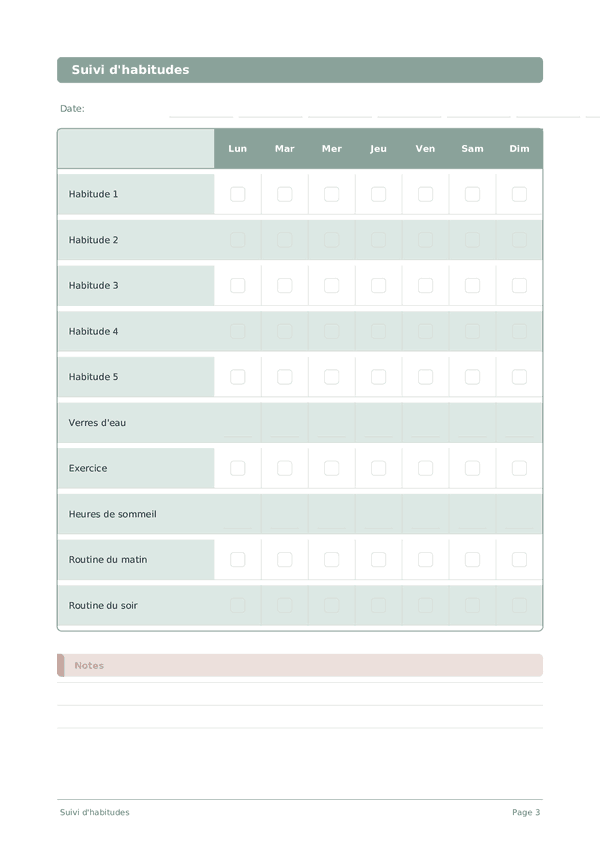
Suivi d'habitudes
Construisez de meilleures habitudes jour après jour
Molette pour zoomer, glisser pour déplacer