Printable Journal de gratitude
Cultivez la reconnaissance et la positivité au quotidien
Transform your mindset by focusing on the good in your life. This journal provides a simple daily structure to record what you are grateful for, capture positive moments, and affirm your best self.
Personnaliser les champs
Activez ou désactivez les champs. Cliquez sur le crayon pour renommer, ou ajoutez vos propres champs.
Avantages
Comment utiliser
Qu'est-ce que ce journal ?
A gratitude journal is one of the most researched and effective wellbeing practices in positive psychology. The concept is simple: each day, you deliberately focus on the good things in your life — from major blessings to small everyday pleasures. This conscious shift in attention rewires your brain over time, making you naturally more attuned to positivity.
Developed from research by psychologists Robert Emmons and Michael McCullough, gratitude journaling has been shown to increase happiness by 25%, improve sleep quality, and reduce symptoms of depression. The practice takes just 5-10 minutes per day but compounds dramatically over weeks and months.
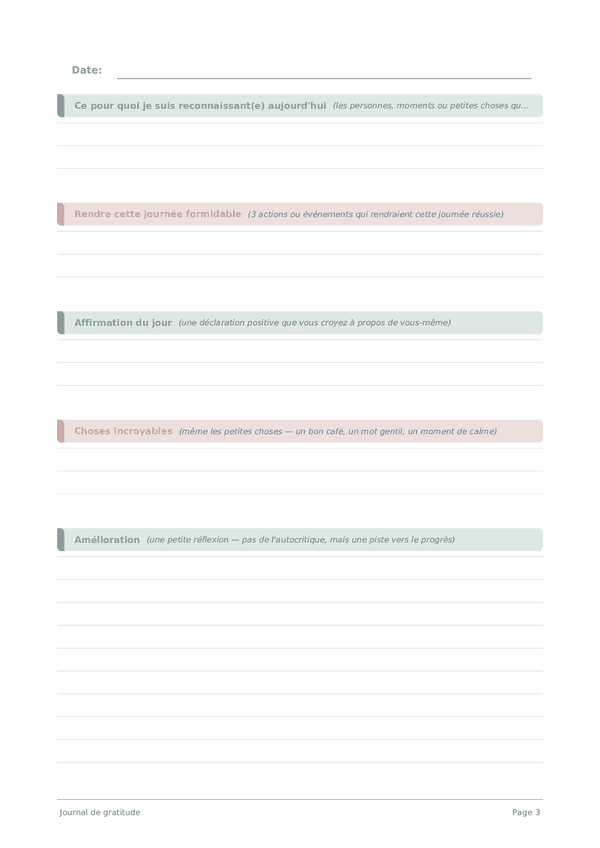
This journal uses a proven five-section structure: what you are grateful for, how to make today great, a personal affirmation, amazing things that happened, and what you could improve. This balanced approach ensures you are not just counting blessings but actively shaping a more positive, intentional life.
Exemple rempli
Voici à quoi ressemble une entrée typique une fois remplie :
Comment remplir chaque champ
Chaque jour, vous trouverez plusieurs sections étiquetées avec des lignes pour écrire. Voici à quoi sert chaque section :
Ce pour quoi je suis reconnaissant(e) aujourd'hui
Listez 1 à 3 choses pour lesquelles vous êtes reconnaissant aujourd'hui. Elles peuvent être grandes ou minuscules — un bon repas, un mot gentil, du soleil. Le journal de gratitude est l'une des pratiques de bien-être les plus soutenues scientifiquement.
Rendre cette journée formidable
3 actions ou événements qui rendraient cette journée réussie
Affirmation du jour
Écrivez une déclaration positive sur vous-même au présent, comme si c'était déjà vrai. Par exemple : « Je suis capable et résilient. » Répéter des affirmations reprogramme vos schémas de pensée avec le temps.
Choses incroyables
Même les petites choses — un bon café, un mot gentil, un moment de calme
Amélioration
Une petite réflexion — pas de l'autocritique, mais une piste vers le progrès
Conseils pour réussir
Quand et à quelle fréquence écrire
Write every evening before bed — gratitude journaling at night has been shown to improve sleep quality (research by Emmons & McCullough, 2003). It takes just 5 minutes. If daily feels like too much, three times per week still produces significant well-being benefits. The key is writing at a consistent time so it becomes automatic.
Questions fréquentes
Que faut-il écrire dans un journal de gratitude quand rien de spécial ne se passe ?
Note des moments petits et précis : un bon café, l'aide d'un collègue, la chaleur du soleil. Emmons & McCullough (2003, Journal of Personality and Social Psychology, 84(2)) ont montré que les gratitudes spécifiques surpassent les génériques — « Anna m'a aidé avec le rapport » fonctionne mieux que « reconnaissant envers mes amis ». Le cerveau réagit aux détails concrets ; les abstractions perdent de leur impact par adaptation hédonique.
Est-il préférable d'écrire le journal de gratitude le matin ou le soir ?
Le matin installe une disposition positive ; le soir améliore le sommeil. Wood et al. (2009, Journal of Psychosomatic Research, 66(1)) ont étudié 401 participants et établi un lien entre la pratique nocturne et une meilleure qualité de sommeil. Si le sommeil est difficile, écris le soir. Choisis un moment fixe : la formation d'une habitude prend en moyenne 66 jours (Lally et al., 2010, European Journal of Social Psychology, 40(6)).
Combien de semaines avant de voir des résultats avec le journal de gratitude ?
Une méta-analyse de Davis et al. (2016, Journal of Counseling Psychology, 63(1)) portant sur 38 études a trouvé des améliorations mesurables de l'humeur et une réduction de l'anxiété après 2 à 3 semaines de pratique régulière. Cregg & Cheavens (2021, Journal of Happiness Studies, 22) l'ont confirmé sur 64 études : les effets durables apparaissent vers 8 semaines ; les tailles d'effet sont petites mais significatives (g de Hedges ≈ 0,29).
Quelle est la différence entre ce journal de gratitude et le Five Minute Journal ?
Le Five Minute Journal est un format commercial lancé par Intelligent Change en 2013 : 3 gratitudes matinales + affirmation + intention quotidienne, et 2 réflexions nocturnes. Notre modèle élargit la structure avec des sections « moments extraordinaires » et « à améliorer ». Même base scientifique : Emmons & McCullough (2003) et le protocole « Three Good Things » de Seligman et al. (2005, American Psychologist, 60(5)).
Puis-je écrire les mêmes gratitudes chaque jour ?
Non recommandé. L'adaptation hédonique (Brickman & Campbell, 1971) conduit le cerveau à s'habituer aux stimuli répétés, et la pratique perd de son impact. Sheldon & Lyubomirsky (2006, Journal of Happiness Studies, 7) ont montré que varier les activités positives maintient les effets bien plus longtemps que la répétition. Note de nouveaux détails, ou revisite la même catégorie sous un angle neuf : pas « reconnaissant pour ma famille » mais « papa a appelé aujourd'hui ».
Le journal de gratitude aide-t-il contre l'anxiété et la dépression ?
Il complète la thérapie mais ne la remplace pas. La méta-analyse de Cregg & Cheavens (2021, Journal of Happiness Studies) sur 64 études a trouvé des effets petits mais significatifs (g de Hedges ≈ 0,29) sur les symptômes de dépression et d'anxiété. L'American Psychological Association reconnaît la pratique de gratitude comme intervention de soutien. Pour une dépression clinique ou un trouble anxieux, consulte d'abord un professionnel de santé mentale agréé — le journal ne remplace pas la psychothérapie ni les médicaments.
Combien de temps prend le journal de gratitude par jour ?
5 à 10 minutes. Les bénéfices émotionnels ne nécessitent pas de longues entrées. Seligman et al. (2005, American Psychologist, 60(5)) ont utilisé le bref protocole « Three Good Things » — 3 éléments chaque soir. Après une semaine seulement, les améliorations d'humeur ont persisté jusqu'à 6 mois. Dans Thanks! (Houghton Mifflin, 2007), Robert Emmons recommande 5 entrées comme équilibre optimal entre profondeur et durabilité de l'habitude.
Ce journal convient-il aux adolescents et aux enfants ?
Oui, à partir de 8 ans. Froh et al. (2008, Journal of School Psychology, 46(2)) ont étudié le journal chez des enfants de 11-13 ans et observé des gains significatifs en optimisme et satisfaction scolaire après 3 semaines. Pour les plus jeunes, simplifie à 3 entrées et ajoute des dessins. Pour les adolescents, la section affirmations soutient le développement de l'identité pendant une période critique pour l'estime de soi.
Vous aimerez aussi
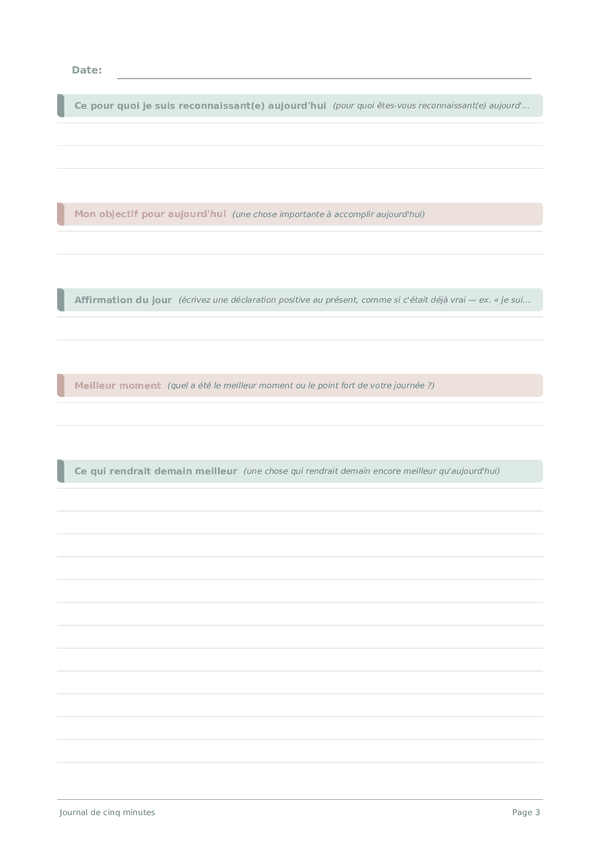
Journal de cinq minutes
Journal quotidien de gratitude et de réflexion en cinq minutes
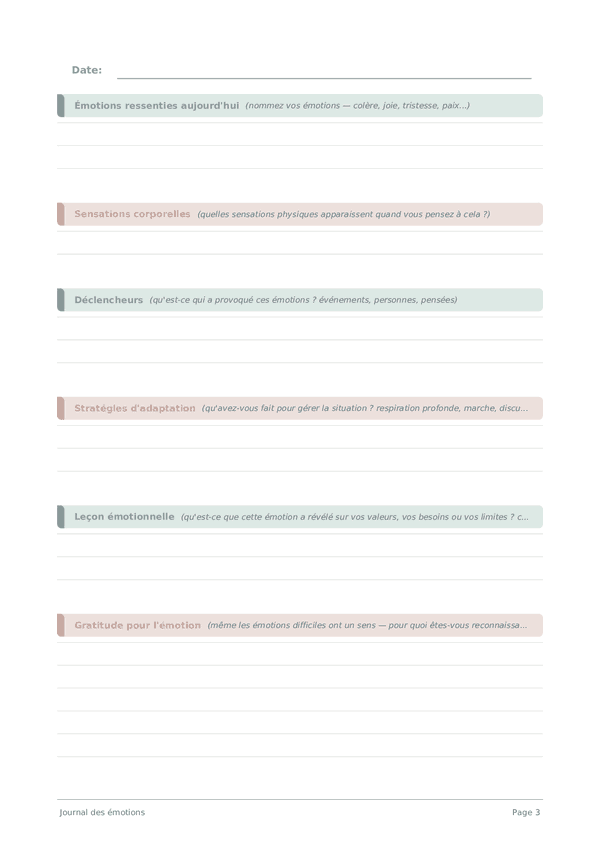
Journal des émotions
Comprenez, traitez et grandissez à travers vos émotions
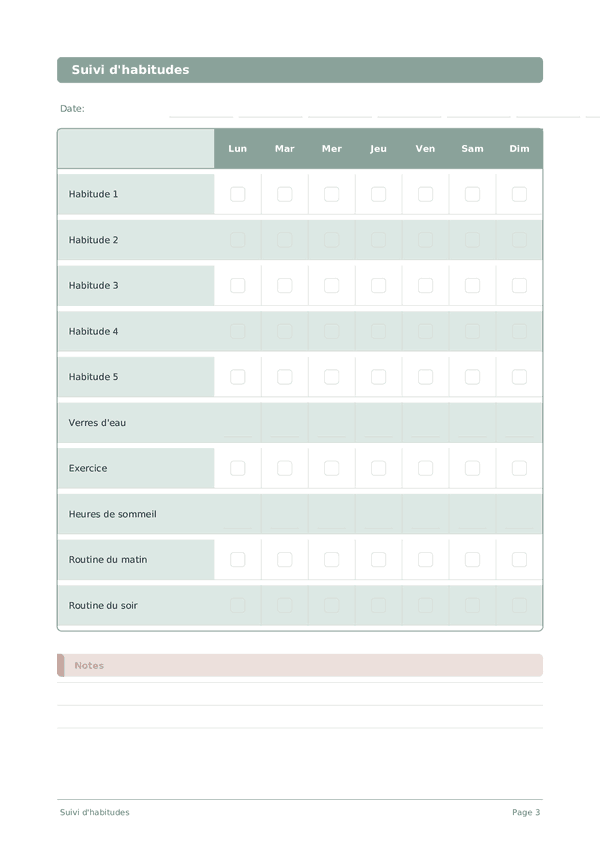
Suivi d'habitudes
Construisez de meilleures habitudes jour après jour
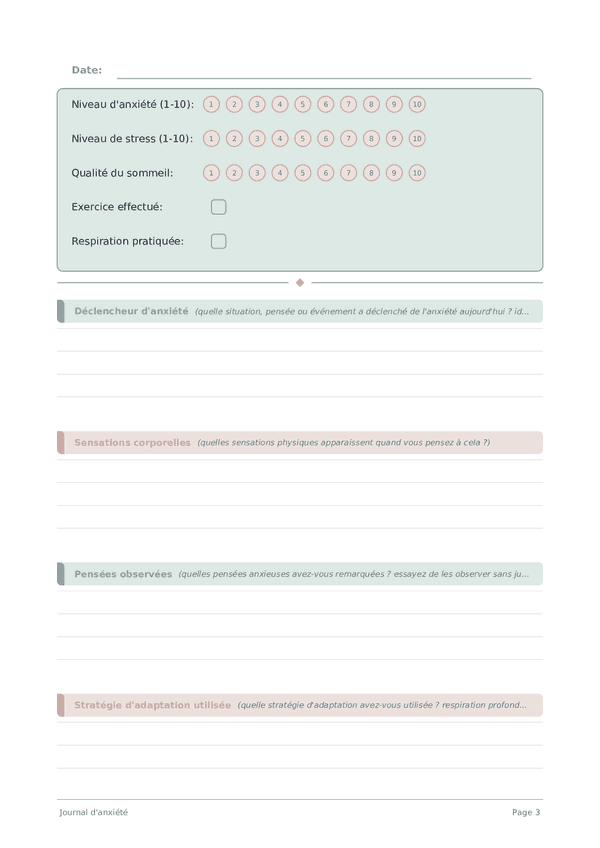
Journal d'anxiété
Suivi quotidien de l'anxiété et réflexion basée sur les TCC
Molette pour zoomer, glisser pour déplacer