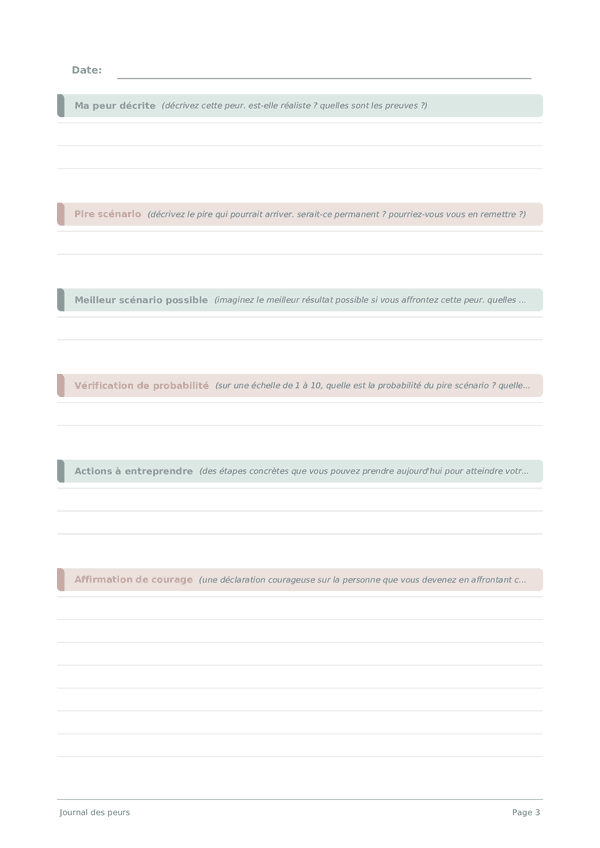
Printable Journal des peurs
Exploration des peurs et développement du courage
Face your fears with structured analysis and courageous action. Based on fear-setting methodology, this journal helps you examine fears rationally, envision outcomes, and take the steps that transform fear into freedom.
Personnaliser les champs
Activez ou désactivez les champs. Cliquez sur le crayon pour renommer, ou ajoutez vos propres champs.
Qu'est-ce que ce journal ?
A fear journal is a structured practice for confronting and dismantling the fears that hold you back. Each entry walks you through describing a fear, examining worst and best case scenarios, reality-testing the probability, and identifying concrete steps to move forward despite the fear.
This journal is for anyone who feels stuck, anxious, or held back by fears — whether rational or irrational. It works for major life fears (career changes, public speaking, relationship vulnerability) as well as the quiet, daily anxieties that accumulate and constrict your life over time.
Research from exposure therapy and cognitive behavioral therapy shows that naming fears precisely and examining them objectively reduces their emotional charge. The structured format of this journal mirrors the therapeutic technique of "cognitive defusion" — creating distance between you and your fearful thoughts so you can see them clearly rather than be controlled by them.
Exemple rempli
Voici à quoi ressemble une entrée typique une fois remplie :
Comment remplir chaque champ
Chaque jour, vous trouverez plusieurs sections étiquetées avec des lignes pour écrire. Voici à quoi sert chaque section :
Ma peur décrite
Décrivez en détail ce qui vous fait peur. Souvent, les peurs se réduisent quand vous les mettez sur papier. Soyez honnête — ce journal est uniquement pour vos yeux.
Pire scénario
Écrivez le pire scénario absolu. Puis demandez-vous : quelle est la probabilité que cela arrive, vraiment ? Et si cela arrivait, pourrais-je y survivre ? En général, la réponse est oui.
Meilleur scénario possible
Imaginez le meilleur résultat possible si vous affrontez cette peur. Quelles opportunités pourraient s'ouvrir à vous ?
Vérification de probabilité
Sur une échelle de 1 à 10, quelle est la probabilité du pire scénario ? Quelles preuves soutiennent ou contredisent votre peur ?
Actions à entreprendre
Décomposez votre objectif en actions concrètes. Que ferez-vous exactement, quand et comment ? Plus c'est précis, mieux c'est.
Affirmation de courage
Une déclaration courageuse sur la personne que vous devenez en affrontant cette peur. Écrivez-la au présent.
Conseils pour réussir
Quand et à quelle fréquence écrire
Write whenever a fear feels strong enough to influence your decisions — this could be daily or several times a week. The key is capturing the fear while it is active, not after it has passed. Spend 10 minutes examining one fear per entry rather than listing many superficially. Weekly, review your fear entries and notice patterns: are they clustered around certain themes (rejection, failure, loss)? Monthly, celebrate the fears you confronted. This journal is most effective as an as-needed tool with a weekly review ritual.
Questions fréquentes
Quelle est la méthodologie du « fear-setting » utilisée dans ce journal ?
Le fear-setting est une analyse structurée de la peur popularisée par Tim Ferriss mais enracinée dans la préméditation stoïcienne (Sénèque, Épictète) et l'analyse de décision. La séquence pire cas, meilleur cas, vérification probabilité et étapes d action reflète l'analyse de décision d'Edwards (1954, Psychological Bulletin, 51(4)) et la recherche contemporaine sur la prise de décision structurée — examiner explicitement les outcomes affaiblit l'anticipation catastrophique vague qui stimule l'évitement.
Comment écrire le « pire cas » aide-t-il vraiment ?
Cela utilise l'exposition imaginaire combinée à la restructuration cognitive. Beck (Cognitive Therapy and the Emotional Disorders, 1976) et la TCC basée sur l'exposition (Foa et Kozak, 1986, Psychological Bulletin, 99(1)) montrent que spécifier les outcomes redoutés réduit leur pouvoir. La peur vague reste catastrophique ; les pires cas nommés paraissent généralement survivables. Deux lignes forcent la spécificité — que se passe-t-il concrètement si l'outcome redouté se produit ?
Pourquoi inclure le « meilleur cas » si la peur est le focus ?
Pour restaurer une pensée équilibrée. Les distorsions cognitives comme la catastrophisation se concentrent exclusivement sur les négatifs. La TCC de Beck utilise explicitement l'équilibrage des preuves — incluant les possibilités positives et négatives — pour affaiblir l'emprise des distorsions. Deux lignes pour un meilleur cas crédible, pas une fantaisie utopique. Le contraste avec pire cas calibre les estimations de probabilité que vérification probabilité formalise.
Comment faire la « vérification probabilité » honnêtement ?
Évalue la probabilité réaliste que le pire cas se produise dans une fenêtre définie. Kahneman (Thinking, Fast and Slow, 2011) et sa recherche avec Tversky sur l'heuristique de disponibilité montrent que les peurs vives semblent plus probables qu'elles ne le sont. Deux lignes : évalue 0 à 100 % et une phrase sur les preuves qui soutiennent ton estimation. La calibration s'améliore avec une pratique répétée sur de multiples peurs.
Que mettre dans les « étapes d action » pour le travail sur la peur ?
Deux catégories : étapes pour prévenir le pire cas, et étapes pour récupérer s'il se produit. Cette double planification sous-tend la flexibilité psychologique (ACT de Hayes) et la recherche sur la prise de décision préparée. Trois lignes suffisent pour les deux. Le côté récupération importe le plus — savoir que tu pourrais gérer le pire désamorce la peur davantage que les seuls plans de prévention.
Est-ce sûr pour l'anxiété clinique ou les phobies ?
Utilise avec soin. Les phobies spécifiques, le trouble panique et le PTSD répondent mieux à une thérapie d'exposition délivrée par un clinicien formé (recommandations du NIMH sur les troubles anxieux). L'écriture non structurée sur les peurs pour une anxiété sévère peut devenir de la rumination plutôt que du traitement. Si les peurs sont débilitantes, consulte un professionnel de santé mentale agréé. Ce journal complète le travail TCC/exposition comme outil entre séances.
Qu'est-ce qu'une bonne « affirmation de courage » ?
Une déclaration d'identité crédible, pas un slogan. Cohen et Sherman (2014, Annual Review of Psychology, 65) sur l'auto-affirmation ont montré que les déclarations basées sur les valeurs étaient efficaces ; « je suis courageux » générique moins. Mieux : « je suis quelqu'un qui agit malgré la peur quand l'action compte » — vérifiable à travers tes étapes d action. La ligne unique est intentionnelle — une déclaration, pas une liste.
À quelle fréquence faire une analyse de peur ?
À la demande, pas quotidiennement. Le fear-setting fonctionne comme intervention ciblée quand on évite une décision ou une action spécifique. Le répéter quotidiennement sur la même peur peut devenir de la rumination — Watkins (2008, Psychological Bulletin, 134(2)) a constaté que la pensée négative répétitive aggravait l'humeur et la qualité des décisions. Utilise une fois par peur significative, puis revisites seulement si de nouvelles informations apparaissent.
Vous aimerez aussi
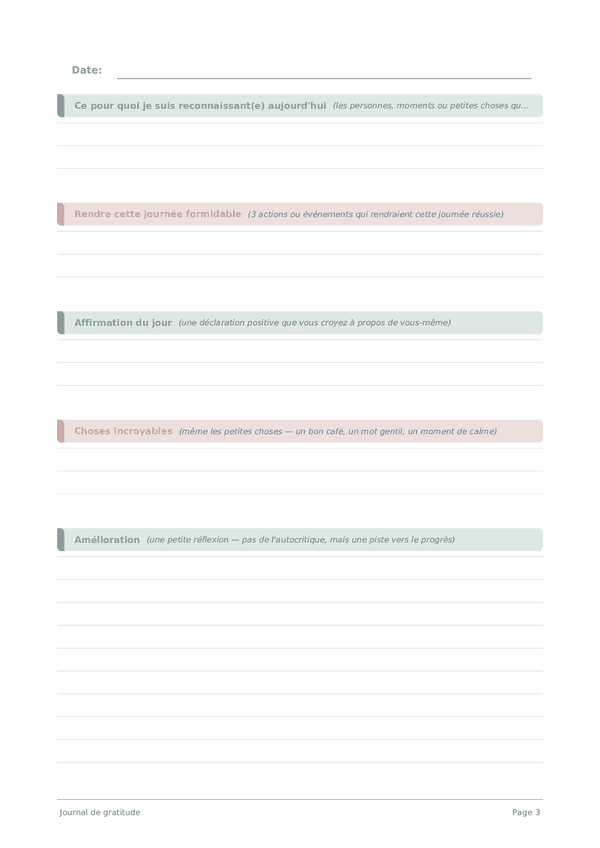
Journal de gratitude
Cultivez la reconnaissance et la positivité au quotidien
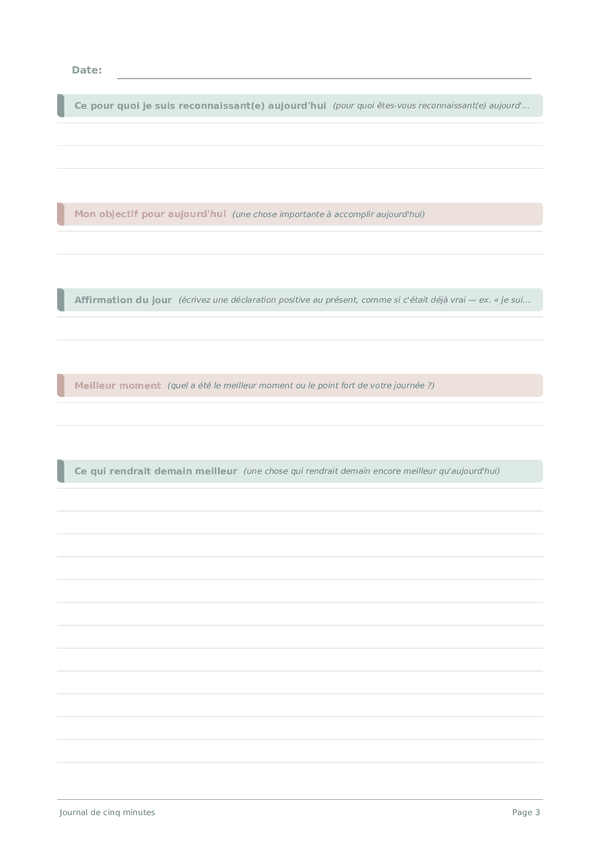
Journal de cinq minutes
Journal quotidien de gratitude et de réflexion en cinq minutes
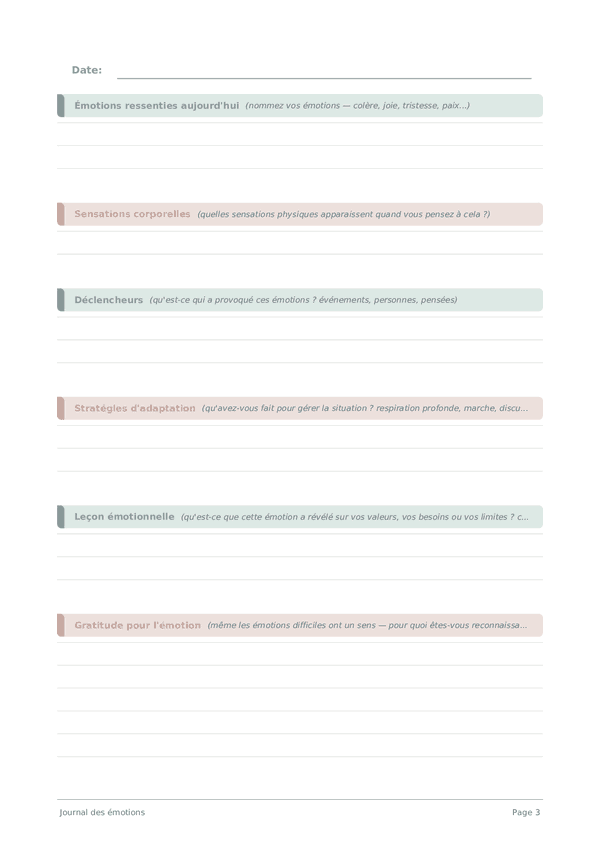
Journal des émotions
Comprenez, traitez et grandissez à travers vos émotions
Suivi d'habitudes
Construisez de meilleures habitudes jour après jour
Molette pour zoomer, glisser pour déplacer