Printable Journal du pardon
Pratique guidée du pardon et libération émotionnelle
Free yourself from resentment through guided forgiveness journaling. Based on the REACH model of forgiveness, explore your feelings, develop empathy, and make the conscious choice to release what no longer serves you.
Personnaliser les champs
Activez ou désactivez les champs. Cliquez sur le crayon pour renommer, ou ajoutez vos propres champs.
Qu'est-ce que ce journal ?
A forgiveness journal is a guided writing practice for processing hurt and resentment through structured reflection. Each entry invites you to explore a situation that caused pain, examine your feelings, practice empathy, and work toward releasing the emotional weight you carry.
This journal is for anyone holding onto grudges, past wounds, or self-blame that drains their energy and limits their present. Forgiveness does not mean excusing harmful behavior — it means choosing to free yourself from the ongoing burden of resentment. This journal supports both forgiving others and forgiving yourself.
Research from Stanford's Forgiveness Project shows that structured forgiveness practices reduce anger, stress, and depression while increasing optimism and self-confidence. The process of writing about pain with the explicit intention of release activates different neural pathways than rumination, turning repetitive hurt into progressive healing.
Exemple rempli
Voici à quoi ressemble une entrée typique une fois remplie :
Comment remplir chaque champ
Chaque jour, vous trouverez plusieurs sections étiquetées avec des lignes pour écrire. Voici à quoi sert chaque section :
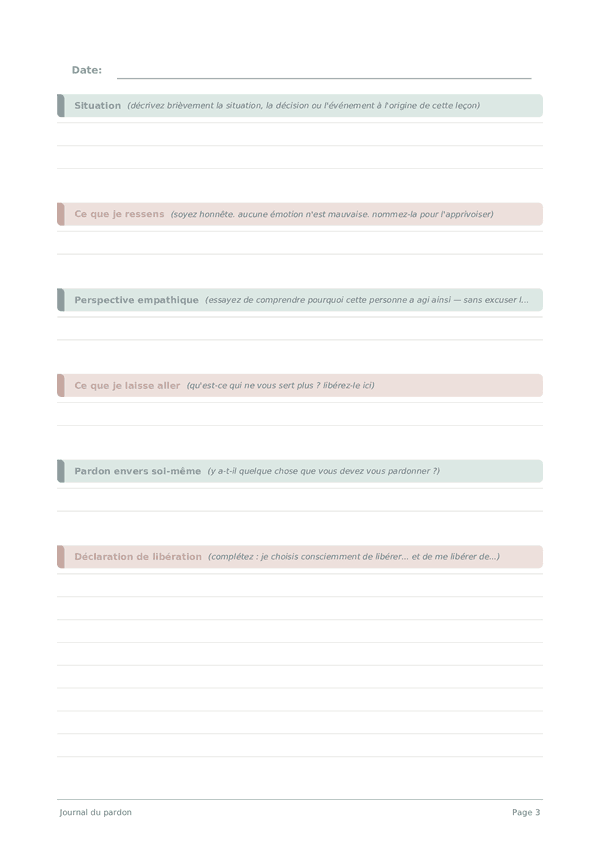
Situation
Décrivez la situation ou l'événement objectivement, comme si vous étiez un observateur neutre. Séparer les faits des émotions vous aide à voir les choses plus clairement.
Ce que je ressens
Décrivez comment vous vous sentez en ce moment avec vos propres mots. Il n'y a pas de mauvaise réponse. Le simple fait de mettre les sentiments sur papier réduit leur charge émotionnelle.
Perspective empathique
Essayez de comprendre pourquoi cette personne a agi ainsi — sans excuser le tort causé
Ce que je laisse aller
Écrivez quelque chose que vous êtes prêt à lâcher — une inquiétude, un ressentiment ou une attente. Nommer ce que vous lâchez est le premier pas vers la libération.
Pardon envers soi-même
Y a-t-il quelque chose que vous devez vous pardonner ?
Déclaration de libération
Complétez : Je choisis consciemment de libérer... et de me libérer de...
Conseils pour réussir
Quand et à quelle fréquence écrire
Write 2-3 times per week, dedicating each entry to one forgiveness topic. This is deep emotional work, and daily entries on the same wound can feel overwhelming. Alternate between forgiving others and forgiving yourself. Spend 15-20 minutes per entry — forgiveness journaling requires more time than typical journals because you need space to process emotions fully. Monthly, re-read your entries to see how your feelings toward specific situations have evolved. Some wounds take months to process; patience with yourself is part of the practice.
Questions fréquentes
Qu'est-ce que le modèle REACH utilisé dans ce journal ?
REACH est le modèle de pardon d'Everett Worthington — Recall (se souvenir), Empathize (empathie), Altruistic gift (don altruiste), Commit (s'engager), Hold on (maintenir). Worthington et Scherer (2004, Psychology and Health, 19(3)) et des essais randomisés subséquents ont documenté ses effets sur l'hostilité et le bien-être. Les sections du journal — situation, sentiments, perspective empathique, lâcher prise, déclaration de libération — reflètent directement la séquence de REACH.
Pardonner signifie-t-il approuver ce qui s'est passé ?
Non. La recherche de Worthington et les ressources de l'APA sur le pardon distinguent explicitement le pardon de l'approbation, de l'oubli ou de la réconciliation. Le pardon est une libération intérieure du ressentiment ; la réconciliation requiert l'autre partie. La section lâcher prise du journal traite ta relation à la blessure, pas la responsabilité de l'offenseur. Tu peux pardonner sans contact ni confiance.
Comment écrire « perspective empathique » sans minimiser le tort ?
Le modèle de Worthington utilise l'empathie pour adoucir l'affect sans justifier le comportement. Deux lignes : écris quels facteurs pourraient expliquer les actions de l'autre personne — pas les excuser. McCullough, Pargament, Thoresen (2000, Forgiveness: Theory, Research, and Practice, Guilford) décrivent cela comme humaniser sans absoudre. Le tort reste un tort ; l'empathie réduit la rumination qui soutient ta souffrance.
Pourquoi inclure le « pardon de soi » ?
Le pardon de soi est un construit distinct du pardon envers autrui. Hall et Fincham (2005, Journal of Social and Clinical Psychology, 24(5)) et Wohl, DeShea, Wahkinney (2008, Canadian Journal of Behavioural Science, 40(1)) ont montré que le pardon de soi réduisait la dépression et la honte lorsqu'il était associé à la responsabilité. Deux lignes forcent le travail plus difficile : nomme ce que tu regrettes, puis offre la même libération que tu offrirais à un autre.
Que doit faire la « déclaration de libération » ?
Elle fonctionne comme un engagement comportemental — ce que Worthington appelle « Maintenir le pardon ». La ligne unique cristallise le choix. Karremans et al. (2003, JPSP, 84(5)) ont constaté que les déclarations de pardon explicites prédisaient de meilleurs résultats que les intentions vagues. Écris la déclaration au présent, en assumant la décision : « je libère le poids de ceci » plutôt que « je vais essayer ».
La tenue d'un journal de pardon est-elle appropriée pour le traumatisme ?
Avec prudence. Worthington et d'autres (Wade, Hoyt, Kidwell, Worthington, 2014, Journal of Counseling Psychology, 61(2) méta-analyse) ont trouvé des interventions de pardon efficaces pour beaucoup mais le pardon sous pression peut nuire aux survivants de traumatismes. Si la blessure implique de l'abus, une agression ou un traumatisme soutenu, consulte un professionnel de santé mentale agréé avec une formation au traumatisme avant un travail de pardon soutenu. Le pardon prématuré peut aggraver le tort.
Combien de temps ce travail prend-il ?
Des jours à des mois selon la sévérité de la blessure. Worthington et Scherer (2004, Psychology and Health, 19(3)) et Wade et al. (2014, Journal of Counseling Psychology, 61(2)) ont trouvé que les effets des interventions de pardon s'échelonnaient avec le nombre de séances et la profondeur de la blessure. Le journal peut être revisité pour la même situation sur plusieurs semaines ; le progrès sur la même blessure est un schéma normal, pas un signe que la pratique a échoué.
Pardonner quelqu'un réconciliera-t-il la relation ?
Pas nécessairement. Le pardon est interne ; la réconciliation requiert le travail de réparation de l'autre partie. Les ressources de l'APA sur le pardon et la littérature clinique traitent ces choix comme séparables. Le journal soutient le pardon — ta paix — sans exiger de contact ni de confiance restaurée. Certains pardonnent sans réconciliation ; certains se réconcilient sans pardon complet. La déclaration de libération t'appartient seul.
Vous aimerez aussi
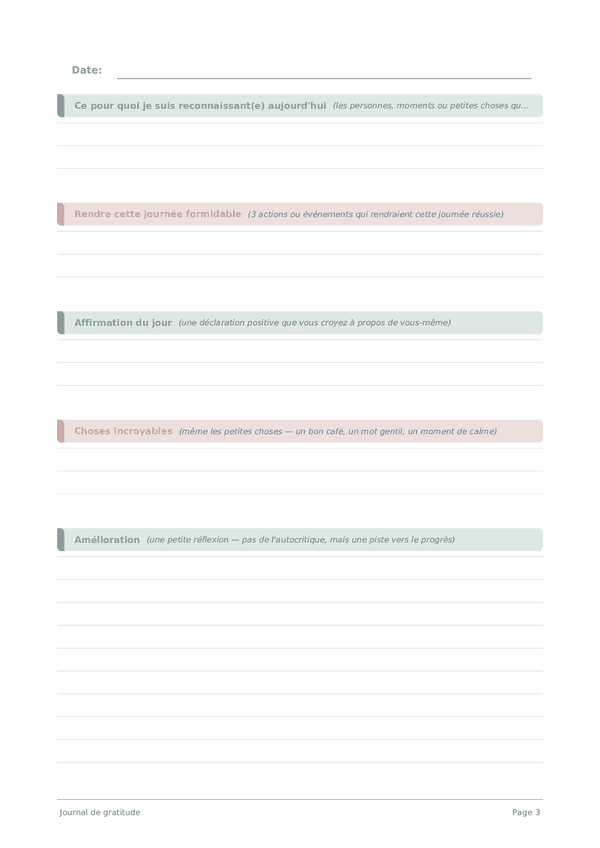
Journal de gratitude
Cultivez la reconnaissance et la positivité au quotidien
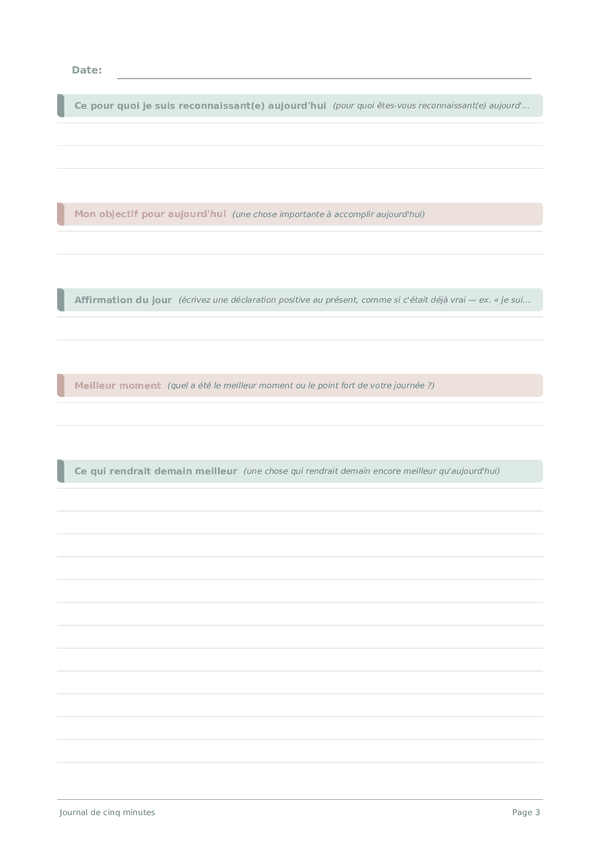
Journal de cinq minutes
Journal quotidien de gratitude et de réflexion en cinq minutes
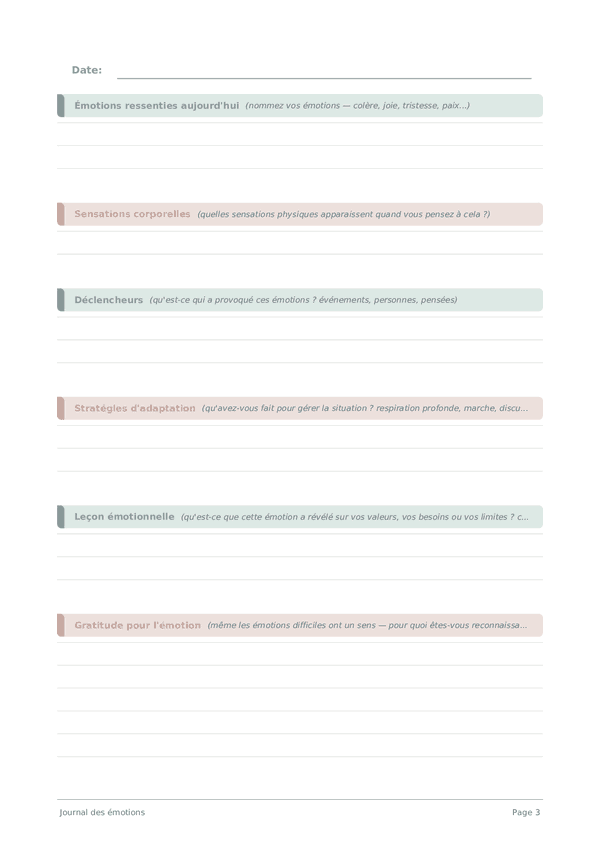
Journal des émotions
Comprenez, traitez et grandissez à travers vos émotions
Suivi d'habitudes
Construisez de meilleures habitudes jour après jour
Molette pour zoomer, glisser pour déplacer