Printable Journal de deuil
Traversez la perte avec compassion et courage
A structured companion for the grief journey. Each day you track the intensity of your grief and sleep, write freely about what you feel, honour memories, and practise small acts of self-care. Research shows that directed expressive writing — combining emotional release with meaning-making — supports long-term healing far better than unguided journaling alone.
Personnaliser les champs
Activez ou désactivez les champs. Cliquez sur le crayon pour renommer, ou ajoutez vos propres champs.
Avantages
Comment utiliser
Qu'est-ce que ce journal ?
A grief journal is a gentle daily companion for navigating the landscape of loss. By tracking grief intensity and sleep alongside writing about feelings, memories, and letters to the person you have lost, you create a sacred space where grief can be witnessed, honored, and gradually integrated into your life.
This journal is for anyone moving through grief — the loss of a loved one, a pet, a relationship, a career, or any significant loss that has reshaped your world. Grief does not follow a timeline, and this journal does not ask it to. It simply creates space for whatever is true today.
Bereavement research has moved beyond the outdated "five stages" model to recognize that grief is not linear but wavelike — coming and going with varying intensity. Writing through grief has been shown to reduce complicated grief symptoms, improve physical health markers, and help mourners find meaning in loss. This journal supports the natural rhythm of your grief while ensuring you do not grieve in isolation.
Exemple rempli
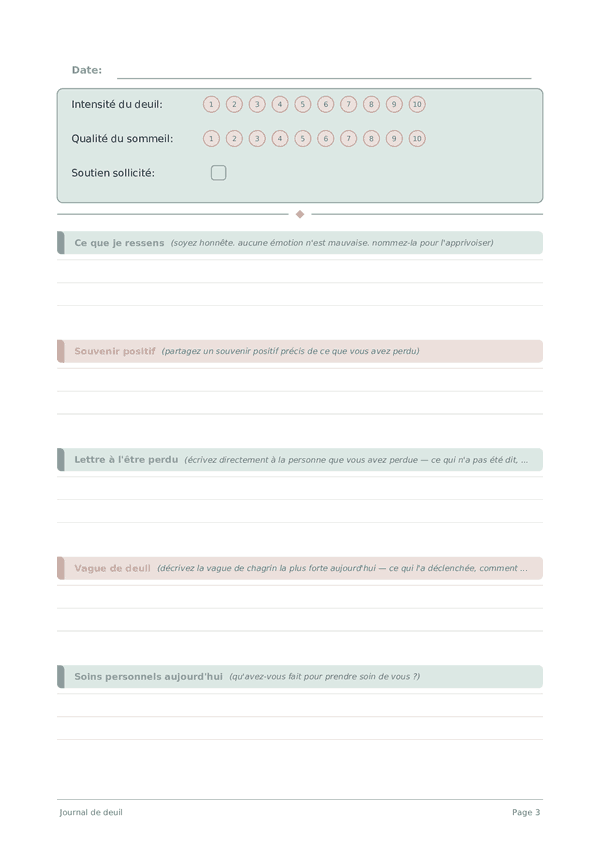
Voici à quoi ressemble une entrée typique une fois remplie :
Comment remplir chaque champ
Le haut de chaque page comporte des champs à remplissage rapide (évaluations, cases à cocher, chiffres). En dessous se trouve une section lignée pour écrire. Voici ce que signifie chaque champ :
Intensité du deuil
Quelle est l'intensité de votre chagrin en ce moment ? Notez de 1 (douleur sourde) à 10 (vague submersive)
Qualité du sommeil
Évaluez la qualité reposante de votre sommeil. 1 signifie terrible et agité, 5 signifie profond et réparateur. La qualité compte autant que la quantité.
Soutien sollicité
Avez-vous appelé, écrit ou parlé à quelqu'un — ami, parrain, famille ou conseiller ?
Ce que je ressens
Décrivez comment vous vous sentez en ce moment avec vos propres mots. Il n'y a pas de mauvaise réponse. Le simple fait de mettre les sentiments sur papier réduit leur charge émotionnelle.
Souvenir positif
Partagez un souvenir positif précis de ce que vous avez perdu
Lettre à l'être perdu
Écrivez directement à la personne que vous avez perdue — ce qui n'a pas été dit, un souvenir, une question, ou simplement « tu me manques »
Vague de deuil
Décrivez la vague de chagrin la plus forte aujourd'hui — ce qui l'a déclenchée, comment vous l'avez ressentie dans votre corps, combien de temps elle a duré
Soins personnels aujourd'hui
Qu'avez-vous fait pour prendre soin de vous ?
Ce pour quoi je suis reconnaissant(e) aujourd'hui
Listez 1 à 3 choses pour lesquelles vous êtes reconnaissant aujourd'hui. Elles peuvent être grandes ou minuscules — un bon repas, un mot gentil, du soleil. Le journal de gratitude est l'une des pratiques de bien-être les plus soutenues scientifiquement.
Conseils pour réussir
Quand et à quelle fréquence écrire
There is no "right" frequency for grief journaling — write when you need to. In acute grief (the first weeks and months), daily writing provides essential release. As grief becomes integrated, write whenever a wave hits or a memory surfaces. Always journal on significant dates: birthdays, anniversaries, holidays. Over time, you may notice the journal shifts from processing pain to preserving connection — both are healthy and valuable.
Questions fréquentes
Que suit et note le Journal du deuil chaque jour ?
Il enregistre l'intensité du deuil (1-10), la qualité du sommeil (1-10), une case indiquant si vous avez cherché du soutien, plus sept lignes d'écriture libre guidée : sentiments, un souvenir, une lettre à l'être cher disparu, description d'une vague de deuil, soins personnels et gratitude. Cette combinaison de suivi et d'écriture expressive s'appuie sur les recherches de Pennebaker. C'est un outil d'adaptation — consultez un spécialiste du deuil si celui-ci envahit votre quotidien.
Comment écrire une lettre productive à l'être cher disparu ?
Adressez-vous à lui par son prénom, écrivez comme s'il vous lisait, et incluez ce que vous auriez voulu dire, des nouvelles actuelles ou des émotions non résolues. L'écriture dans le cadre des « liens continus » est une intervention reconnue en pratique contemporaine du deuil. Gardez les entrées courtes — même trois phrases comptent. Si le deuil s'intensifie au-delà de 6 à 12 mois (critères CIM-11, OMS 2022), consultez un spécialiste.
Le journal peut-il remplacer l'accompagnement au deuil ?
Non. La CIM-11 (OMS, 2022) reconnaît le trouble de deuil prolongé comme une condition clinique lorsque le deuil intense persiste plus de 6 mois avec altération du fonctionnement ; le DSM-5-TR (American Psychiatric Association, 2022) le définit de façon similaire. Le journal soutient le traitement quotidien et fournit des données à partager avec un thérapeute. En cas de crise ou de pensées suicidaires, appelez le **3114** (Numéro National de Prévention du Suicide — France, gratuit, 24h/24).
Qu'est-ce qu'une vague de deuil et comment la décrire ?
Une vague de deuil est une montée soudaine et intense — souvent déclenchée par une chanson, un lieu, un anniversaire ou un signal sensoriel — qui s'atténue en minutes ou heures. Dans votre entrée, notez le déclencheur, la sensation corporelle (oppression, larmes, épuisement) et la durée. Suivre les vagues sur des semaines révèle des déclencheurs personnels, une technique reconnue dans le travail de deuil des « liens continus ». Ces données aident à anticiper les jours difficiles.
En quoi diffère-t-il d'un simple carnet vierge ?
Un carnet vierge offre une expression non structurée. Ce modèle combine le suivi (intensité, sommeil, soutien) avec des questions dirigées — souvenir, lettre, vague, soins personnels — qui s'appuient sur des protocoles d'écriture expressive. Les recherches de Pennebaker, largement citées dans la littérature sur le deuil et le trauma, ont montré que l'écriture dirigée combinant révélation émotionnelle et construction de sens produit des bénéfices plus durables qu'un simple défoulement non guidé.
Est-il normal d'évaluer l'intensité du deuil à 10 après des semaines ou des mois ?
Oui. Le deuil aigu est très variable ; l'intensité peut culminer à des anniversaires, des fêtes ou lors de facteurs de stress sans lien avec la perte. La CIM-11 (OMS, 2022) et le DSM-5-TR (American Psychiatric Association, 2022) signalent le trouble de deuil prolongé uniquement lorsque le deuil intense avec altération du fonctionnement persiste au-delà de 6 à 12 mois. Le journal aide à distinguer les vagues normales d'un schéma nécessitant des soins spécialisés.
Que faire si écrire sur la perte me fait me sentir plus mal ?
Une détresse temporaire pendant l'écriture expressive est documentée dans les recherches de Pennebaker et généralement suivie d'un soulagement. Cependant, si les entrées empirent systématiquement votre état, intensifient les pensées intrusives ou déclenchent une dissociation, suspendez les questions d'écriture et utilisez uniquement les sections de suivi. Ce schéma peut signaler un deuil compliqué ou un trauma nécessitant une aide professionnelle spécialisée.
À quelle fréquence et combien de temps utiliser le Journal du deuil ?
Quotidiennement pendant le deuil aigu (les 3 à 6 premiers mois), puis hebdomadairement à mesure que l'intensité se stabilise. Les critères CIM-11 (OMS, 2022) mesurent la persistance au-delà de 6 mois — évaluez vos résultats à ce stade avec un clinicien si les scores restent constamment élevés. Les anniversaires et les fêtes justifient souvent de revenir temporairement aux entrées quotidiennes. Il n'y a pas de point final fixe — utilisez le journal tant qu'il aide.
Vous aimerez aussi
Molette pour zoomer, glisser pour déplacer