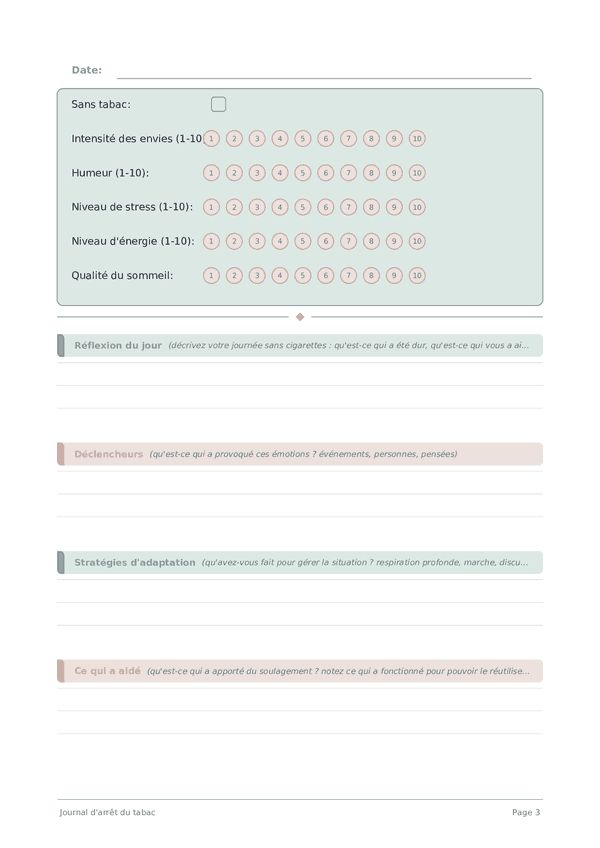
Printable Journal d'arrêt du tabac
Suivi quotidien et réflexion pour votre parcours sans tabac
Combine daily tracking with reflective journaling to support your quit smoking journey. Rate cravings, mood, stress, and energy each day, then write about triggers, coping strategies, and personal victories. Research shows that writing down goals and tracking progress significantly increases success rates in smoking cessation.
Personnaliser les champs
Activez ou désactivez les champs. Cliquez sur le crayon pour renommer, ou ajoutez vos propres champs.
Avantages
Comment utiliser
Qu'est-ce que ce journal ?
A quit smoking journal is a daily support tool for your journey to becoming smoke-free. By tracking your smoke-free status, cravings, mood, and stress alongside reflective writing about triggers and what helped, you build a personalized quit strategy based on real data from your own experience.
This journal is for anyone in the process of quitting smoking — whether you are on day one or day one hundred. Quitting is not a single event but a daily practice that requires self-awareness, strategy, and self-compassion. This journal provides all three.
Smoking cessation research identifies self-monitoring as one of the most effective behavioral strategies for quitting. People who track their cravings and triggers are 2x more likely to successfully quit long-term. The journaling component adds emotional processing that reduces the stress response — one of the primary drivers of relapse — while the daily format creates accountability without pressure.
Exemple rempli
Voici à quoi ressemble une entrée typique une fois remplie :
Comment remplir chaque champ
Le haut de chaque page comporte des champs à remplissage rapide (évaluations, cases à cocher, chiffres). En dessous se trouve une section lignée pour écrire. Voici ce que signifie chaque champ :
Sans tabac
Cochez cette case pour chaque jour sans tabac. Visualiser votre série de jours sans cigarette renforce votre détermination.
Intensité des envies (1-10)
Quelle est l'intensité de vos envies aujourd'hui ? Notez de 1 (à peine perceptible) à 10 (irrésistible)
Humeur (1-10)
Évaluez votre état émotionnel général de la journée. 1 signifie très bas ou déprimé, 10 signifie exceptionnellement heureux et positif. Ne réfléchissez pas trop — fiez-vous à votre instinct.
Niveau de stress (1-10)
Évaluez votre stress sur une échelle de 1 à 10. Avec le temps, vous identifierez vos schémas de stress et les stratégies d'adaptation qui fonctionnent le mieux.
Niveau d'énergie (1-10)
Évaluez votre niveau d'énergie physique et mentale. 1 signifie épuisé et vidé, 10 signifie plein d'énergie et alerte. Cela vous aide à identifier quelles activités stimulent ou drainent votre énergie.
Qualité du sommeil
Évaluez la qualité reposante de votre sommeil. 1 signifie terrible et agité, 5 signifie profond et réparateur. La qualité compte autant que la quantité.
Réflexion du jour
Revenez sur votre journée honnêtement. Qu'est-ce qui s'est bien passé ? Qu'est-ce qui pourrait être amélioré ? Il ne s'agit pas de juger — il s'agit d'apprendre et de grandir.
Déclencheurs
Identifiez ce qui a provoqué vos réactions émotionnelles — événements, personnes, pensées, environnements. Reconnaître les déclencheurs vous donne le pouvoir de vous y préparer ou de les éviter.
Stratégies d'adaptation
Qu'avez-vous fait pour gérer la situation ? Respiration profonde, marche, discussion...
Ce qui a aidé
Qu'est-ce qui a apporté du soulagement ? Notez ce qui a fonctionné pour pouvoir le réutiliser quand l'anxiété monte.
Accomplissements
Qu'avez-vous accompli aujourd'hui ? Listez les tâches terminées et les progrès réalisés
Conseils pour réussir
Quand et à quelle fréquence écrire
Journal every evening for the first 30 days without exception — this is the critical window where habits form and cravings peak. Log cravings in real-time during the day (even a quick note on your phone to expand later). After the first month, maintain daily entries for at least 3 months total. The craving tracker loses urgency around month 2-3, and that is actually the most dangerous time — keep writing. After 3 months, shift to weekly check-ins to guard against complacency.
Questions fréquentes
Que suit le Journal d'arrêt du tabac chaque jour ?
Une case « sans tabac » plus cinq évaluations sur 1 à 10 (intensité des envies, humeur, stress, énergie, qualité du sommeil), avec des questions sur les déclencheurs, les stratégies d'adaptation, ce qui a aidé et les accomplissements. La structure s'aligne sur le suivi décrit dans le rapport du U.S. Surgeon General Smoking Cessation (2020). Elle complète — sans remplacer — les méthodes fondées sur des preuves : TSN, varénicline ou accompagnement.
Comment suivre les variations d'humeur et de stress dues au sevrage ?
Évaluez humeur et stress à la même heure chaque jour — le matin est courant, car les symptômes du sevrage nicotinique culminent la première semaine et s'atténuent en 2 à 4 semaines selon le U.S. Surgeon General (2020). Notez si les évaluations sont liées à des déclencheurs spécifiques (café, après le repas, conduite) ou au sevrage général. Des symptômes sévères persistants justifient un appel à votre médecin — le risque de dépression augmente pendant le sevrage.
Le journal seul suffit-il pour arrêter de fumer ?
Le journal seul a des effets modestes. Le U.S. Surgeon General (2020) et les matériaux CDC montrent que combiner le soutien comportemental avec une pharmacothérapie approuvée (TSN, varénicline, bupropion) double environ le succès du sevrage. Utilisez ce journal avec la ligne d'aide à l'arrêt du tabac : **39 89** (Tabac Info Service — France, gratuit), votre médecin ou un tabacologue pour la combinaison la plus efficace.
À quoi sert l'évaluation de l'intensité des envies ?
Elle suit la force de l'envie la plus forte sur une échelle 0-10. Les envies culminent généralement durant la première semaine et diminuent sur 4 à 12 semaines selon le U.S. Surgeon General (2020). Associer chaque évaluation à son déclencheur (lieu, émotion, heure) constitue une carte personnelle utilisée dans l'accompagnement cognitivo-comportemental à l'arrêt du tabac. La baisse des évaluations semaine après semaine est un signe documenté de neuroadaptation.
En quoi diffère-t-il d'une application d'aide à l'arrêt ?
Les applications automatisent les séries de jours sans tabac et les économies réalisées ; ce modèle papier capture le contenu réflexif — déclencheurs, stratégies d'adaptation, ce qui a spécifiquement fonctionné — qui reflète l'accompagnement TCC décrit dans les documents du U.S. Surgeon General (2020). Inconvénient : pas de notifications. Beaucoup de personnes utilisent les deux, le journal servant de document que leur médecin ou tabacologue consulte pour des ajustements personnalisés.
Puis-je l'utiliser si je diminue avec un substitut nicotinique ?
Oui. La TSN (patchs, gommes, pastilles) est recommandée par le U.S. Surgeon General (2020) comme soutien de première ligne. La case à cocher marque les jours entièrement sans tabac ; la réflexion capture le timing de la TSN et les envies résiduelles. Partagez ces données avec votre prescripteur pour ajuster le dosage. Contactez Tabac Info Service (**39 89**) pour un accompagnement gratuit. Suivez toujours le protocole TSN de votre médecin.
Que faire si je craque et fume une cigarette — dois-je tout recommencer à zéro ?
Un seul écart n'est pas une rechute complète. Les matériaux du CDC et du U.S. Surgeon General (2020) soulignent que la plupart des personnes qui arrêtent ont besoin de plusieurs tentatives. Laissez la case vide pour ce jour, puis écrivez en détail ce qui l'a déclenché et ce que vous feriez différemment. Reprenez le lendemain. Si les écarts se multiplient, contactez votre médecin ou le **39 89** (Tabac Info Service).
Combien de temps utiliser le journal après l'arrêt ?
Le risque de rechute reste élevé pendant au moins 12 mois — le U.S. Surgeon General (2020) documente que la plupart des rechutes surviennent dans les trois premiers mois. Des entrées quotidiennes durant les semaines 1 à 12 sont les plus profitables ; passez à des bilans hebdomadaires jusqu'au mois 12. Continuez plus longtemps en cas de facteurs de stress importants, déclencheurs documentés de rechute.
Vous aimerez aussi
Molette pour zoomer, glisser pour déplacer