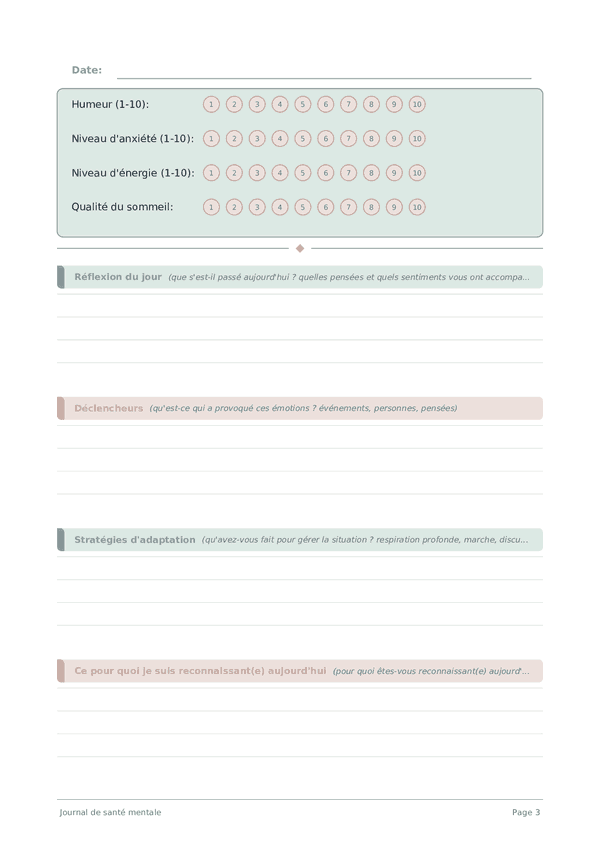
Printable Journal de santé mentale
Un bilan quotidien complet pour votre esprit
Track mood, anxiety, energy, and sleep in one place to get a holistic view of your mental health. Reflect on your day to build emotional awareness and resilience.
Personnaliser les champs
Activez ou désactivez les champs. Cliquez sur le crayon pour renommer, ou ajoutez vos propres champs.
Avantages
Comment utiliser
Qu'est-ce que ce journal ?
A mental health journal is a structured daily check-in that combines mood and wellness tracking with reflective writing. By rating key indicators like mood, anxiety, energy, and sleep quality each day, you build a longitudinal picture of your emotional landscape and the factors that influence it.
This journal serves anyone invested in their psychological well-being — whether you are managing a diagnosed condition, working through a difficult period, or simply want to understand yourself better. Therapists and counselors frequently recommend journaling as a complement to professional treatment.
Research published in the Journal of Affective Disorders indicates that consistent self-monitoring of mood and emotional states improves emotional regulation and helps people identify early warning signs before a downturn becomes a crisis. The combination of quantitative tracking and qualitative reflection creates both data and narrative — two powerful tools for self-understanding.
Exemple rempli
Voici à quoi ressemble une entrée typique une fois remplie :
Comment remplir chaque champ
Le haut de chaque page comporte des champs à remplissage rapide (évaluations, cases à cocher, chiffres). En dessous se trouve une section lignée pour écrire. Voici ce que signifie chaque champ :
Humeur (1-10)
Évaluez votre état émotionnel général de la journée. 1 signifie très bas ou déprimé, 10 signifie exceptionnellement heureux et positif. Ne réfléchissez pas trop — fiez-vous à votre instinct.
Niveau d'anxiété (1-10)
Évaluez votre niveau d'anxiété aujourd'hui. Mettre un chiffre dessus rend le sentiment plus gérable et traçable.
Niveau d'énergie (1-10)
Évaluez votre niveau d'énergie physique et mentale. 1 signifie épuisé et vidé, 10 signifie plein d'énergie et alerte. Cela vous aide à identifier quelles activités stimulent ou drainent votre énergie.
Qualité du sommeil
Évaluez la qualité reposante de votre sommeil. 1 signifie terrible et agité, 5 signifie profond et réparateur. La qualité compte autant que la quantité.
Réflexion du jour
Revenez sur votre journée honnêtement. Qu'est-ce qui s'est bien passé ? Qu'est-ce qui pourrait être amélioré ? Il ne s'agit pas de juger — il s'agit d'apprendre et de grandir.
Déclencheurs
Identifiez ce qui a provoqué vos réactions émotionnelles — événements, personnes, pensées, environnements. Reconnaître les déclencheurs vous donne le pouvoir de vous y préparer ou de les éviter.
Stratégies d'adaptation
Qu'avez-vous fait pour gérer la situation ? Respiration profonde, marche, discussion...
Ce pour quoi je suis reconnaissant(e) aujourd'hui
Listez 1 à 3 choses pour lesquelles vous êtes reconnaissant aujourd'hui. Elles peuvent être grandes ou minuscules — un bon repas, un mot gentil, du soleil. Le journal de gratitude est l'une des pratiques de bien-être les plus soutenues scientifiquement.
Ce qui s'est bien passé
Même les petites victoires comptent — nommez-en au moins une
Conseils pour réussir
Quand et à quelle fréquence écrire
Fill in the tracker daily to build a reliable mental health baseline. The writing section can be brief on good days (2–3 sentences) and longer on hard days (as much as you need). Review weekly to spot trends. If you're in therapy, review your journal before each session — it helps you make the most of your time with your therapist.
Questions fréquentes
Que capture ce journal qu'un seul score d'humeur ne capte pas ?
Il sépare quatre dimensions — humeur, niveau anxiété, énergie, qualité_sommeil — sur des échelles de 0 à 10. Les cadres d'évaluation clinique du NIMH traitent ces éléments comme des indicateurs distincts plutôt que comme un composite unique. Une journée avec faible énergie mais humeur stable se lit différemment d'une humeur basse avec énergie normale, et la section de réflexion te permet d'enregistrer le contexte que les chiffres seuls ne peuvent capturer.
Comment partager ce journal avec mon thérapeute ?
Apporte deux à quatre semaines d'entrées complétées à une séance. Les recommandations de pratique clinique de l'APA traitent les données générées par le client comme complémentaires à l'évaluation. Mets en évidence les jours où les notes ont divergé fortement, ou où un seul déclencheur est apparu dans plusieurs entrées. Beaucoup de thérapeutes utilisent ce format comme données entre séances ; demande s'ils préfèrent le tracker, la réflexion ou les deux.
Que mettre dans « déclencheurs » versus « ce qui s est bien passé » ?
Les déclencheurs sont les situations, pensées, personnes ou environnements qui ont fait baisser tes notes. Ce qui s est bien passé capture le contraire — les moments qui ont élevé l'humeur ou restauré l'énergie. Ensemble, ils cartographient ta régulation quotidienne de l'affect. La théorie élargir-et-construire de Fredrickson (2001, American Psychologist, 56(3)) soutient l'enregistrement actif d'événements positifs pour élargir les répertoires comportementaux avec le temps.
En quoi est-ce différent du Journal d'anxiété ou du Journal d'humeur ?
Le Journal de santé mentale est plus large et moins fréquent : il échantillonne quatre dimensions centrales plus une réflexion ouverte, adapté à un bilan quotidien. Le Journal d'anxiété se centre sur les registres de pensées TCC ; le Journal d'humeur met l'accent sur la granularité émotionnelle. Choisis selon le besoin — une anxiété diagnostiquée oriente vers le Journal d'anxiété, un auto-suivi large vers celui-ci.
Cela peut-il m'aider à remarquer les premiers signes de déclin ?
Oui, c'est une utilisation centrale. Le modèle cognitif de Beck et le modèle comportemental de la dépression de Lewinsohn soulignent tous deux la dérive lente du sommeil, de l'énergie et de l'humeur comme signaux prodromiques. Suivre des semaines de notes de 0 à 10 rend les tendances à la baisse visibles avant qu'elles n'atteignent des seuils de crise. Si tu observes un déclin soutenu, contacte rapidement un professionnel de santé mentale agréé.
Que faut-il écrire dans « stratégies de coping » ?
Note spécifiquement ce que tu as fait et comment ça s'est passé. Aldao, Nolen-Hoeksema, Schweizer (2010, Clinical Psychology Review, 30(2)) ont constaté que la réévaluation cognitive et l'acceptation corrèlent avec de meilleurs résultats ; la rumination et l'évitement avec de moins bons. Catégoriser tes stratégies — « j'ai marché », « j'ai scrollé les réseaux sociaux » — sur plusieurs semaines révèle ce qui améliore vraiment tes notes.
Est-il sûr de l'utiliser si j'ai des pensées d'automutilation ?
Le journal ne remplace pas les soins de crise. Si tu as des pensées d'automutilation ou de suicide, contacte immédiatement les services d'urgence ou une ligne de crise. En France : le 3114 (Numéro National de Prévention du Suicide, gratuit, 24h/24) ou le 15 (SAMU) pour toute urgence. Les recommandations de l'OMS et de l'APA soulignent l'intervention professionnelle comme primaire. Le journal peut compléter un traitement en cours mais ne doit pas retarder une aide urgente.
À quelle fréquence remplir la section de réflexion ?
Vise le tracker quotidiennement, la réflexion trois à cinq fois par semaine. La réflexion quotidienne fonctionne pour certains mais en fatigue d'autres ; Burton et King (2004, Journal of Research in Personality, 38(2)) ont montré que même une brève écriture expressive produisait des effets, tandis que Pennebaker (1997, Psychological Science, 8(3)) a démontré que trois à quatre séances par semaine sont souvent suffisantes pour les bénéfices de traitement émotionnel.
Vous aimerez aussi
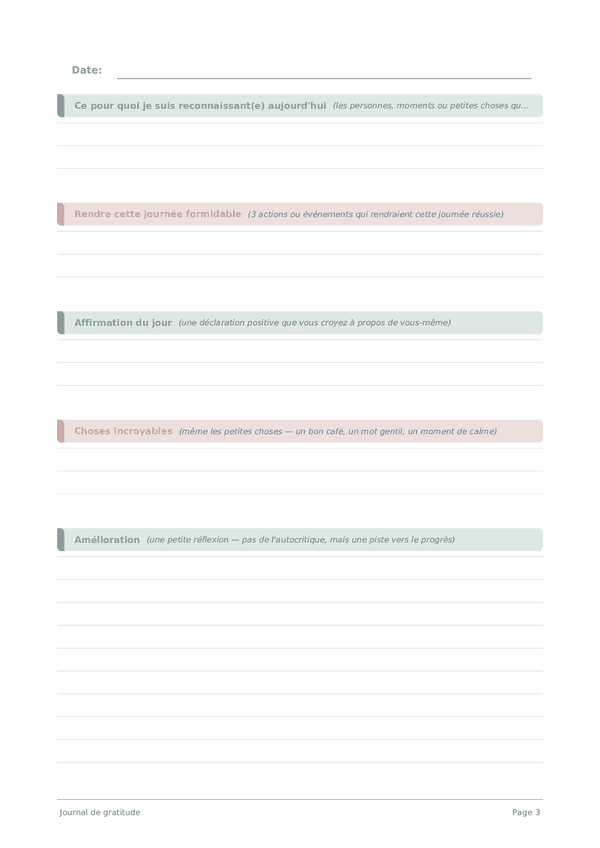
Journal de gratitude
Cultivez la reconnaissance et la positivité au quotidien
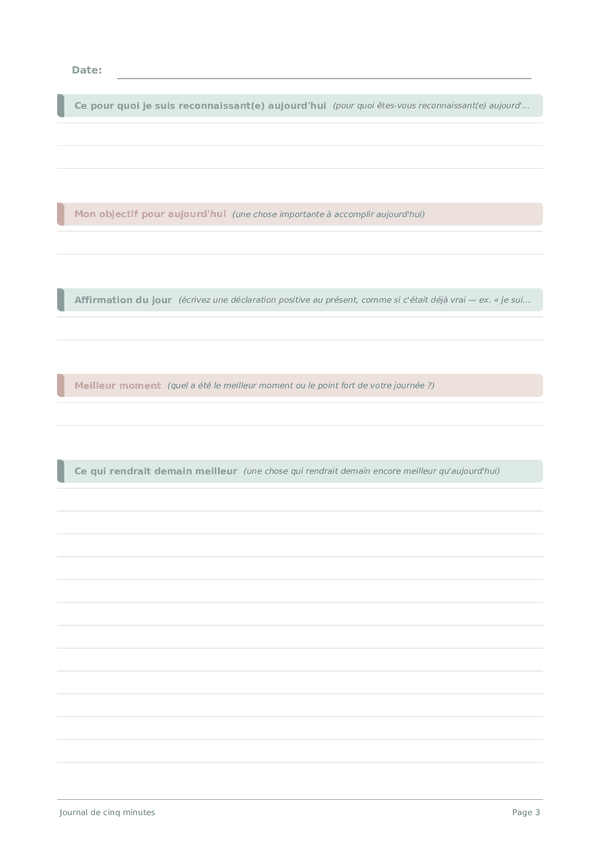
Journal de cinq minutes
Journal quotidien de gratitude et de réflexion en cinq minutes
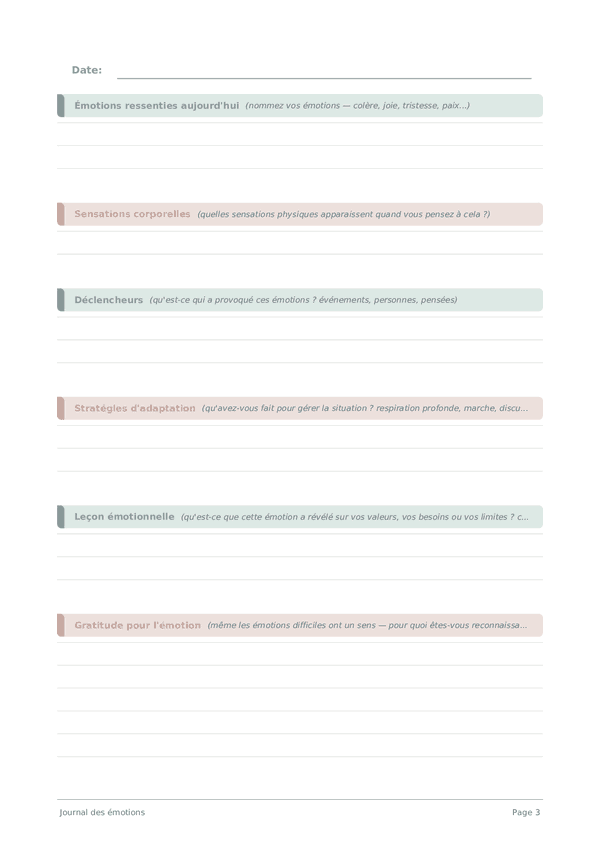
Journal des émotions
Comprenez, traitez et grandissez à travers vos émotions
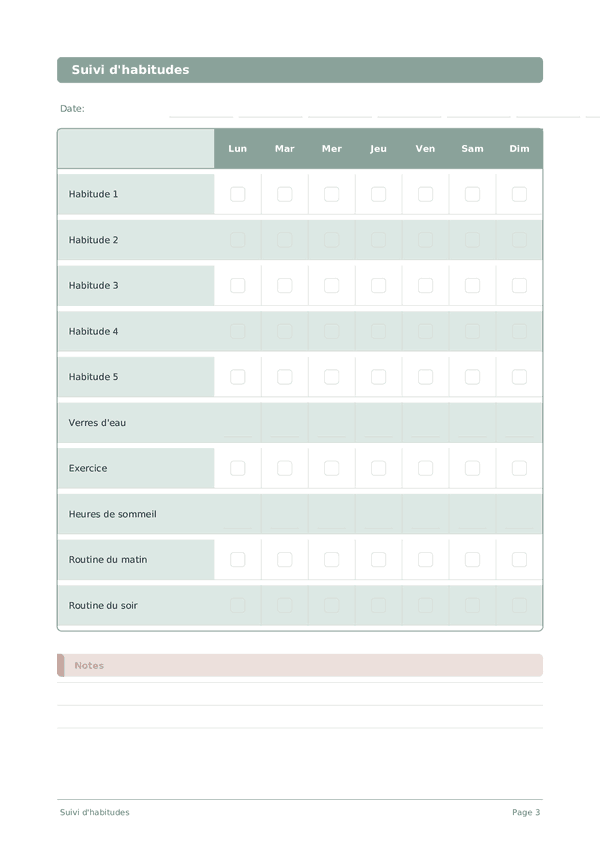
Suivi d'habitudes
Construisez de meilleures habitudes jour après jour
Molette pour zoomer, glisser pour déplacer