Printable Journal de pleine conscience
Ancrez-vous dans le moment présent grâce à l'écriture quotidienne inspirée du MBSR
The Mindfulness Journal is built on evidence-based principles from Mindfulness-Based Stress Reduction (MBSR), developed by Jon Kabat-Zinn at the University of Massachusetts. Each daily entry guides you through a structured sequence: setting an intention, scanning your body, sharpening sensory awareness, cultivating gratitude, and practicing self-compassion. By writing without judgment, you train your attention to rest in the present — the foundation of every proven mindfulness program.
Personnaliser les champs
Activez ou désactivez les champs. Cliquez sur le crayon pour renommer, ou ajoutez vos propres champs.
Avantages
Comment utiliser
Qu'est-ce que ce journal ?
A mindfulness journal is a daily writing practice designed to anchor you in the present moment and cultivate non-judgmental awareness. Rooted in Buddhist meditation traditions and adapted by modern psychology, mindfulness journaling combines structured reflection with contemplative exercises to reduce mental chatter and increase inner calm.
Research from Harvard Medical School and the University of Massachusetts shows that regular mindfulness practice reduces cortisol levels, shrinks the brain's stress center (amygdala), and strengthens areas associated with attention and emotional regulation. Writing is a particularly effective mindfulness tool because it forces you to slow down and articulate your inner experience.
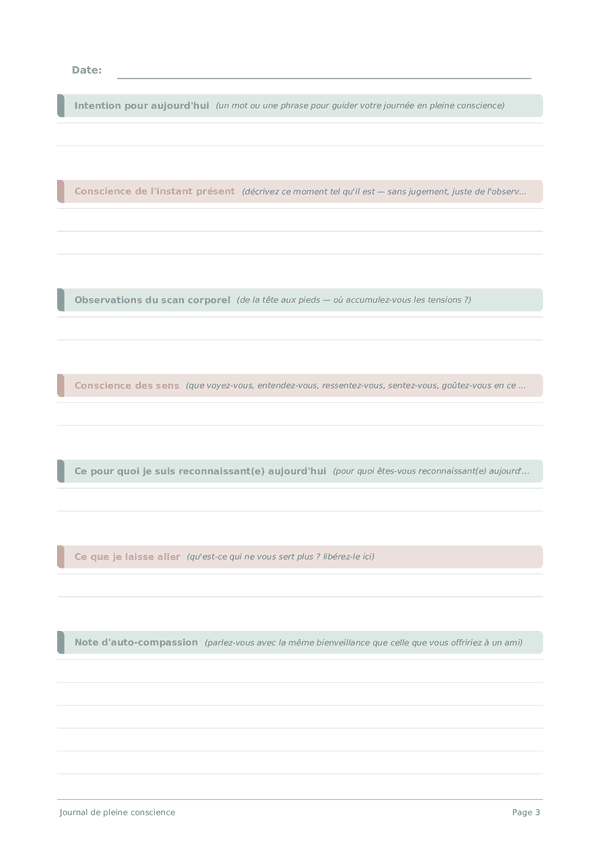
This journal guides you through seven focused sections: setting an intention, present-moment awareness, body scan observations, sensory awareness, gratitude, letting go, and self-compassion. Each section takes just 1-2 minutes, making the entire practice achievable in under 15 minutes.
Exemple rempli
Voici à quoi ressemble une entrée typique une fois remplie :
Comment remplir chaque champ
Chaque jour, vous trouverez plusieurs sections étiquetées avec des lignes pour écrire. Voici à quoi sert chaque section :
Intention pour aujourd'hui
Un mot ou une phrase pour guider votre journée en pleine conscience
Conscience de l'instant présent
Décrivez ce que vous remarquez en ce moment — sons, sensations, pensées. Cela vous ancre dans le présent et développe la conscience de pleine attention.
Observations du scan corporel
Scannez de la tête aux pieds — où y a-t-il de la tension, de la chaleur, de l'engourdissement ou du relâchement ? Observez simplement sans chercher à changer quoi que ce soit
Conscience des sens
Que voyez-vous, entendez-vous, ressentez-vous, sentez-vous, goûtez-vous en ce moment ?
Ce pour quoi je suis reconnaissant(e) aujourd'hui
Listez 1 à 3 choses pour lesquelles vous êtes reconnaissant aujourd'hui. Elles peuvent être grandes ou minuscules — un bon repas, un mot gentil, du soleil. Le journal de gratitude est l'une des pratiques de bien-être les plus soutenues scientifiquement.
Ce que je laisse aller
Écrivez quelque chose que vous êtes prêt à lâcher — une inquiétude, un ressentiment ou une attente. Nommer ce que vous lâchez est le premier pas vers la libération.
Note d'auto-compassion
Parlez-vous avec la même bienveillance que celle que vous offririez à un ami
Conseils pour réussir
Quand et à quelle fréquence écrire
Write once a day, ideally right after your meditation or mindfulness practice while awareness is heightened. Morning practice followed by immediate journaling is the most effective pattern — you capture insights while they're vivid. If you don't have a formal practice, use the journal itself as a 5-minute mindfulness exercise: sit, breathe, observe, then write.
Questions fréquentes
Qu'est-ce que le MBSR et pourquoi ce journal y est-il fondé ?
Le MBSR (Mindfulness-Based Stress Reduction) a été développé par Jon Kabat-Zinn à l'Université du Massachusetts Medical Center en 1979 et reste l'une des interventions de pleine conscience les plus étudiées. Khoury et al. (2015, Journal of Psychosomatic Research, 78(6)) ont méta-analysé 29 études et trouvé que le MBSR produisait des effets modérés sur le stress et l'anxiété chez les adultes en bonne santé. Les sections du journal reflètent ses pratiques fondamentales.
Comment faire correctement le « scan corporel observations » ?
Le scan corporel est l'une des pratiques d'ancrage du MBSR. Déplace lentement ton attention des pieds à la tête, en remarquant les sensations, la température, la tension ou leur absence — sans essayer de changer quoi que ce soit. Deux lignes suffisent pour un résumé : où tu as remarqué la tension, où se trouvait l'aisance. Kerr et al. (2013, Frontiers in Human Neuroscience, 7) ont constaté qu'une pratique régulière du scan corporel modifiait la régulation du cortex somatosensoriel.
Quelle est la différence entre pleine conscience et relaxation ?
La pleine conscience est une conscience non jugeante de l'expérience présente, y compris le contenu désagréable. La relaxation vise à réduire l'excitation. Kabat-Zinn les distingue explicitement : le MBSR cultive l'équanimité avec ce qui est, pas des sentiments agréables. Goyal et al. (2014, JAMA Internal Medicine, 174(3)) ont trouvé que les programmes de pleine conscience amélioraient l'anxiété et la dépression là où la simple relaxation n'atteignait pas la même taille d'effet.
Que fait la « note d autocompassion » dans un journal de pleine conscience ?
La recherche de Kristin Neff sur l'autocompassion (Neff, 2003, Self and Identity, 2(2)) l'identifie comme un construit sœur de la pleine conscience — trois piliers : pleine conscience, humanité commune, bonté envers soi. Des programmes dérivés du MBSR comme le Mindful Self-Compassion (MSC) les intègrent. La ligne de clôture t'entraîne à t'adresser à toi-même comme tu parlerais à un ami qui lutte avec la même difficulté.
Comment « conscience des sens » est-elle liée à l'ancrage ?
Nommer ce que tu vois, entends, touches, sens et goûtes est la technique classique d'ancrage 5-4-3-2-1 utilisée dans les soins tenant compte des traumatismes et la tolérance à la détresse DBT (Linehan). Elle ancre l'attention dans le présent sensoriel, interrompant les boucles de rumination que Watkins (2008, Psychological Bulletin, 134(2)) a identifiées comme transdiagnostiques dans la dépression et l'anxiété. Les deux lignes forcent la sélection de données vivantes du moment présent.
Faut-il tenir le journal avant ou après la méditation ?
Après. L'établissement d'intention peut être fait avant, mais scan corporel, conscience des sens et lâcher prise sont plus clairs si tu t'es d'abord assis. Killingsworth et Gilbert (2010, Science, 330(6006)) ont montré que l'errance de l'esprit corrèle avec un bonheur moindre ; une courte séance avant l'écriture réduit l'errance et produit des entrées plus honnêtes. Même cinq minutes de conscience de la respiration affinisent le résultat du journal.
La tenue d'un journal de pleine conscience est-elle appropriée lors d'un rétablissement après un traumatisme ?
Sois prudent. Certains survivants de traumatismes vivent une détresse accrue pendant la pleine conscience axée sur le corps — Treleaven (Trauma-Sensitive Mindfulness, Norton, 2018) et les recherches de Britton et al. (2021, Clinical Psychological Science, 9(6)) documentent des effets indésirables. Si tu as un historique de traumatisme, consulte un professionnel de santé mentale agréé formé aux traumatismes avant une pratique soutenue. Modifie ou raccourcis le scan corporel selon tes besoins.
Combien de temps avant que la tenue du journal de pleine conscience produise des résultats ?
Le MBSR est un protocole de 8 semaines parce que c'est approximativement quand des changements mesurables émergent. Tang, Holzel et Posner (2015, Nature Reviews Neuroscience, 16(4)) ont examiné des changements neuronaux apparaissant en quelques semaines. Les entrées quotidiennes — même dix minutes — sur 8 semaines atteignent le seuil de dosage utilisé par la plupart des études. Une pratique irrégulière produit des résultats irréguliers ; le journal soutient l'observance.
Vous aimerez aussi
Journal de gratitude
Cultivez la reconnaissance et la positivité au quotidien
Journal de cinq minutes
Journal quotidien de gratitude et de réflexion en cinq minutes
Journal des émotions
Comprenez, traitez et grandissez à travers vos émotions
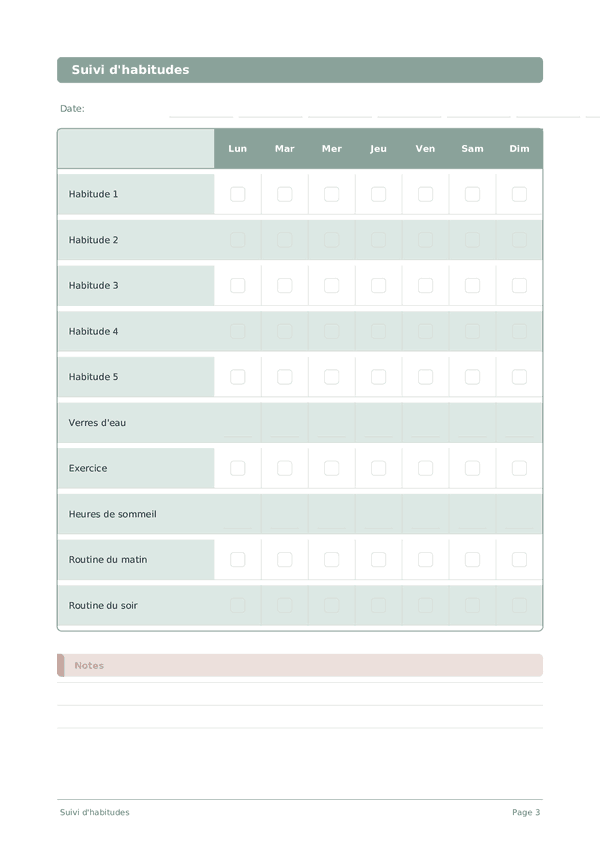
Suivi d'habitudes
Construisez de meilleures habitudes jour après jour
Molette pour zoomer, glisser pour déplacer