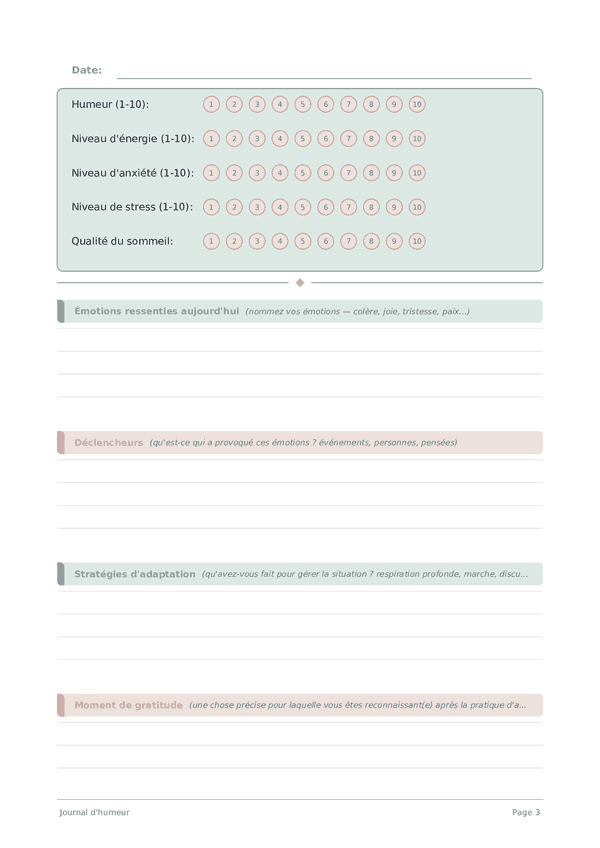
Printable Journal d'humeur
Suivez vos émotions, repérez les tendances et développez votre conscience émotionnelle
A comprehensive daily mood journal that combines quantitative tracking with reflective writing. Rate your mood, energy, anxiety, stress, and sleep quality each day, then explore what emotions you felt, what triggered them, how you coped, what you are grateful for, and what patterns you noticed. Grounded in cognitive behavioral therapy and positive psychology research, this hybrid format helps you develop emotional intelligence, recognize recurring triggers, and build a personalized toolkit for emotional resilience.
Personnaliser les champs
Activez ou désactivez les champs. Cliquez sur le crayon pour renommer, ou ajoutez vos propres champs.
Avantages
Comment utiliser
Qu'est-ce que ce journal ?
A mood journal is a daily self-monitoring tool that helps you understand the connection between your emotions, energy, sleep, and daily experiences. By tracking your mood numerically alongside written reflections, you create a personal emotional map that reveals patterns invisible in the moment.
Mood tracking is widely recommended by therapists and psychologists as a foundational practice for emotional intelligence. It helps you identify what triggers negative moods, what activities boost your wellbeing, and how factors like sleep and stress interact with your emotional state. Over weeks, the data becomes genuinely insightful.
This journal combines quick numerical ratings (mood, energy, anxiety, stress, sleep quality) with guided writing prompts for deeper exploration. The hybrid format means you can fill in the tracker in under a minute on busy days, while the writing section invites you to dig deeper when you have more time.
Exemple rempli
Voici à quoi ressemble une entrée typique une fois remplie :
Comment remplir chaque champ
Le haut de chaque page comporte des champs à remplissage rapide (évaluations, cases à cocher, chiffres). En dessous se trouve une section lignée pour écrire. Voici ce que signifie chaque champ :
Humeur (1-10)
Évaluez votre état émotionnel général de la journée. 1 signifie très bas ou déprimé, 10 signifie exceptionnellement heureux et positif. Ne réfléchissez pas trop — fiez-vous à votre instinct.
Niveau d'énergie (1-10)
Évaluez votre niveau d'énergie physique et mentale. 1 signifie épuisé et vidé, 10 signifie plein d'énergie et alerte. Cela vous aide à identifier quelles activités stimulent ou drainent votre énergie.
Niveau d'anxiété (1-10)
Évaluez votre niveau d'anxiété aujourd'hui. Mettre un chiffre dessus rend le sentiment plus gérable et traçable.
Niveau de stress (1-10)
Évaluez votre stress sur une échelle de 1 à 10. Avec le temps, vous identifierez vos schémas de stress et les stratégies d'adaptation qui fonctionnent le mieux.
Qualité du sommeil
Évaluez la qualité reposante de votre sommeil. 1 signifie terrible et agité, 5 signifie profond et réparateur. La qualité compte autant que la quantité.
Émotions ressenties aujourd'hui
Nommez les émotions spécifiques que vous avez ressenties. La recherche montre que nommer les émotions réduit leur intensité et augmente la conscience de soi.
Déclencheurs
Identifiez ce qui a provoqué vos réactions émotionnelles — événements, personnes, pensées, environnements. Reconnaître les déclencheurs vous donne le pouvoir de vous y préparer ou de les éviter.
Stratégies d'adaptation
Qu'avez-vous fait pour gérer la situation ? Respiration profonde, marche, discussion...
Moment de gratitude
Une chose précise pour laquelle vous êtes reconnaissant(e) après la pratique d'aujourd'hui
Éclairage sur l'humeur
Quel schéma ou quelle leçon sur vos émotions avez-vous remarqué aujourd'hui ?
Conseils pour réussir
Quand et à quelle fréquence écrire
Fill in your mood tracker at the end of each day, ideally at the same time (before bed works well). The tracker numbers take under a minute. Add a few sentences of reflection — this is where the real insight lives. After two weeks, start reviewing your data weekly to spot which days score highest and what they have in common.
Questions fréquentes
Comment cinq notes et un récit surpassent-ils un seul score d'humeur ?
Cinq échelles de 0 à 10 — humeur, énergie, niveau anxiété, niveau stress, qualité_sommeil — séparent des construits distincts qui évoluent indépendamment. La recherche PANAS de Watson, Clark et Tellegen (1988, JPSP, 54(6)) a établi que les affects positifs et négatifs ne sont pas les extrémités opposées d'un seul axe. Associer les chiffres à un récit capture à la fois la forme dimensionnelle de ta journée et son sens.
Qu'est-ce que l'« insight humeur » et comment en trouver un ?
Insight humeur est un schéma, une leçon ou une observation que tu as remarqué sur ta vie émotionnelle aujourd'hui. C'est l'étape de synthèse. Le travail de Wilson et Gilbert sur la prévision affective (2003, Advances in Experimental Social Psychology, 35) montre que nous prédisons mal nos émotions sans données. Écrire un insight hebdomadaire à partir de tes notes transforme des sentiments abstraits en connaissance de soi actionnable.
À quel point faut-il être précis dans « émotions ressenties » ?
Utilise des mots précis, pas « bien » ou « mal ». Kashdan, Barrett, McKnight (2015, Current Directions in Psychological Science, 24(1)) ont montré que la granularité émotionnelle — distinguer « seul » de « rejeté » d'« isolé » — prédit une meilleure régulation. Une section de 7 lignes laisse de la place pour nommer trois ou quatre sentiments distincts. L'« insight humeur » du journal repose sur cette résolution.
Comment ce journal utilise-t-il la psychologie positive ?
À travers instant de gratitude et la section d'insight. Le cadre de psychologie positive de Seligman (Seligman et al., 2005, American Psychologist, 60(5)) intègre l'identification des émotions positives et la construction du sens, tous deux présents ici. Lyubomirsky (The How of Happiness, Penguin, 2007) rapporte que les pratiques de gratitude contribuent à des gains durables de bien-être. Le format hybride combine cela avec un suivi de déclencheurs et coping de style TCC.
Quels schémas chercher après un mois ?
Fais trois vérifications : quels jours de la semaine corrèlent avec une humeur basse, quels déclencheurs apparaissent dans plus de trois entrées, et si qualité_sommeil précède le changement d'humeur du lendemain. La recherche de Watson sur les affects circadiens et hebdomadaires et les schémas de rumination cartographiés par Watkins (2008, Psychological Bulletin, 134(2)) suggèrent tous deux que la révision hebdomadaire fait émerger des schémas invisibles au jour le jour.
Faut-il noter l'humeur au même moment chaque jour ?
Oui — idéalement le soir pour une évaluation rétrospective de la journée. L'heure de la journée affecte fortement l'humeur notée (Stone et al., 2006, Emotion, 6(1) sur les schémas d'humeur diurnes). Échantillonner à différents moments mélange du bruit diurne dans ta ligne de tendance. Choisis une heure et protège-la ; la cohérence de mesure révèle de vrais changements plutôt que des artefacts d'heure de la journée.
Est-ce suffisant pour les troubles cliniques de l'humeur ?
Non. Le journal soutient la conscience de soi et peut compléter le traitement, mais les troubles de l'humeur diagnostiqués — dépression majeure, trouble bipolaire, dysthymie — nécessitent des soins cliniques. Les recommandations de l'APA, du NIMH et de l'OMS recommandent un traitement fondé sur des preuves d'un professionnel de santé mentale agréé. Beaucoup de cliniciens utilisent le suivi d'humeur parallèlement à la thérapie ; demande si ce format leur est utile.
En quoi est-ce différent des applis de suivi des émotions ?
Les applis génèrent des données longitudinales mais réduisent la réflexion à des tapotements. La disposition hybride force le traitement écrit — Lieberman et al. (2007, Psychological Science, 18(5)) ont montré que nommer les émotions en mots réduit la réactivité de l'amygdale, un effet produit par le langage et non par la sélection. Le récit de sept lignes capture les évaluations qui alimentent les notes, ce qui rend les données actionnables.
Vous aimerez aussi
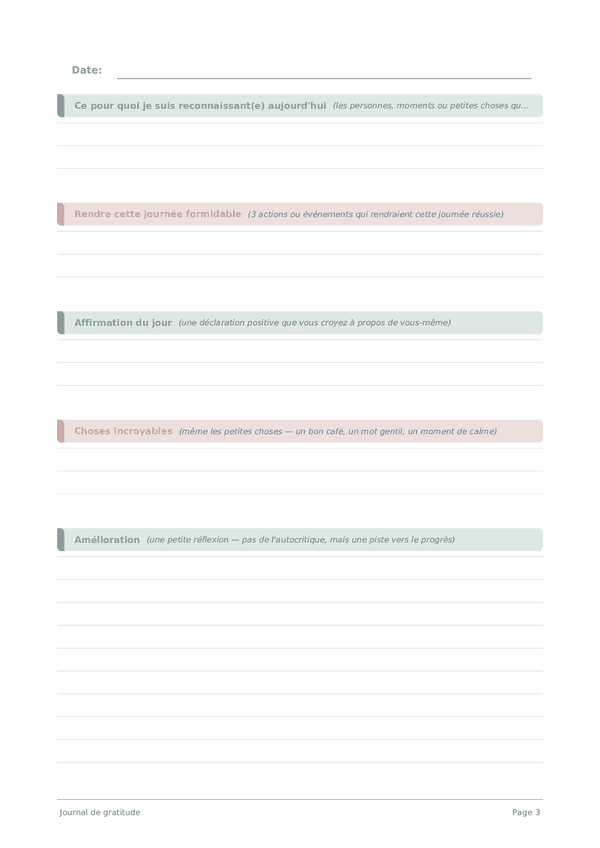
Journal de gratitude
Cultivez la reconnaissance et la positivité au quotidien
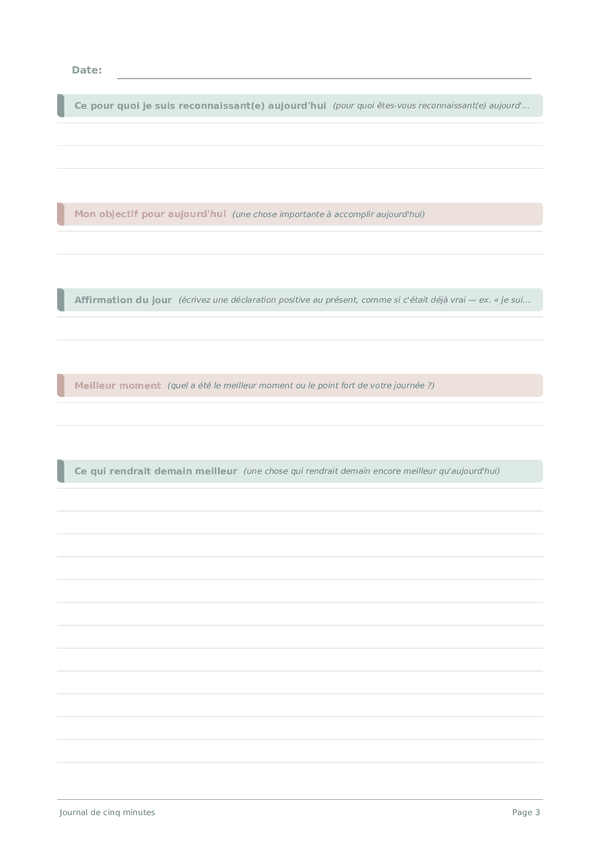
Journal de cinq minutes
Journal quotidien de gratitude et de réflexion en cinq minutes
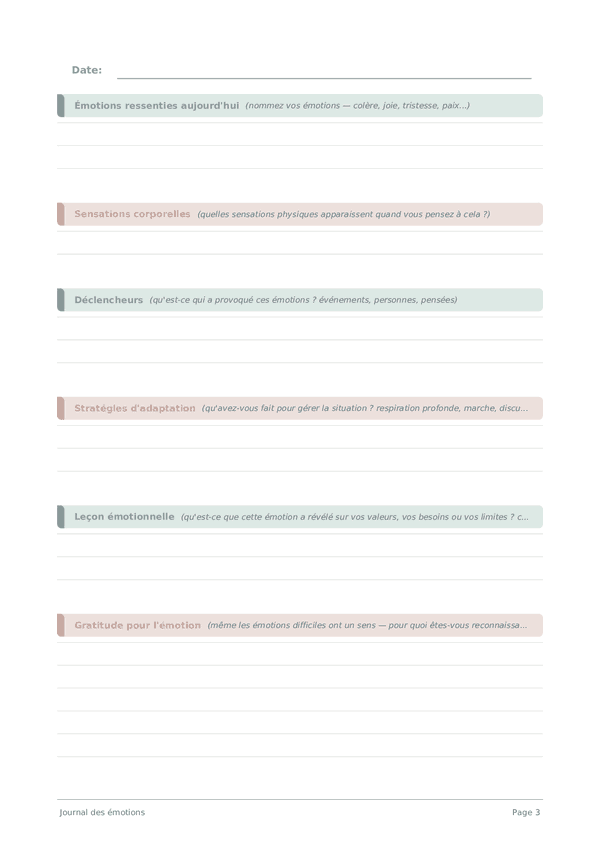
Journal des émotions
Comprenez, traitez et grandissez à travers vos émotions
Suivi d'habitudes
Construisez de meilleures habitudes jour après jour
Molette pour zoomer, glisser pour déplacer