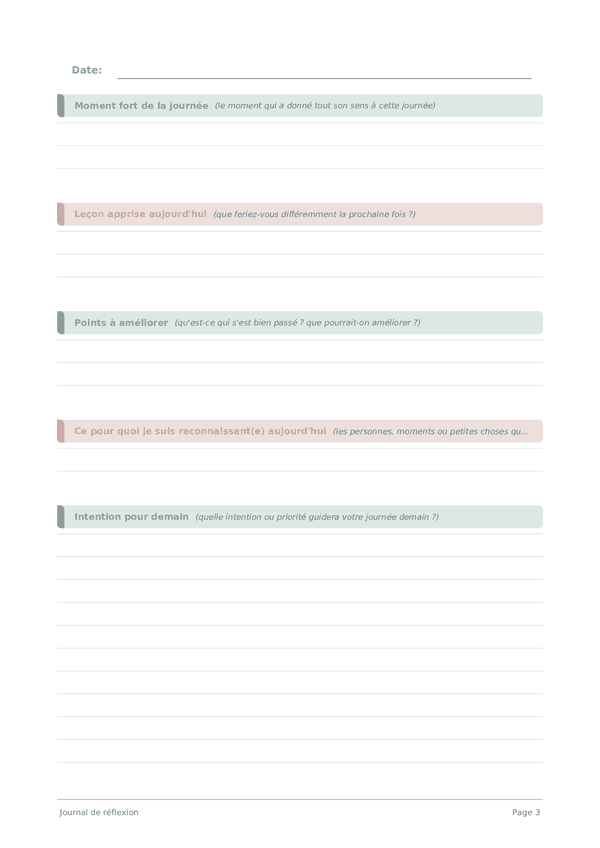
Printable Journal de réflexion
Terminez chaque journée avec clarté, perspicacité et intention
The Reflection Journal is a structured end-of-day review that takes just 5–10 minutes. Capture the day's highlight, the key lesson you learned, one area to improve, what you're grateful for, and your intention for tomorrow. This five-part ritual turns daily experience into lasting growth — building self-awareness, gratitude, and purposeful momentum one evening at a time.
Personnaliser les champs
Activez ou désactivez les champs. Cliquez sur le crayon pour renommer, ou ajoutez vos propres champs.
Avantages
Comment utiliser
Qu'est-ce que ce journal ?
A reflection journal is your daily space for looking back at the day with honest eyes. Unlike forward-looking planners, this journal is about learning from lived experience — celebrating wins, processing challenges, extracting lessons, and consciously designing better tomorrows based on what today taught you.
Reflective practice is a cornerstone of continuous improvement, used by everyone from military leaders to CEOs to therapists. Studies show that employees who spend 15 minutes reflecting at the end of the day perform 23% better than those who do not. The act of reflection transforms raw experience into usable wisdom.
This journal's five-section structure — highlight, lesson learned, areas for improvement, gratitude, and tomorrow's intention — creates a balanced reflective practice that avoids both toxic positivity and unproductive self-criticism. Each entry becomes a conversation with yourself about what matters most.
Exemple rempli
Voici à quoi ressemble une entrée typique une fois remplie :
Comment remplir chaque champ
Chaque jour, vous trouverez plusieurs sections étiquetées avec des lignes pour écrire. Voici à quoi sert chaque section :
Moment fort de la journée
Quel a été le meilleur moment de votre journée ? Capturez l'instant qui a donné de la valeur à cette journée. Ces moments forts deviennent une collection de vos souvenirs les plus heureux.
Leçon apprise aujourd'hui
Retenez un enseignement de l'expérience d'aujourd'hui. Avec le temps, ces leçons deviennent une bibliothèque de sagesse personnelle.
Points à améliorer
Identifiez un domaine spécifique où vous pouvez faire mieux demain. Soyez constructif, pas critique — il s'agit de croissance, pas d'auto-jugement.
Ce pour quoi je suis reconnaissant(e) aujourd'hui
Listez 1 à 3 choses pour lesquelles vous êtes reconnaissant aujourd'hui. Elles peuvent être grandes ou minuscules — un bon repas, un mot gentil, du soleil. Le journal de gratitude est l'une des pratiques de bien-être les plus soutenues scientifiquement.
Intention pour demain
Quelle intention ou priorité guidera votre journée demain ?
Conseils pour réussir
Quand et à quelle fréquence écrire
Write every evening as part of your wind-down routine — 10–15 minutes before bed. Reflection works best when you have the full day to look back on, but you're not yet exhausted. If daily is too much, write at least on Wednesday (mid-week check-in) and Sunday (full-week reflection). Over time, the evening reflection habit becomes a form of self-coaching.
Questions fréquentes
Qu'est-ce qui rend cette structure en cinq parties efficace ?
Point culminant, leçon apprise, choses_à_améliorer, reconnaissant pour, intention demain couvrent ensemble l'amplification des événements positifs (recherche de Bryant sur la savouration, 2003, Journal of Mental Health, 12(2)), la construction du sens (Park, 2010, Psychological Bulletin, 136(2)), la gratitude et les intentions d'implémentation (Gollwitzer, 1999, American Psychologist, 54(7)). Chaque mécanisme fondé sur des preuves tient en une courte section, s'inscrivant dans une fenêtre de 5 à 10 minutes.
Comment écrire une « leçon apprise » utile ?
Convertis l'expérience en principe transférable, pas en autocritique. Park (2010, Psychological Bulletin, 136(2)) sur la construction du sens et le cycle d'apprentissage expérientiel de Kolb traitent tous deux la réflexion comme l'étape qui transforme les événements en apprentissage. Une leçon utile est une phrase indiquant ce que tu sais maintenant et que tu peux appliquer demain — pas « je n'aurais pas dû faire X » mais « les réunions à 8h du matin épuisent mon focus matinal ».
Pourquoi y a-t-il une ligne « intention demain » ?
Les intentions d'implémentation — plans si-alors — comblent le fossé entre savoir et faire. Gollwitzer (1999, American Psychologist, 54(7)) et Gollwitzer et Sheeran (2006, Advances in Experimental Social Psychology, 38) ont méta-analysé 94 études montrant que les intentions spécifiées avec des déclencheurs situationnels doublaient les taux d'action. Deux lignes suffisent pour une déclaration si-alors claire, pas une longue liste de choses à faire.
« Choses_à_améliorer » est-ce la même chose que l'autocritique ?
Non, et la distinction compte. Neff (2011, Self-Compassion, William Morrow) a montré que l'autocompassion corrèle avec la croissance et la motivation ; une dure autocritique prédit l'inverse. Formule la ligne comme une prochaine étape constructive — ce que tu ferais différemment — pas un jugement moral. Trois lignes devraient produire un changement spécifique et actionnable, pas une liste d'échecs.
Quand le faire — vraiment le soir ?
La fin de journée est conventionnelle, mais les recherches sont mitigées. Le sommeil consolide les souvenirs émotionnels (Walker, 2009, Annals of the New York Academy of Sciences, 1156) ; réfléchir avant de dormir peut préparer le traitement. Certains trouvent la réflexion tardive ruminative — Trapnel et Campbell (1999, JPSP, 76(2)) ont distingué la réflexion saine de la rumination. Si la réflexion t'empêche de dormir, décale-la en début de soirée.
Que faire si ma journée n'a pas de vrai « point culminant » ?
Trouve le plus petit moment positif honnêtement. La théorie élargir-et-construire de Fredrickson (2001, American Psychologist, 56(3)) a montré que même de petits événements positifs ont des effets mesurables lorsqu'on les remarque. La recherche de Bryant sur la savouration suggère qu'accorder délibérément de l'attention aux micro-positifs — un bon café, un échange aimable — entraîne la détection de l'affect positif. Trois lignes accommodent le petit ; tu n'as pas besoin d'une expérience de pic.
En quoi est-ce différent d'un journal de gratitude ?
Un journal de gratitude se concentre sur un mécanisme. Le Journal de réflexion ajoute la construction du sens, la révision constructive et l'intention prospective — un cycle de fin de journée plus complet. Emmons et McCullough (2003, JPSP, 84(2)) ont établi les effets de la gratitude ; les interventions axées sur la réflexion comme le « meilleur soi possible » de Seligman et al. (2005, American Psychologist, 60(5)) opèrent par des mécanismes différents mais complémentaires.
À quelle vitesse faut-il s'attendre à des résultats ?
Seligman et al. (2005, American Psychologist, 60(5)) ont trouvé qu'un exercice structuré de psychologie positive produisait des changements de bien-être détectables en une semaine et maintenus six mois. Pour repérer des schémas entre les jours, attends 2 à 4 semaines. La structure en cinq parties est densément chargée, donc la complétion quotidienne sur un mois est la dose minimale pour voir si elle te convient.
Vous aimerez aussi
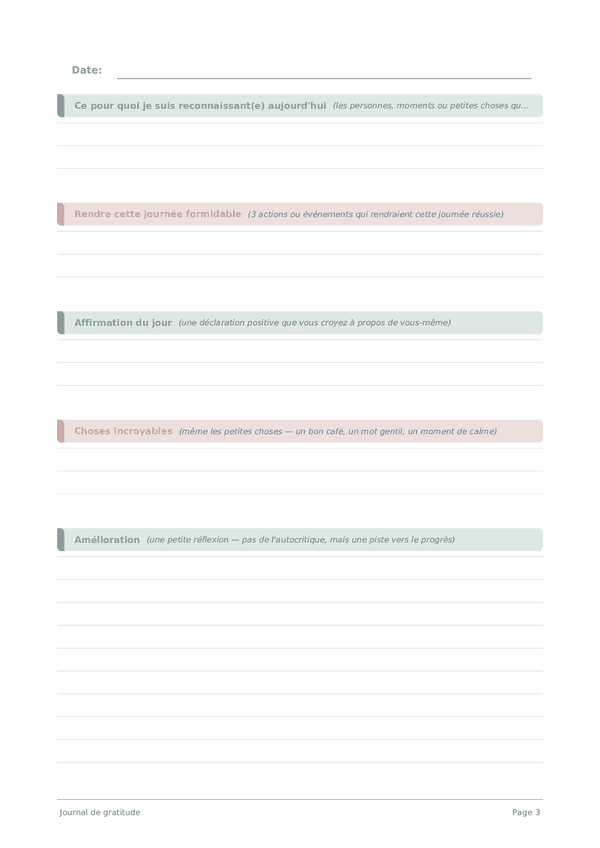
Journal de gratitude
Cultivez la reconnaissance et la positivité au quotidien
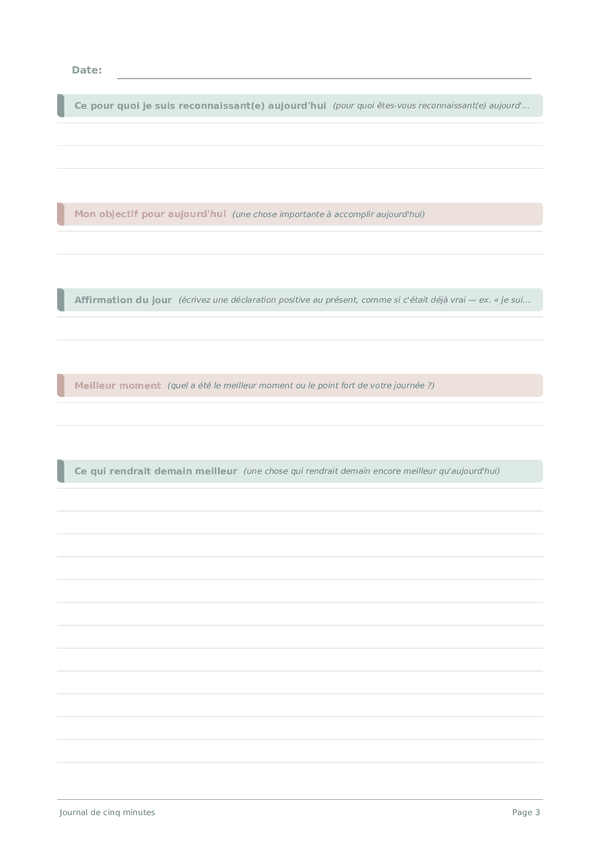
Journal de cinq minutes
Journal quotidien de gratitude et de réflexion en cinq minutes
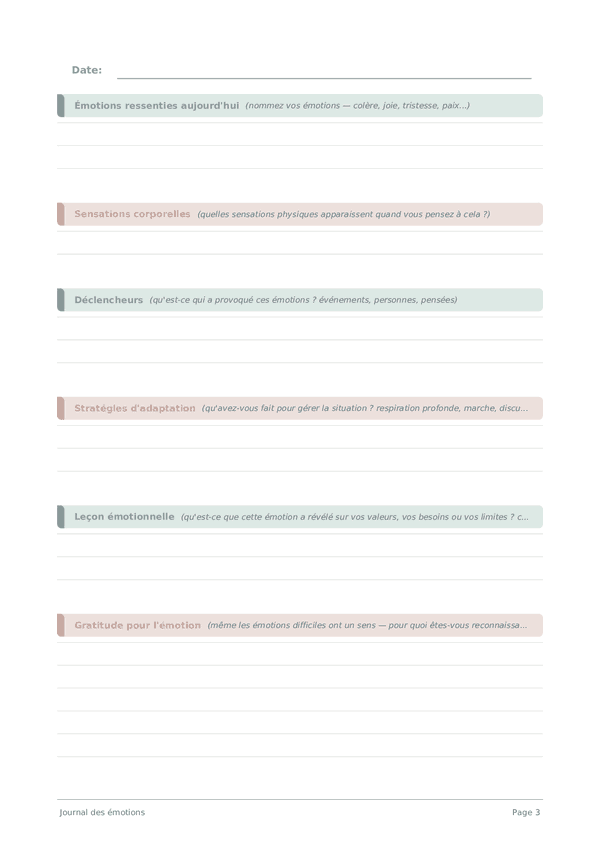
Journal des émotions
Comprenez, traitez et grandissez à travers vos émotions
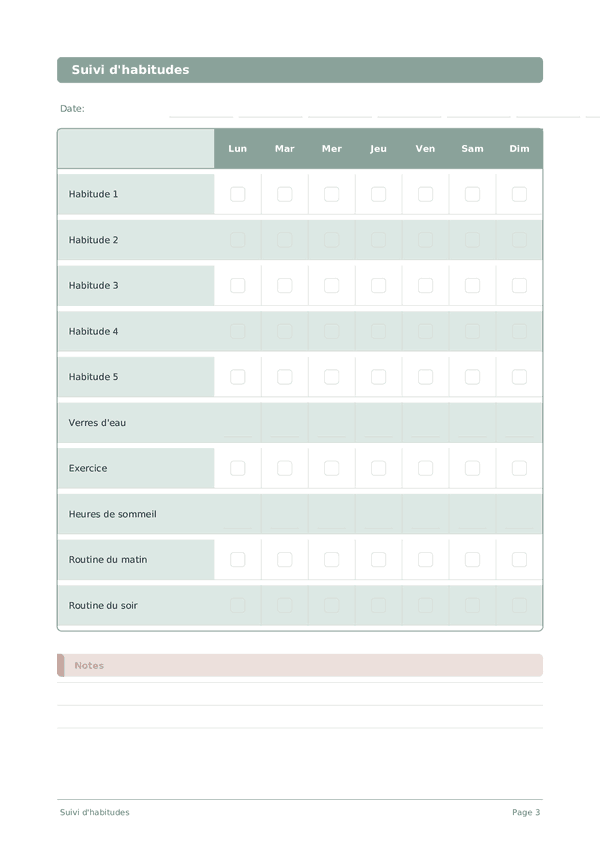
Suivi d'habitudes
Construisez de meilleures habitudes jour après jour
Molette pour zoomer, glisser pour déplacer