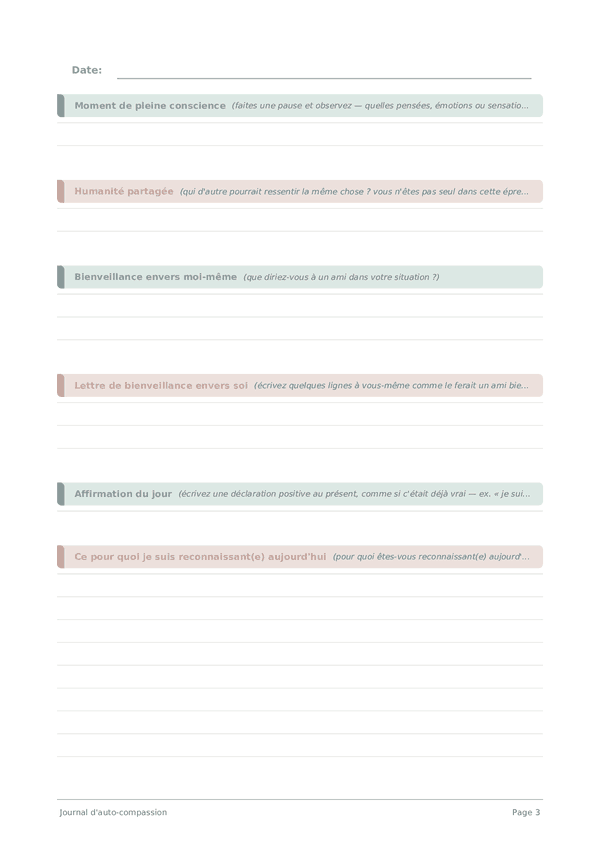
Printable Journal d'auto-compassion
Pratique quotidienne d'auto-compassion et de bienveillance intérieure
Cultivate genuine self-compassion through Kristin Neff three-pillar practice: mindfulness, common humanity, and self-kindness. Treat yourself with the same warmth and understanding you would offer a dear friend.
Personnaliser les champs
Activez ou désactivez les champs. Cliquez sur le crayon pour renommer, ou ajoutez vos propres champs.
Qu'est-ce que ce journal ?
A self-compassion journal is a daily practice built on Dr. Kristin Neff's three pillars of self-compassion: mindfulness, common humanity, and self-kindness. Each entry guides you through recognizing suffering without over-identifying with it, remembering that struggle is universally human, and treating yourself with the same warmth you would offer a friend.
This journal is for anyone who tends to be their own harshest critic — perfectionists, overachievers, people-pleasers, and anyone who finds it easier to be compassionate to others than to themselves. It is particularly powerful during periods of failure, loss, or transition.
Research shows that self-compassion is a stronger predictor of mental health than self-esteem. While self-esteem depends on achievement and comparison, self-compassion provides a stable foundation of self-worth regardless of outcomes. Regular self-compassion practice has been shown to reduce cortisol, increase emotional resilience, and decrease symptoms of anxiety and depression.
Exemple rempli
Voici à quoi ressemble une entrée typique une fois remplie :
Comment remplir chaque champ
Chaque jour, vous trouverez plusieurs sections étiquetées avec des lignes pour écrire. Voici à quoi sert chaque section :
Moment de pleine conscience
Faites une pause et observez — quelles pensées, émotions ou sensations sont présentes en ce moment, sans jugement ?
Humanité partagée
Qui d'autre pourrait ressentir la même chose ? Vous n'êtes pas seul dans cette épreuve
Bienveillance envers moi-même
Écrivez quelque chose de bienveillant envers vous-même, comme vous le feriez pour un ami cher traversant la même expérience. L'auto-compassion est une compétence qui se développe avec la pratique.
Lettre de bienveillance envers soi
Écrivez quelques lignes à vous-même comme le ferait un ami bienveillant — avec chaleur, compréhension et encouragement
Affirmation du jour
Écrivez une déclaration positive sur vous-même au présent, comme si c'était déjà vrai. Par exemple : « Je suis capable et résilient. » Répéter des affirmations reprogramme vos schémas de pensée avec le temps.
Ce pour quoi je suis reconnaissant(e) aujourd'hui
Listez 1 à 3 choses pour lesquelles vous êtes reconnaissant aujourd'hui. Elles peuvent être grandes ou minuscules — un bon repas, un mot gentil, du soleil. Le journal de gratitude est l'une des pratiques de bien-être les plus soutenues scientifiquement.
Conseils pour réussir
Quand et à quelle fréquence écrire
Write daily, ideally in the evening when you can reflect on moments of self-criticism from the day. Each entry takes 10 minutes. Focus on one moment of difficulty and walk through the three pillars: mindfulness (acknowledging pain without exaggerating), common humanity (recognizing others share this), and self-kindness (treating yourself gently). After three weeks of daily practice, self-compassion begins to feel less forced and more natural. Review weekly to notice which self-critical patterns are losing their grip.
Questions fréquentes
Quels sont les trois piliers de l'autocompassion selon Kristin Neff ?
Pleine conscience, humanité commune et bonté envers soi — définis dans Neff (2003, Self and Identity, 2(2)) et développés dans ses travaux publiés ultérieurs. Les sections du journal instant de pleine conscience, humanité_commune et bonté_envers_soi correspondent directement à ces piliers. Le programme Mindful Self-Compassion (MSC) de Neff et Germer (Neff et Germer, 2013, Journal of Clinical Psychology, 69(1)) a montré des améliorations mesurables du bien-être sur un protocole de 8 semaines.
Que mettre dans « humanité_commune » ?
La reconnaissance que la lutte que tu traverses te connecte aux autres plutôt que t'isoler. Neff (2003, Self and Identity, 2(2)) a identifié l'isolement comme un obstacle central dans l'autocritique — « moi seul lutte avec ça ». Deux lignes : nomme la difficulté et indique comment elle fait partie de l'expérience humaine partagée. Cela recadre le jugement de soi comme un schéma universel, pas un défaut personnel.
En quoi la « bonté_envers_soi » est-elle différente de l'indulgence ?
Neff et Vonk (2009, Journal of Personality, 77(1)) ont explicitement distingué l'autocompassion de l'auto-indulgence — l'autocompassion implique de se traiter avec soin tout en soutenant la croissance, pas d'éviter les choses difficiles. Trois lignes suffisent pour une bonté qui te tient responsable, pas pour une permission de te désengager. « Je vais me reposer ce soir » diffère de « je vais rater la deadline ».
Que doit faire la « lettre de bonté_envers_soi » ?
C'est une intervention basée sur l'imagerie adaptée du programme MSC de Neff et Germer (Neff et Germer, 2013, Journal of Clinical Psychology, 69(1)). Trois lignes pour t'écrire comme tu écrirais à un ami dans la même situation. La recherche de Neff et la thérapie focalisée sur la compassion de Gilbert (Gilbert, 2009, The Compassionate Mind, Constable) montrent tous deux que cet exercice d'écriture de lettres adoucit la voix autocritique.
L'autocompassion diminue-t-elle la motivation ?
Non — c'est le contraire. Breines et Chen (2012, Personality and Social Psychology Bulletin, 38(9)) ont constaté que l'autocompassion après un échec augmentait la motivation à s'améliorer par rapport à l'autocritique. L'autocompassion fournit la sécurité pour reconnaître les erreurs ; l'autocritique dure déclenche souvent l'évitement. La structure du journal soutient un traitement de soi orienté vers la croissance, pas la complaisance.
Est-ce approprié pendant la dépression ?
Souvent bénéfique mais pas curatif. MacBeth et Gumley (2012, Clinical Psychology Review, 32(6)) ont méta-analysé l'autocompassion et l'ont trouvée systématiquement associée à une moindre psychopathologie. La recherche MSC de Neff et Germer montre des bénéfices dans les échantillons sous-cliniques et cliniques. Pour la dépression diagnostiquée, consulte un professionnel de santé mentale agréé — la pratique d'autocompassion complète mais ne remplace pas le traitement fondé sur des preuves.
En quoi est-ce différent de la pensée positive ou des affirmations ?
L'autocompassion reconnaît la difficulté plutôt que la supplanter. Neff et Vonk (2009, Journal of Personality, 77(1)) ont montré que l'autocompassion produisait un bien-être plus stable que l'estime de soi parce qu'elle ne dépend pas d'évaluations positives. La section instant de pleine conscience invite explicitement à contacter la douleur ; les pratiques d'affirmation la dépassent souvent. Des mécanismes différents, des outils complémentaires.
Combien de temps avant de voir des effets ?
Neff et Germer (2013, Journal of Clinical Psychology, 69(1)) ont utilisé un protocole MSC de 8 semaines avec des améliorations mesurables du bien-être. Les entrées quotidiennes sur cette période approchent la dose. L'autocritique est souvent bien pratiquée depuis des années ; attends une résistance au début et des changements notables après 4 à 8 semaines d'entrées régulières. Le format compact en six sections maintient la complétion quotidienne réaliste.
Vous aimerez aussi
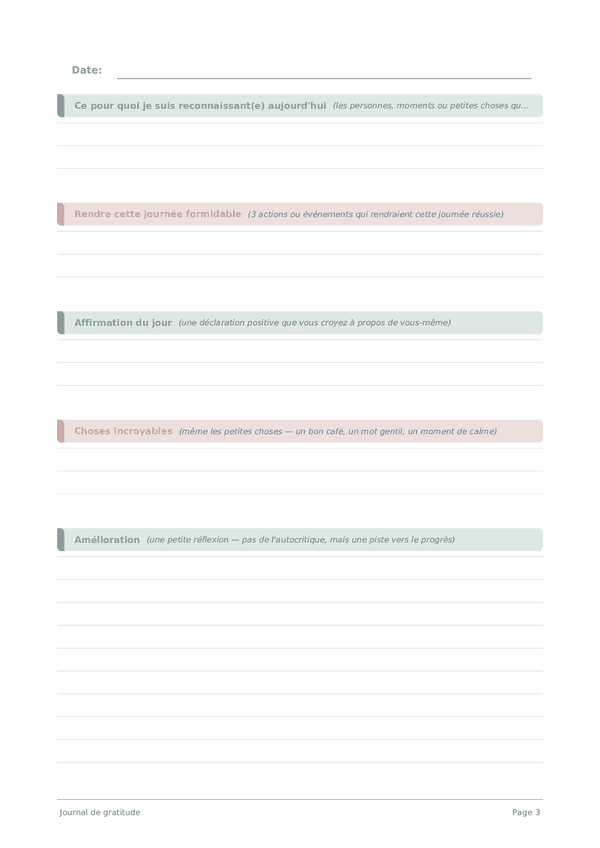
Journal de gratitude
Cultivez la reconnaissance et la positivité au quotidien
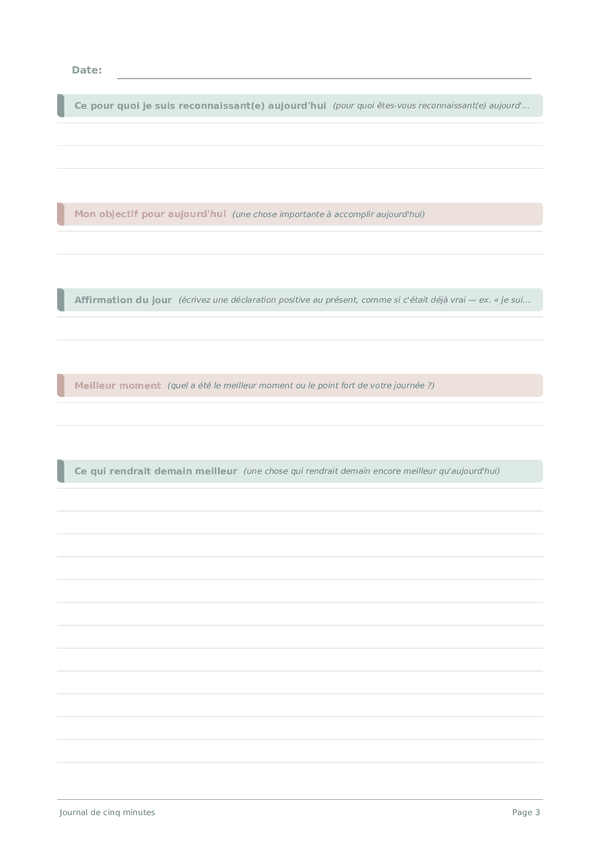
Journal de cinq minutes
Journal quotidien de gratitude et de réflexion en cinq minutes
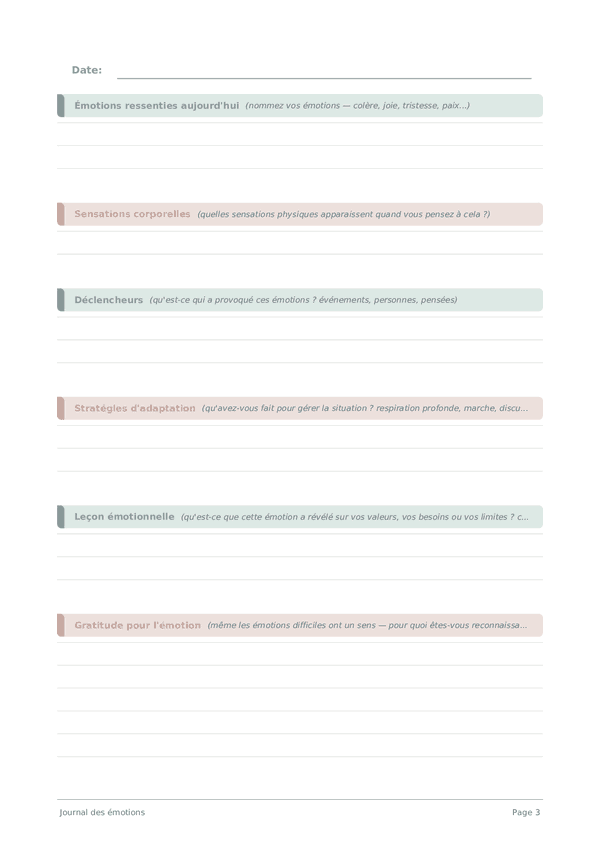
Journal des émotions
Comprenez, traitez et grandissez à travers vos émotions
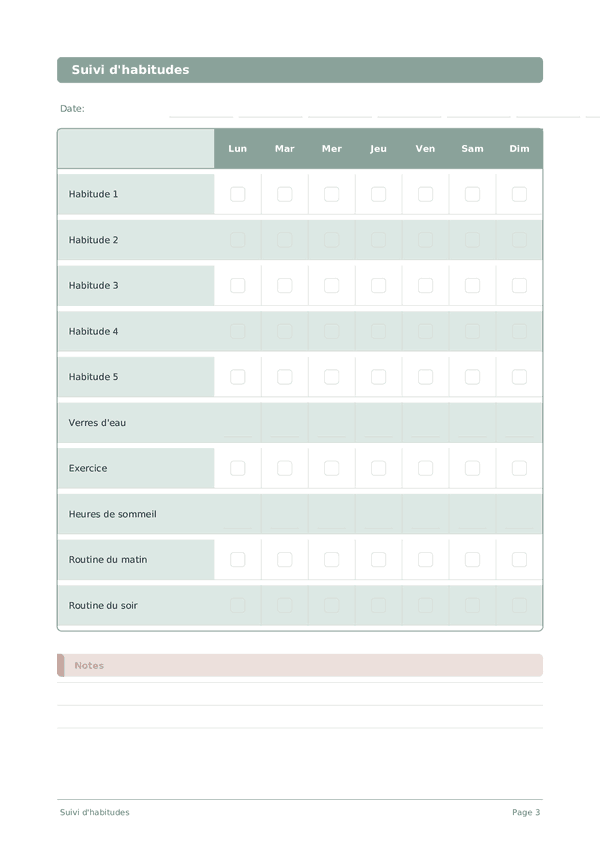
Suivi d'habitudes
Construisez de meilleures habitudes jour après jour
Molette pour zoomer, glisser pour déplacer