Printable Journal d'estime de soi
Renforcement quotidien de l'estime de soi et de la force intérieure
Strengthen your self-worth through daily recognition of accomplishments, positive qualities, and strengths. Challenge negative self-talk, practice self-compassion, and build unshakeable confidence from within.
Personnaliser les champs
Activez ou désactivez les champs. Cliquez sur le crayon pour renommer, ou ajoutez vos propres champs.
Qu'est-ce que ce journal ?
A self-esteem journal is a daily writing practice that systematically builds a healthier relationship with yourself. Each entry guides you through recognizing your accomplishments, identifying your positive qualities, and reframing negative self-talk — the three pillars of sustainable self-worth.
This journal is for anyone who struggles with self-criticism, imposter syndrome, or a persistent inner voice that minimizes their achievements. It is particularly valuable during transitions — new jobs, relationship changes, or any period when self-doubt tends to amplify.
Psychological research on self-compassion, led by Dr. Kristin Neff, demonstrates that structured positive self-reflection rewires habitual thought patterns over time. By writing down evidence of your strengths and worth daily, you counteract the negativity bias that makes criticism stick and compliments slide off.
Exemple rempli
Voici à quoi ressemble une entrée typique une fois remplie :
Comment remplir chaque champ
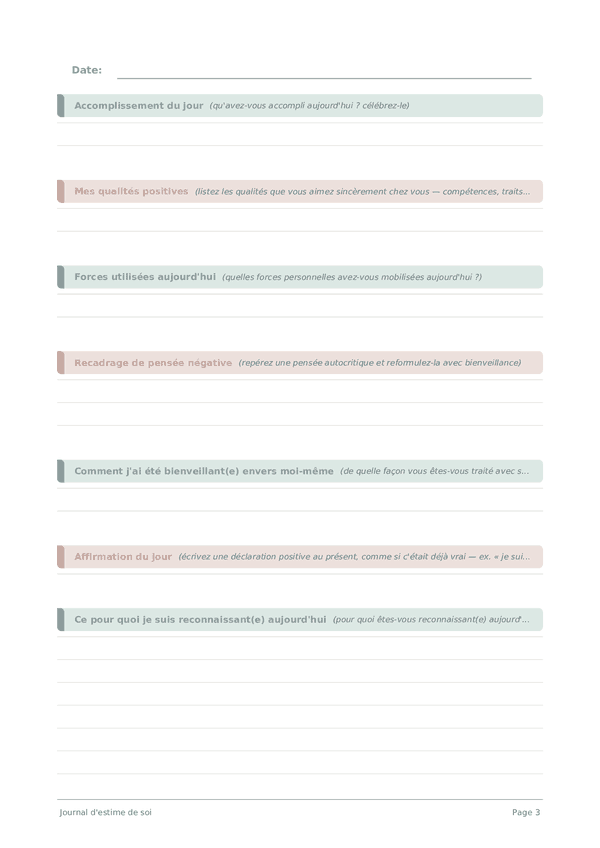
Chaque jour, vous trouverez plusieurs sections étiquetées avec des lignes pour écrire. Voici à quoi sert chaque section :
Accomplissement du jour
Notez quelque chose que vous avez accompli aujourd'hui, aussi petit soit-il. Reconnaître les petites victoires quotidiennes renforce la confiance et l'élan.
Mes qualités positives
Listez vos forces, talents et traits positifs. Nous oublions souvent nos propres qualités. Relire cette liste les jours difficiles peut être remarquablement réconfortant.
Forces utilisées aujourd'hui
Quelles forces personnelles avez-vous mobilisées aujourd'hui ?
Recadrage de pensée négative
Repérez une pensée autocritique et reformulez-la avec bienveillance
Comment j'ai été bienveillant(e) envers moi-même
De quelle façon vous êtes-vous traité avec soin, patience ou compassion aujourd'hui ?
Affirmation du jour
Écrivez une déclaration positive sur vous-même au présent, comme si c'était déjà vrai. Par exemple : « Je suis capable et résilient. » Répéter des affirmations reprogramme vos schémas de pensée avec le temps.
Ce pour quoi je suis reconnaissant(e) aujourd'hui
Listez 1 à 3 choses pour lesquelles vous êtes reconnaissant aujourd'hui. Elles peuvent être grandes ou minuscules — un bon repas, un mot gentil, du soleil. Le journal de gratitude est l'une des pratiques de bien-être les plus soutenues scientifiquement.
Conseils pour réussir
Quand et à quelle fréquence écrire
Write every evening, spending 10 minutes reflecting on how you spoke to yourself today. Self-esteem shifts gradually, so daily practice matters more than session length. After two weeks of daily entries, review them all in one sitting — you will likely notice you are kinder to yourself than you realized. Monthly, revisit your strengths list and add new ones. Building self-esteem is slow, steady work, and this journal is your daily proof that you are showing up for yourself.
Questions fréquentes
Pourquoi le journal inclut-il le « recadrage pensée négative » ?
Une faible estime de soi est maintenue en partie par des pensées automatiques négatives sur soi. Fennell (Overcoming Low Self-Esteem, Robinson, 1999) et la TCC pour l'estime de soi (basée sur Beck, Cognitive Therapy and the Emotional Disorders, 1976) traitent l'identification et la restructuration des pensées comme centrales. La section de trois lignes laisse de la place pour écrire la pensée négative mot pour mot et une alternative équilibrée — le mécanisme actif.
En quoi « qualités positives » est-il différent des accomplissements ?
L'accomplissement est ce que tu as fait ; les qualités positives sont qui tu es. La Classification VIA des forces de caractère (Peterson et Seligman, 2004, Character Strengths and Virtues, Oxford) traite des traits comme la gentillesse, la persévérance, l'équité comme des attributs de niveau identitaire. Deux lignes pour nommer une ou deux qualités que tu as remarquées en toi aujourd'hui déplace l'attention de la production vers le caractère.
Pourquoi combiner le travail sur l'estime de soi avec l'autocompassion (« bienveillance envers soi ») ?
Neff (2003, Self and Identity, 2(2) ; 2011, Self-Compassion, William Morrow) a montré que l'autocompassion corrèle avec un bien-être stable sans la contingence que la haute estime de soi peut introduire. Crocker et Wolfe (2001, Psychological Review, 108(3)) sur les contingences de la valeur de soi ont averti que l'estime de soi liée à la performance est fragile. Le journal les associe pour ancrer la valeur dans le traitement de soi, pas les réalisations.
Qu'est-ce qu'une entrée « forces utilisées aujourd hui » utile ?
Identifie un moment spécifique plus la force déployée — « j'ai donné un retour honnête en réunion ; c'est du courage ». Le travail de repérage des forces de Niemiec et la classification VIA (Peterson et Seligman, 2004) suggèrent que le repérage quotidien des forces développe une conscience que la faible estime de soi filtre autrement. Deux lignes forcent la sélection ; tu entraînes la perception, pas le catalogage.
Écrire des affirmations rehaussera-t-il réellement l'estime de soi ?
Avec soin. Wood, Perunovic, Lee (2009, Psychological Science, 20(7)) ont constaté que les affirmations positives génériques aggravaient l'humeur chez les participants ayant une faible estime de soi. Le journal associe l'affirmation à des preuves concrètes dans d'autres champs, ce que la recherche soutient. Utilise la ligne d'affirmation pour des déclarations que tu peux crédiblement tenir. Si l'estime de soi est persistamment basse, consulte un professionnel de santé mentale agréé.
Comment l'entrée quotidienne reconditionne-t-elle la perception de soi ?
Par un changement cumulatif du biais attentionnel. Mor et Winquist (2002, Psychological Bulletin, 128(4)) sur l'attention auto-focalisée et la recherche sur la discordance de soi (Higgins, 1987, Psychological Review, 94(3)) montrent que le focus répété sur le contenu auto-relatif façonne la conception de soi. La consignation quotidienne des accomplissements, qualités et forces repèse ce que ton esprit retient des données auto-pertinentes. Des mois, pas des jours ; attends des changements mesurables après 8 à 12 semaines.
Ce journal est-il adapté si j'ai une dépression clinique ?
Il peut soutenir mais pas remplacer le traitement. Une faible estime de soi co-existe avec la dépression mais ce sont des construits distincts (Sowislo et Orth, 2013, Psychological Bulletin, 139(1) méta-analyse). Si tu as une dépression diagnostiquée, consulte un professionnel de santé mentale agréé — la TCC, l'activation comportementale ou la pharmacothérapie peuvent être indiquées. Le journal complète un tel traitement comme pratique de soutien.
Que faire si mes entrées semblent fausses au début ?
C'est courant et attendu. Wood et al. (2009, Psychological Science, 20(7)) et Fennell (Overcoming Low Self-Esteem, Robinson, 1999) notent tous deux que les schémas de soi négatifs résistent initialement aux preuves positives. Écris la plus petite vérité défendable — « j'ai renvoyé un email difficile aujourd'hui » surpasse les grandes affirmations. Sur plusieurs semaines, les preuves s'accumulent plus vite que le schéma peut les rejeter.
Vous aimerez aussi
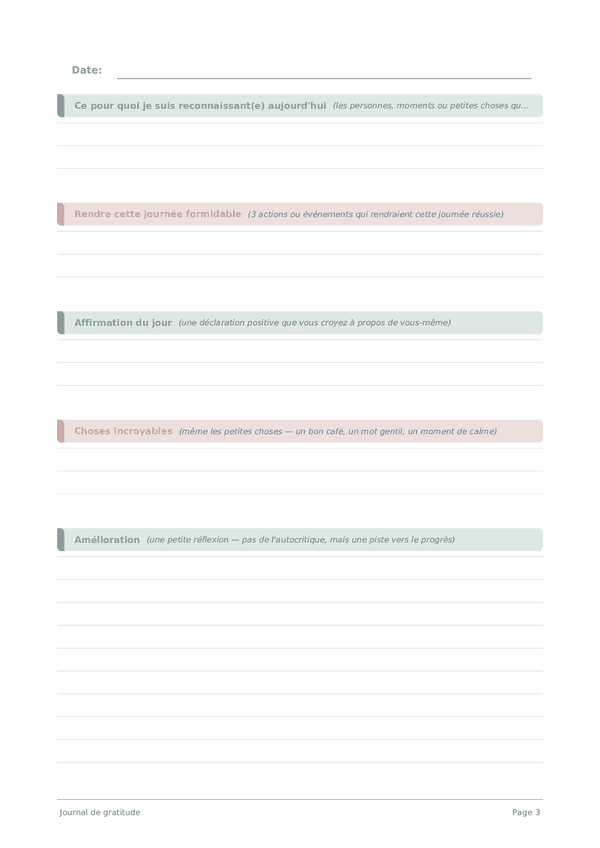
Journal de gratitude
Cultivez la reconnaissance et la positivité au quotidien
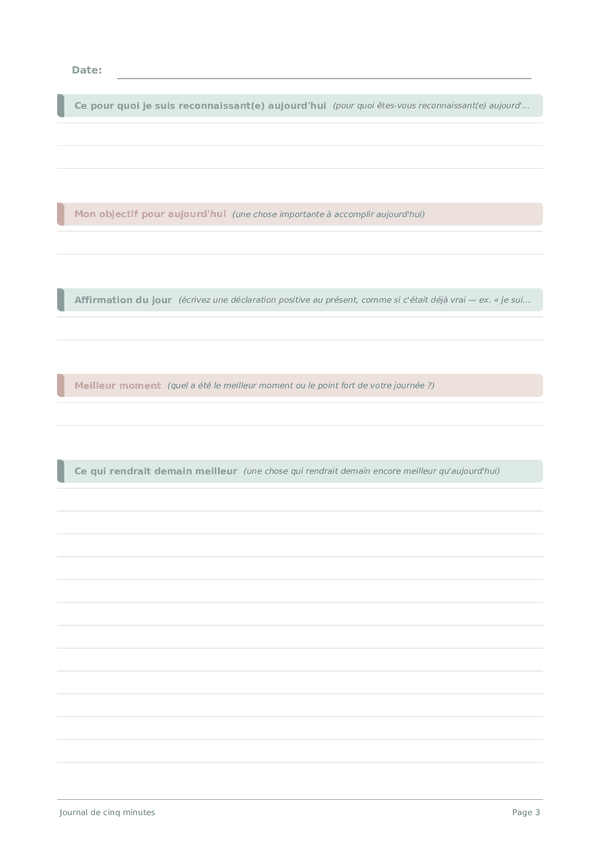
Journal de cinq minutes
Journal quotidien de gratitude et de réflexion en cinq minutes
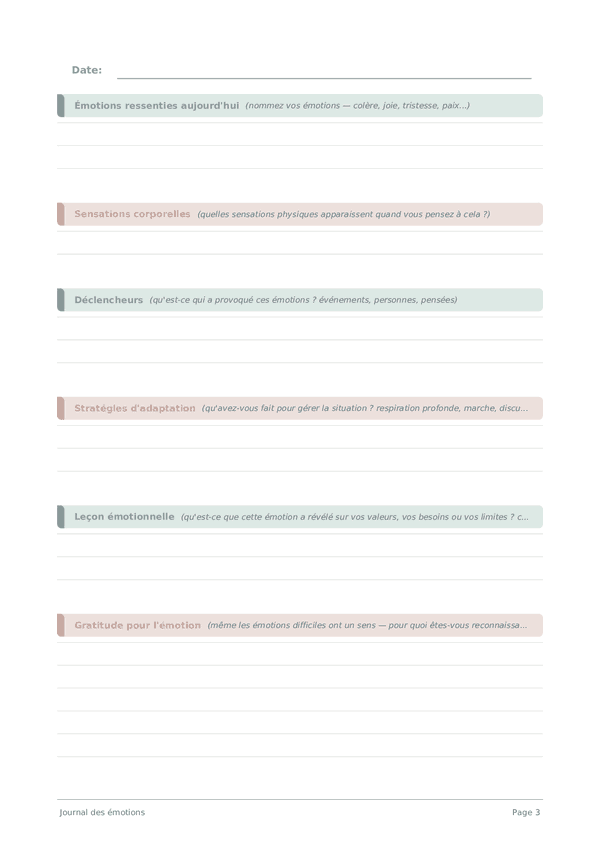
Journal des émotions
Comprenez, traitez et grandissez à travers vos émotions
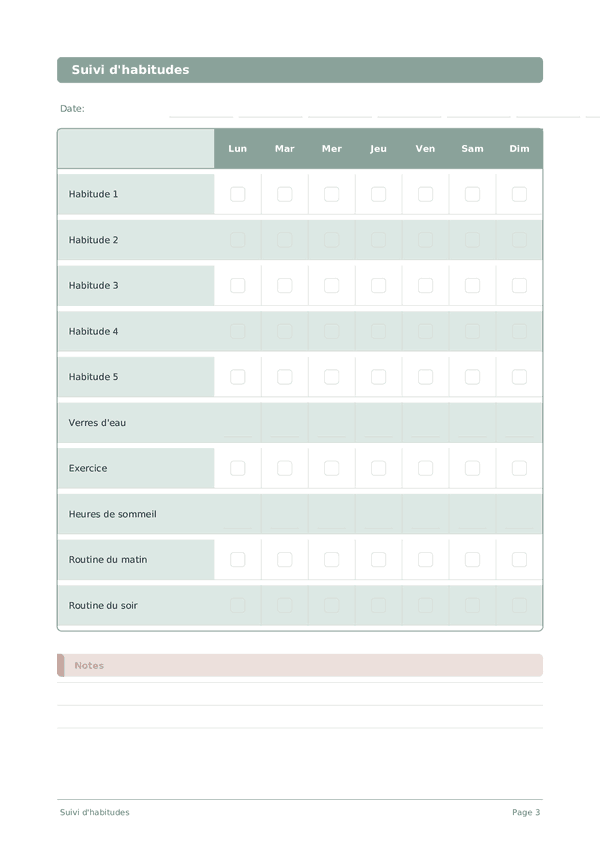
Suivi d'habitudes
Construisez de meilleures habitudes jour après jour
Molette pour zoomer, glisser pour déplacer