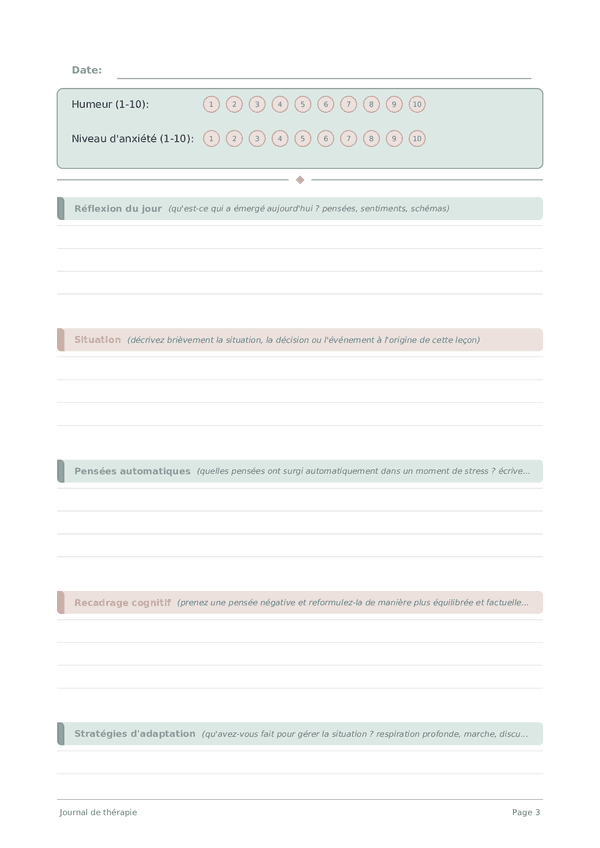
Printable Journal de thérapie
Maximisez les bienfaits de vos séances de thérapie
Capture key takeaways from therapy sessions, track homework assignments, and reflect on progress between appointments. A valuable bridge between sessions.
Personnaliser les champs
Activez ou désactivez les champs. Cliquez sur le crayon pour renommer, ou ajoutez vos propres champs.
Avantages
Comment utiliser
Qu'est-ce que ce journal ?
A therapy journal is a guided writing practice designed to complement your therapeutic work. By tracking your mood and anxiety alongside structured reflections on situations, automatic thoughts, and cognitive reframes, you practice the core skills of cognitive behavioral therapy between sessions.
This journal is ideal for anyone currently in therapy or practicing self-guided CBT techniques. It provides a framework for examining the connection between situations, thoughts, and emotional responses — the foundation of most evidence-based therapeutic approaches.
Clinical research consistently shows that clients who journal between therapy sessions make faster progress and retain therapeutic gains longer. Writing down automatic thoughts and practicing reframes strengthens neural pathways for healthier thinking patterns, turning therapeutic insights into lasting cognitive habits.
Exemple rempli
Voici à quoi ressemble une entrée typique une fois remplie :
Comment remplir chaque champ
Le haut de chaque page comporte des champs à remplissage rapide (évaluations, cases à cocher, chiffres). En dessous se trouve une section lignée pour écrire. Voici ce que signifie chaque champ :
Humeur (1-10)
Évaluez votre état émotionnel général de la journée. 1 signifie très bas ou déprimé, 10 signifie exceptionnellement heureux et positif. Ne réfléchissez pas trop — fiez-vous à votre instinct.
Niveau d'anxiété (1-10)
Évaluez votre niveau d'anxiété aujourd'hui. Mettre un chiffre dessus rend le sentiment plus gérable et traçable.
Réflexion du jour
Revenez sur votre journée honnêtement. Qu'est-ce qui s'est bien passé ? Qu'est-ce qui pourrait être amélioré ? Il ne s'agit pas de juger — il s'agit d'apprendre et de grandir.
Situation
Décrivez la situation ou l'événement objectivement, comme si vous étiez un observateur neutre. Séparer les faits des émotions vous aide à voir les choses plus clairement.
Pensées automatiques
Quelles pensées ont surgi automatiquement dans un moment de stress ? Écrivez-les exactement telles qu'elles sont venues — même si elles semblent irrationnelles
Recadrage cognitif
Prenez une pensée négative et reformulez-la de manière plus équilibrée et factuelle. Que dirait un ami bienveillant ?
Stratégies d'adaptation
Qu'avez-vous fait pour gérer la situation ? Respiration profonde, marche, discussion...
Ce pour quoi je suis reconnaissant(e) aujourd'hui
Listez 1 à 3 choses pour lesquelles vous êtes reconnaissant aujourd'hui. Elles peuvent être grandes ou minuscules — un bon repas, un mot gentil, du soleil. Le journal de gratitude est l'une des pratiques de bien-être les plus soutenues scientifiquement.
Conseils pour réussir
Quand et à quelle fréquence écrire
Write after every therapy session while insights are fresh — ideally within 1 hour. Between sessions, use the journal when you notice automatic thoughts or cognitive distortions in daily life. Before your next session, spend 5 minutes reviewing your entries to identify what you want to explore further. This between-session work is what transforms weekly therapy into continuous growth.
Questions fréquentes
Comment ce journal soutient-il la psychothérapie ?
Il fonctionne comme devoir entre les séances, une pratique soutenue dans la TCC, l'ACT et la thérapie de schéma. Kazantzis, Whittington et Dattilio (2010, Clinical Psychology: Science and Practice, 17(2)) ont méta-analysé les devoirs de thérapie et trouvé que les devoirs complétés amélioraient les résultats. Les champs structurés (situation, pensées automatiques, recadrage cognitif, stratégies de coping) reflètent le registre de pensées quotidien de Beck utilisé en TCC.
Que mettre dans « pensées automatiques » versus « recadrage cognitif » ?
Pensées automatiques capture les pensées verbatim qui ont émergé dans la situation — exactement telles qu'elles sont apparues. Recadrage cognitif est l'alternative restructurée et équilibrée par les preuves. C'est la technique classique à deux colonnes de Beck (Cognitive Therapy and the Emotional Disorders, 1976). La section de 10 lignes laisse de la place pour les deux. Ne saute pas la pensée originale — le recadrage ne fonctionne qu'en contraste.
Comment apporter ce journal à mon thérapeute de façon productive ?
Apporte deux à quatre semaines d'entrées et mets en évidence les schémas. Les recommandations de pratique clinique de l'APA et Kazantzis et al. (2010, Clinical Psychology: Science and Practice, 17(2)) recommandent que les données générées par le client ancrent le travail de séance. Marque les entrées où le recadrage s'est avéré difficile — c'est probablement là que le travail de thérapie se concentre. Ne t'attends pas à ce que les thérapeutes lisent chaque entrée ; offre un résumé plus des détails sélectionnés.
Pourquoi « humeur » et « niveau anxiété » sont-ils les seuls champs du tracker ?
Ces deux indicateurs couvrent les cibles de thérapie les plus communes — symptômes de dépression et d'anxiété — et s'alignent conceptuellement avec de brefs screeners cliniques (PHQ-9 pour la dépression, GAD-7 pour l'anxiété). Garder le tracker minimal préserve la fonction principale du journal comme réflexion de liaison entre séances. Ajoute plus de dimensions via le Journal de santé mentale si nécessaire.
Ce journal est-il un substitut à la thérapie ?
Non. Il complète mais ne remplace pas la psychothérapie. Les recommandations de l'APA, du NIMH et de l'OMS traitent toutes la psychothérapie comme une intervention clinique nécessitant des prestataires formés. Le journal est un outil pour prolonger les effets de la thérapie entre les séances — capturer ce qui a émergé, pratiquer des techniques comme le recadrage cognitif — sous la guidance d'un professionnel de santé mentale agréé.
Que faire si je ne vois pas actuellement de thérapeute ?
Le journal a encore une valeur d'autoassistance mais sois conscient de ses limites. Cuijpers et al. (2010, Clinical Psychology Review, 30(1)) ont examiné la TCC en auto-assistance et trouvé des effets plus petits mais réels par rapport à la TCC guidée par un thérapeute. La séquence de restructuration cognitive est utilisable seul. Si tu te retrouves bloqué sur le même contenu, ou si la détresse s'aggrave, consulte un clinicien agréé.
À quel point faut-il être honnête dans le journal ?
Aussi honnête que possible — les entrées sélectives en réduisent la valeur thérapeutique. Pennebaker (1997, Psychological Science, 8(3)) sur l'écriture expressive a montré que les bénéfices se mettaient à l'échelle avec l'engagement émotionnel. Si tu t'inquiètes que quelqu'un le lise, stocke-le en sécurité ou utilise un code privé. Tenir un journal adapté pour les autres annule le traitement cognitif qui produit le bénéfice.
À quelle fréquence écrire entre les séances ?
Vise deux à quatre entrées entre les séances hebdomadaires. Quotidien peut fatiguer ; moins d'une fois par semaine perd l'élan. Kazantzis et al. (2016, Cognitive Therapy and Research, 40(6)) ont trouvé qu'un engagement modéré dans les devoirs (plusieurs entrées par semaine) était optimal — trop peu et les effets disparaissent, trop et la qualité chute. Demande à ton thérapeute un rythme cible.
Vous aimerez aussi
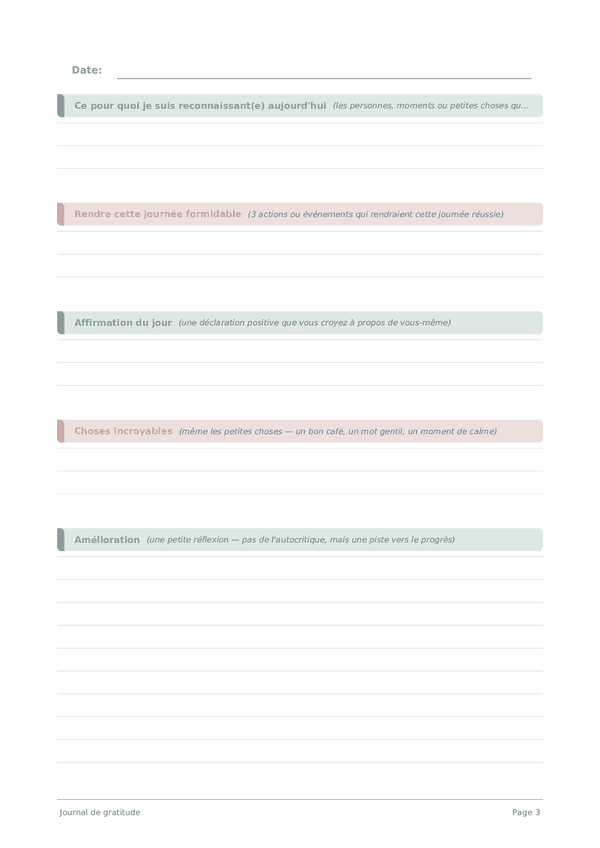
Journal de gratitude
Cultivez la reconnaissance et la positivité au quotidien
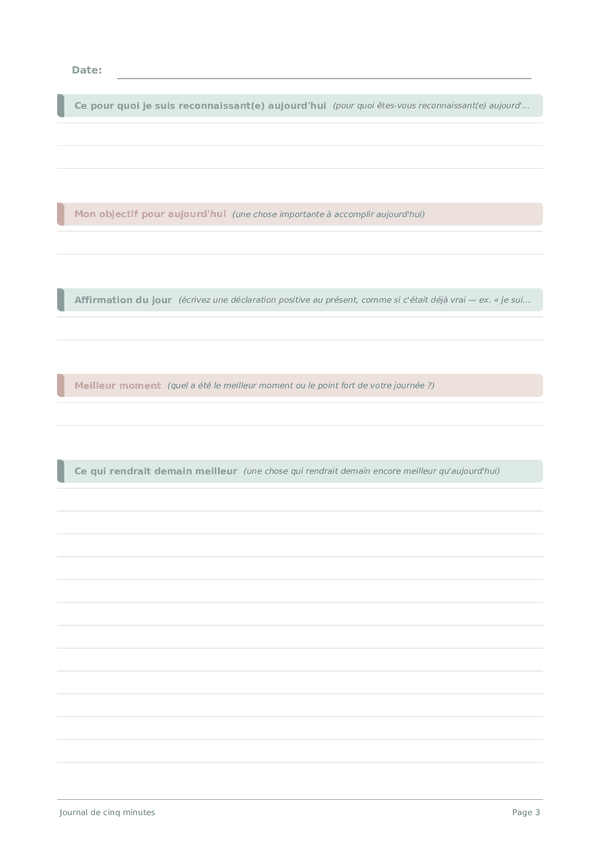
Journal de cinq minutes
Journal quotidien de gratitude et de réflexion en cinq minutes
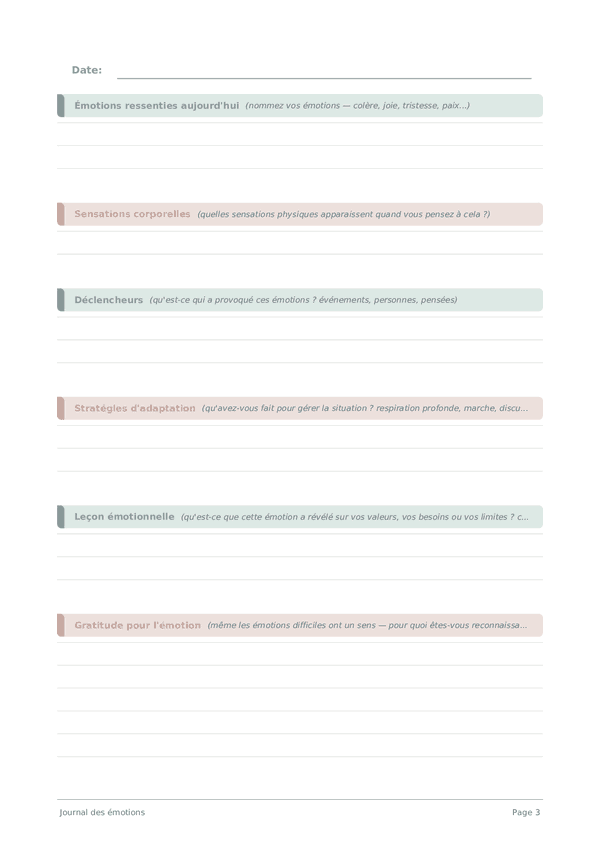
Journal des émotions
Comprenez, traitez et grandissez à travers vos émotions
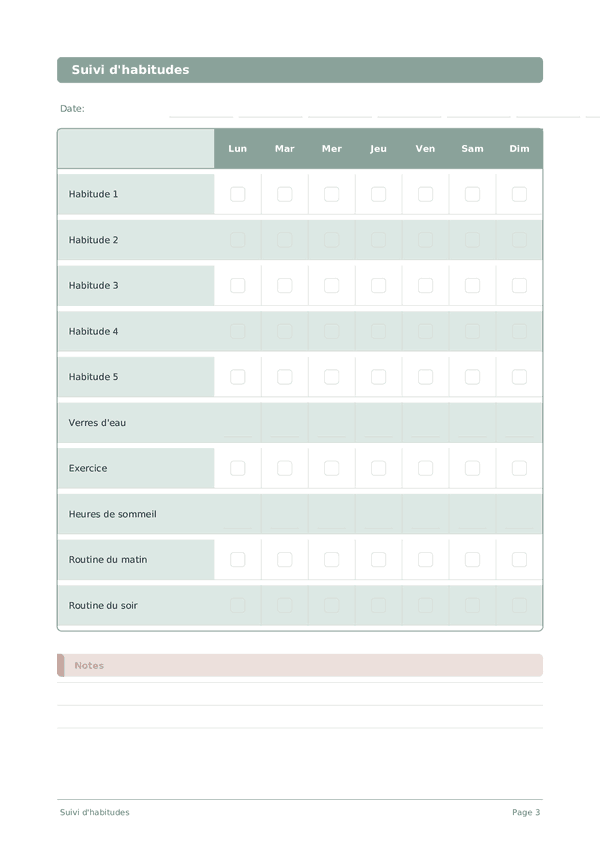
Suivi d'habitudes
Construisez de meilleures habitudes jour après jour
Molette pour zoomer, glisser pour déplacer