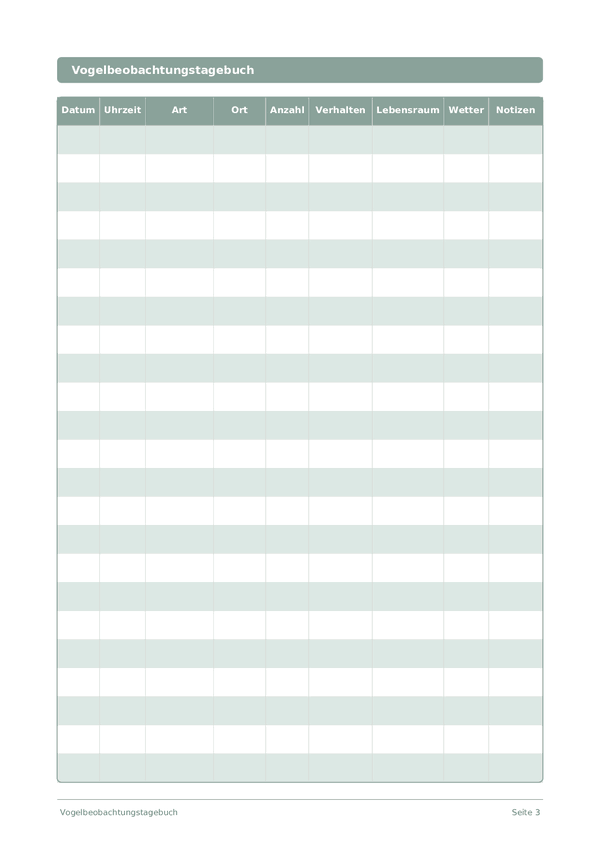
Printable Vogelbeobachtungstagebuch
Jede Vogelsichtung mit Art, Lebensraum und Verhalten festhalten
A structured field log designed for birders of all levels. Capture species, location, count, behavior, habitat, and weather conditions for every sighting. Build a detailed life list, track seasonal migrations, and spot long-term patterns in bird activity across different habitats.
Felder anpassen
Schalten Sie Felder ein oder aus. Klicken Sie auf den Stift zum Umbenennen oder fügen Sie eigene Felder hinzu.
Vorteile
Anleitung
Was ist dieses Journal?
A birdwatching journal is a structured observation log for recording every bird you spot in the field. By documenting species, location, behavior, and habitat conditions, you build a personal birding database that tracks your growing knowledge and reveals patterns in bird activity across seasons and locations.
This journal is for birders at every level — from backyard bird feeders to dedicated listers pursuing life lists. It is equally valuable whether you are learning to identify your first ten species or tracking rare migrants at a known hotspot.
Citizen science research has shown that personal birding records contribute significantly to understanding bird populations and migration patterns. Beyond contributing to collective knowledge, the practice of careful observation and recording trains your eyes and ears to detect subtle differences — the skill that separates casual observers from skilled birders.
Ausgefülltes Beispiel
So sieht ein typischer Eintrag aus, wenn er ausgefüllt ist:
| Datum | Uhrzeit | Art | Ort | Anzahl | Verhalten | Lebensraum | Wetter | Notizen |
|---|---|---|---|---|---|---|---|---|
| 2025-03-04 | 7:15 | Northern Cardinal | Riverside Park, feeder area | 2 | Male singing from top of oak; female foraging below feeder | Suburban park, mixed deciduous, near water | Overcast, 8C, calm | Bright red male very vocal — territorial song. Pair seems resident. |
| 2025-03-04 | 7:30 | Black-capped Chickadee | Riverside Park, willow grove | 4 | Active foraging flock moving through willows, hanging upside down on twigs | Willow grove near river bank | Overcast, 8C, calm | Mixed with Tufted Titmice. Very active and vocal — "chick-a-dee-dee-dee" calls. |
| 2025-03-04 | 8:05 | Great Blue Heron | Riverside Park, river shallows | 1 | Standing motionless in ankle-deep water, hunting. Struck once — missed. | River shallows, rocky bottom, overhanging willows | Overcast, mist clearing, 9C | Same individual as last Tuesday? Same spot. Patient hunter. Stood for 20 min without moving. |
| 2025-03-04 | 8:20 | Red-tailed Hawk | Above Riverside Park, soaring | 1 | Soaring in wide circles, gaining altitude, then heading east | Open sky above park and fields | Cloud breaking, thermals starting | Light morph adult. Beautiful contrast against grey sky. All songbirds went quiet. |
Wie Sie jedes Feld ausfüllen
Jede Seite ist eine Tabelle mit Spalten. Füllen Sie pro Eintrag eine Zeile aus. Hier erfahren Sie, wofür jede Spalte gedacht ist:
Datum
Schreiben Sie das heutige Datum. Dies verankert Ihren Eintrag in der Zeit und hilft beim späteren Durchsehen der Einträge.
Uhrzeit
Notieren Sie die Uhrzeit der Messung oder des Ereignisses. Gleichmäßige Zeiten machen Daten vergleichbar und zeigen tageszeitabhängige Muster.
Art
Name der gefangenen Fischart
Ort
Wo wurde das Foto aufgenommen?
Anzahl
Verhalten
Lebensraum
Wetter
Sonnig, bewölkt, Regen, Wind — aktuelle Bedingungen
Notizen
Fügen Sie zusätzlichen Kontext oder Gedanken hinzu. Diese Auffangspalte ist für alles, was nirgendwo anders hinpasst, aber später nützlich sein könnte.
Tipps für den Erfolg
Wann und wie oft schreiben
Log every birding outing immediately, whether it is a dedicated trip or a casual backyard observation. Fill in one row per species sighted per session. Weekly birders should review their log monthly to track species diversity trends. During migration seasons (spring and fall), daily logging is especially valuable. At the end of each year, review your complete log to calculate your annual species count and compare it to previous years.
Häufig gestellte Fragen
Welche Felder machen eine Sichtung für Citizen Science nützlich?
Das eBird-Protokoll des Cornell Lab of Ornithology verlangt Art, Datum, Uhrzeit, Standort, Anzahl und Habitat — jede Spalte, die dieses Journal bietet. Verhalten und Wetter zu ergänzen erhöht den wissenschaftlichen Wert weiter. Die Feldprotokolle der Audubon Society und des NABU (Naturschutzbund Deutschland) entsprechen demselben Minimumset. Ihr gedrucktes Logbuch lässt sich später in eBird übertragen und liefert nutzbare Datensätze für Zugvogel- und Bestandsanalysen, die Forscher tatsächlich auswerten.
Soll ich gängige oder wissenschaftliche Artennamen aufzeichnen?
Beides funktioniert, wenn Sie konsistent bleiben. Cornell Lab und eBird akzeptieren gängige englische Namen nach standardisierten Listen; iNaturalist und die IOC World Bird List nutzen wissenschaftliche Binomen für eindeutige Identifikation. Bei mehrsprachiger Beobachtung oder seltenen Arten schreiben Sie beides — „Rotkehlchen (Erithacus rubecula)". Die Artenspalte ist 22 Einheiten breit, gerade um diese doppelte Notation bei Bedarf zu ermöglichen.
Wie spezifisch sollte die Habitatspalte sein?
Spezifisch genug, dass ein Fremder denselben Mikrohabitat fände. Die Aufzeichnungsrichtlinien von RSPB, Audubon und NABU unterscheiden breite Biome von Mikrohabitaten — „Laubwaldrand, mittlere Kronenschicht" schlägt „Wald". Die Habitatauflösung bestimmt den analytischen Wert langfristiger Aufzeichnungen: Sie erlaubt es, Artenvorkommen mit Vegetationstyp, Wassernähe und Störungsgrad zu korrelieren, wenn Sie später Muster überprüfen und Bestandstrends erkennen wollen.
Was zählt als nützliche Verhaltensnotiz?
Verhalten, das die ökologische Rolle signalisiert: Nahrungssuche (und wovon), Singen, Rufen, Balzen, Brüten, Foragierhöhe, Hassen, Ziehen. Cornells Birds of the World katalogisiert Verhaltensweisen nach Arten — Ihre Notizen speisen denselben Wortschatz. Vermeiden Sie vage Einträge wie „aktiv". Konkrete Verben wie „sammelt Insekten von Eichenrinde" machen Einträge durchsuchbar und enthüllen Habitatnutzungsmuster, die reine Zähltotals nicht zeigen können.
Wie unterscheidet sich das von Merlin oder eBird?
Merlin identifiziert Arten; eBird protokolliert Checklisten. Beide hängen von Akku und Bildschirmaufmerksamkeit ab — was die Stille brechen kann, die Vögel belohnen. Dieses Papierlog befreit Augen und Ohren, ermöglicht das Skizzieren von Feldmerkmalen, die Merlin nicht erfassen kann, und liefert eine dauerhafte Aufzeichnung unabhängig von Kontoänderungen. Viele ernsthafte Vogelbeobachter nutzen beides: App im Moment, Papier für Dauerhaftigkeit.
Wie beeinflusst das Wetter, was ich sehen werde?
Stark. Die Feldhinweise von RSPB, NABU und Cornell Lab merken an, dass bedeckte Morgen die Morgenchoraktivität verlängern können, Wetterfronten während des Zugs Fallouts auslösen und starker Wind die Detektion von Singvögeln unterdrückt. Das Protokollieren der Wetterspalte neben Arten erlaubt langfristige Korrelation — irgendwann erkennen Sie, welche Bedingungen in Ihrem lokalen Revier die besten Vogelbeobachtungsstunden produzieren und welche Arten zu erwarten sind.
Wie lange dauert es, bis Muster im Logbuch erscheinen?
Etwa ein volles Jahr. Jahreszyklen brauchen 12 Monate, um sichtbar zu werden — erste Ankünfte, Zugspitze, Brut, Abzug. Mit 14 Zeilen pro Seite füllen wöchentliche Beobachter eine Seite pro Saison. eBird-Daten des Cornell Lab zeigen, dass mehrjährige persönliche Listen die Detektionsfähigkeit von Jahr zu Jahr deutlich verbessern. Zugzeiten werden nach zwei bis drei Jahreszyklen prädiktiv.
Ist dieses Journal für komplette Anfänger geeignet?
Ja. Anfänger profitieren am meisten von Struktur: Pflichtfelder wie Anzahl und Verhalten trainieren die disziplinierte Aufmerksamkeit, die Vogelbeobachter von Gelegenheitsschauern unterscheidet. Die Materialien der Cornell Lab Bird Academy empfehlen, ab dem ersten Tag zu protokollieren, selbst wenn Sie nur drei gängige Arten pro Ausflug bestimmen. Die Notizspalte nimmt unsichere Bestimmungen auf — schreiben Sie „Sperling, gestreifte Brust, Kiefernhain", bis Sie später bestätigen können.
Das könnte Ihnen auch gefallen
Scrollen zum Zoomen, ziehen zum Bewegen