Printable Naturtagebuch
Beobachten, staunen und sich mit der Natur verbinden
A structured nature journal inspired by the John Muir Laws method of "I Notice, I Wonder, It Reminds Me Of." Each page combines quick environmental data — location, weather, sky conditions, and temperature — with guided observation prompts that train you to see nature more deeply. Record species, sounds, and sketches alongside your reflections to build a personal field record over time.
Felder anpassen
Schalten Sie Felder ein oder aus. Klicken Sie auf den Stift zum Umbenennen oder fügen Sie eigene Felder hinzu.
Vorteile
Anleitung
Was ist dieses Journal?
A nature journal is a daily observation practice that trains you to see the natural world with fresh, attentive eyes. By recording what you notice, what you wonder about, and what species you observe, you develop the naturalist's art of careful attention that transforms any outdoor moment into a discovery.
This journal is for nature lovers, aspiring naturalists, environmental educators, and anyone who wants to slow down and actually see the world around them. You do not need to be an expert — the practice of noticing and wondering is itself the skill being developed.
Environmental education research shows that regular nature journaling increases ecological awareness, scientific thinking skills, and reported connection to the natural world. The practice of writing "I notice" and "I wonder" — championed by naturalist John Muir Laws — bypasses the need for expert knowledge and activates genuine curiosity, making every outdoor experience richer and more meaningful.
Ausgefülltes Beispiel
So sieht ein typischer Eintrag aus, wenn er ausgefüllt ist:
Wie Sie jedes Feld ausfüllen
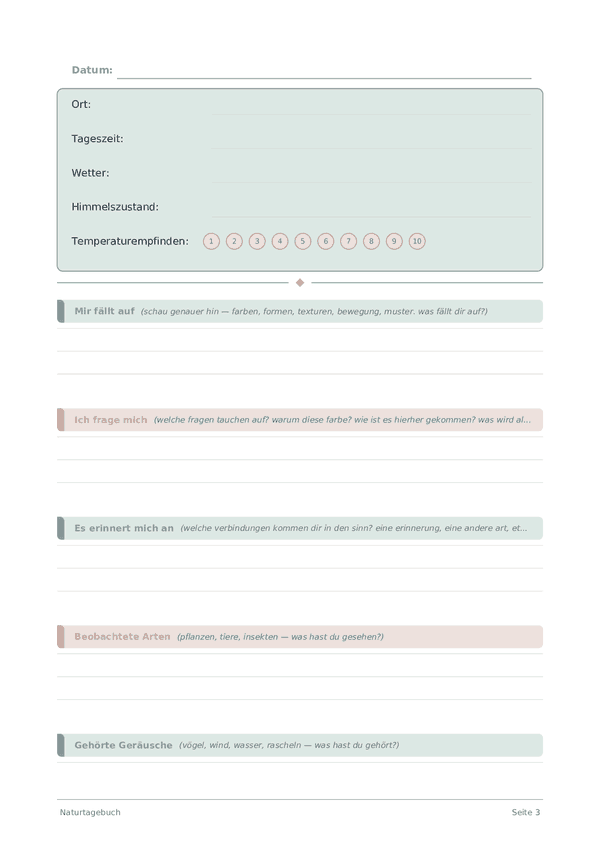
Oben auf jeder Seite befinden sich schnell ausfüllbare Felder (Bewertungen, Kontrollkästchen, Zahlen). Darunter ist ein linierter Bereich zum Schreiben. Hier erfahren Sie, was jedes Feld bedeutet:
Ort
Wo wurde das Foto aufgenommen?
Tageszeit
Morgens, nachmittags, abends, nachts
Wetter
Sonnig, bewölkt, Regen, Wind — aktuelle Bedingungen
Himmelszustand
Wie sieht der Himmel gerade aus? Beschreibe Wolken, Klarheit oder Wetter
Temperaturempfinden
Wie fühlt sich die Temperatur auf deiner Haut an? Beschreibe es in deinen eigenen Worten
Mir fällt auf
Schau genauer hin — Farben, Formen, Texturen, Bewegung, Muster. Was fällt dir auf?
Ich frage mich
Welche Fragen tauchen auf? Warum diese Farbe? Wie ist es hierher gekommen? Was wird als Nächstes passieren?
Es erinnert mich an
Welche Verbindungen kommen dir in den Sinn? Eine Erinnerung, eine andere Art, etwas das du gelesen hast?
Beobachtete Arten
Pflanzen, Tiere, Insekten — was hast du gesehen?
Gehörte Geräusche
Vögel, Wind, Wasser, Rascheln — was hast du gehört?
Skizze & Notizen
Schnelle Skizze deiner Beobachtung — keine Zeichenkünste nötig, nur Formen und Beschriftungen
Tipps für den Erfolg
Wann und wie oft schreiben
Bring your journal every time you step outdoors with intention \u2014 whether it is a park walk, a forest hike, or sitting in your backyard. Write for 15\u201320 minutes while observing. Aim for at least twice a week to build a continuous seasonal record. Review entries monthly to notice phenological patterns like when certain birds appear, when wildflowers bloom, and when insects emerge. Over a year, your journal becomes a personal field guide for your area.
Häufig gestellte Fragen
Was ist die „Ich bemerke, Ich frage mich, Es erinnert mich an"-Methode?
Es ist ein strukturiertes Beobachtungsschema, das vom Naturforscher John Muir Laws popularisiert wurde, um die Wahrnimmung im Feld zu verlangsamen. „Ich bemerke" trainiert konkrete sensorische Aufzeichnung. „Ich frage mich" erzeugt offene Fragen, ohne sofort Antworten zu fordern. „Es erinnert mich an" schmiedet assoziative Erinnerung. Die drei Impulse führen vom passiven Schauen zur aktiven Untersuchung — deshalb stehen sie im Zentrum jeder Seite dieses Journals.
Wie unterstützt das die Attention Restoration Theory?
Kaplan (1995, Journal of Environmental Psychology, 15(3), 169–182) postulierte, dass natürliche Umgebungen gerichtete Aufmerksamkeit durch sanfte Faszination wiederherstellen. Die strukturierten Impulse hier kanalisieren diese Faszination in dokumentierbare Beobachtung statt in Gedankenwandern. Das Ausfüllen der acht Zeilen unter „Ich bemerke" verkörpert genau den von Kaplan beschriebenen Modus — mühelose Auseinandersetzung mit Umweltdetails — und verwandelt einen Spaziergang in eine messbare erholsame Sitzung.
Brauche ich Zeichentalent für den Skizzenbereich?
Nein. Der Skizzenbereich existiert zur Erinnerungsverankerung, nicht zur Kunst. Roger Tory Peterson und moderne Autoren von Bestimmungsbüchern betonen, dass schnelle beschriftete Diagramme — selbst Strichfiguren mit Pfeilen — gepflegte Zeichnungen bei der ID-Erinnerung übertreffen. Notieren Sie Proportionen, Farben und ein unterscheidendes Merkmal. Die Skizzenleitlinien des Cornell Lab of Ornithology behandeln Markierungen als Daten, nicht als Ästhetik. Drei Minuten pro Skizze genügen vollkommen.
Wie unterscheidet sich das von einem gewöhnlichen Naturtagebuch?
Die meisten leeren Naturhefte lassen Sie vor einer weißen Seite stehen. Diese Vorlage gibt die Laws-Methoden-Impulse plus einen fünfteiligen Umwelttracker vor (Standort, Zeit, Wetter, Himmel, Temperaturempfinden), sodass jeder Eintrag über Besuche hinweg vergleichbar ist. Die Struktur verkürzt die Einstiegszeit — nützlich bei kaltem oder windigem Wetter — und bewahrt dennoch offene linierte Bereiche für persönliche Beobachtungen und Notizen aus dem Feld.
Warum beobachtete Arten und gehörte Geräusche getrennt erfassen?
Visuelle und akustische Detektion erfassen unterschiedliche Teile eines Ökosystems. eBird und Merlin Sound ID des Cornell Lab of Ornithology behandeln sie als komplementäre Datenströme — viele Arten werden weit häufiger gehört als gesehen. Das Trennen der Felder trainiert aktives Hören, nicht nur Schauen. Über Monate offenbart das Klangprotokoll saisonale Sänger und Verschiebungen im Morgenchor, die ein reines Sichtjournal verpassen würde. NABU empfiehlt dasselbe Vorgehen.
Kann Naturjournaling Stress reduzieren?
Die Evidenz spricht dafür. Hunter, Gillespie & Chen (2019, Frontiers in Psychology, 10) zeigten Cortisolabfall bei 20-minütigem Naturkontakt. Ulrich et al. (1991, Journal of Environmental Psychology, 11(3), 201–230) dokumentierten schnellere Stresserholung in natürlichen Umgebungen. Strukturiertes Journaling fügt achtsame Aufmerksamkeit hinzu, was Kaplan mit Erholung verband. Diese Kombination ist unterstützende Praxis, kein klinisches Heilverfahren — konsultieren Sie bei diagnostizierter Angst eine Fachperson.
Wie oft sollte ich journalen, um Nutzen zu sehen?
White et al. (2019, Scientific Reports, 9, article 7730) identifizierten 120 Minuten pro Woche in der Natur als Wohlbefindensschwelle. Drei bis vier Einträge wöchentlich, jeweils 20–40 Minuten, erreichen dieses Ziel. Daten von iNaturalist-Beitragenden zeigen ebenfalls: Beobachtungsfähigkeit verstärkt sich mit der Häufigkeit — Ihr zehnter Eintrag erfasst Details, die Ihr zweiter übersehen hat. Konsistenz schlägt lange, aber seltene Sitzungen deutlich.
Ist dieses Journal in jeder Jahreszeit und jedem Biom nutzbar?
Ja. Die Impulse sind biom-unabhängig: eine Parkbank in der Stadt, eine Alpenwiese oder ein städtisches Fensterbrett liefern alle gültige „Ich bemerke / Ich frage mich"-Einträge. Doug Tallamy argumentiert in „Bringing Nature Home" (Timber Press, 2007), dass nachhaltige lokale Beobachtung wichtiger ist als spektakuläre Standorte. Winter und Regenzeit erzeugen oft schärfere Journale, weil weniger Reize zu genauerem Hinsehen auf das Verbleibende zwingen.
Das könnte Ihnen auch gefallen
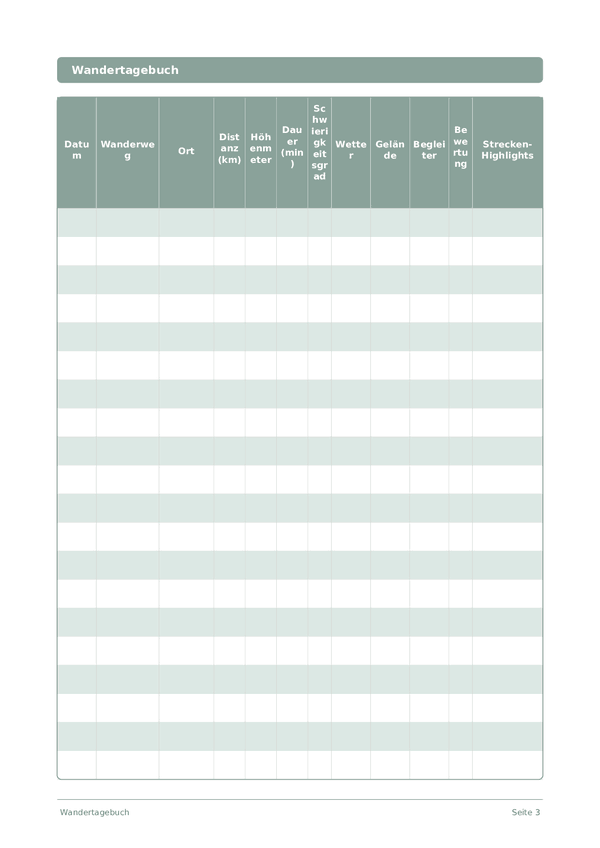
Wandertagebuch
Jeden Wanderweg, Gipfel und jedes Outdoor-Abenteuer verfolgen
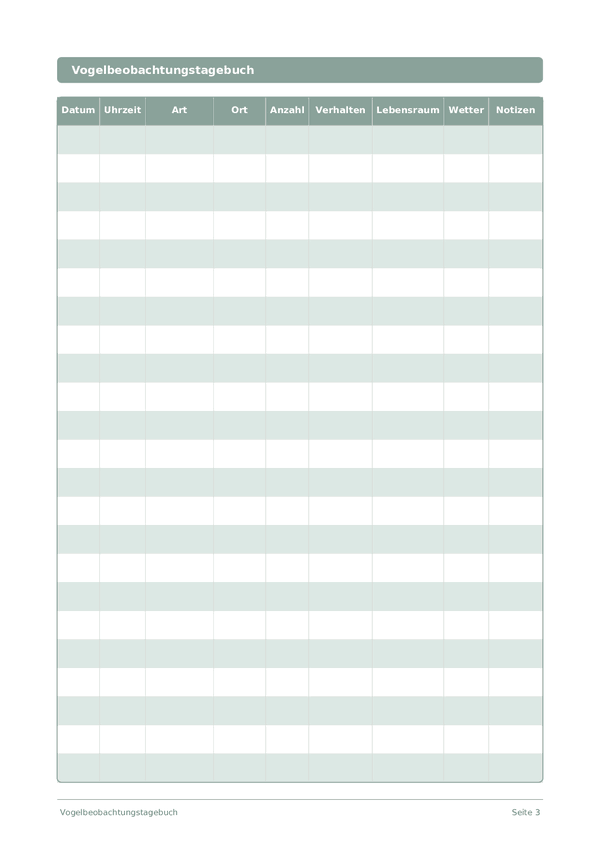
Vogelbeobachtungstagebuch
Jede Vogelsichtung mit Art, Lebensraum und Verhalten festhalten
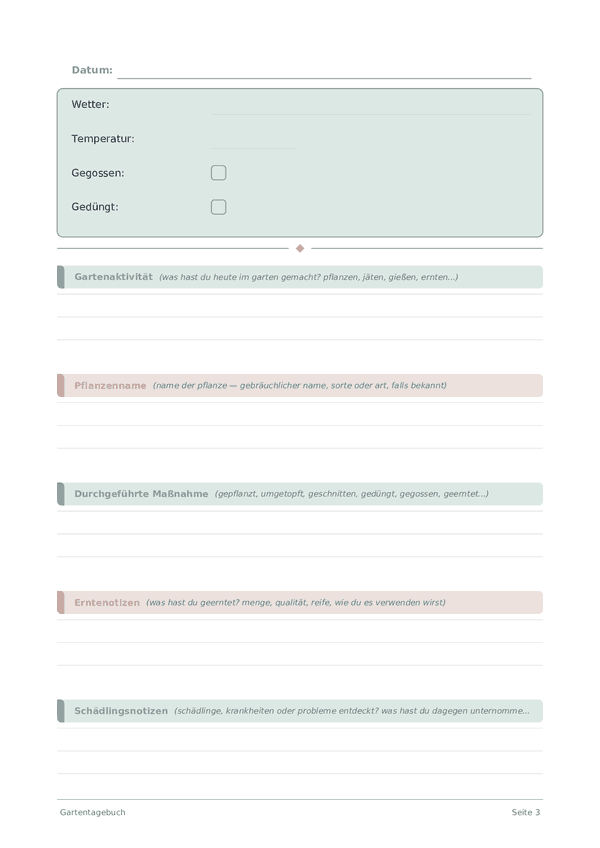
Gartentagebuch
Planen, verfolgen und von jeder Gartensaison lernen
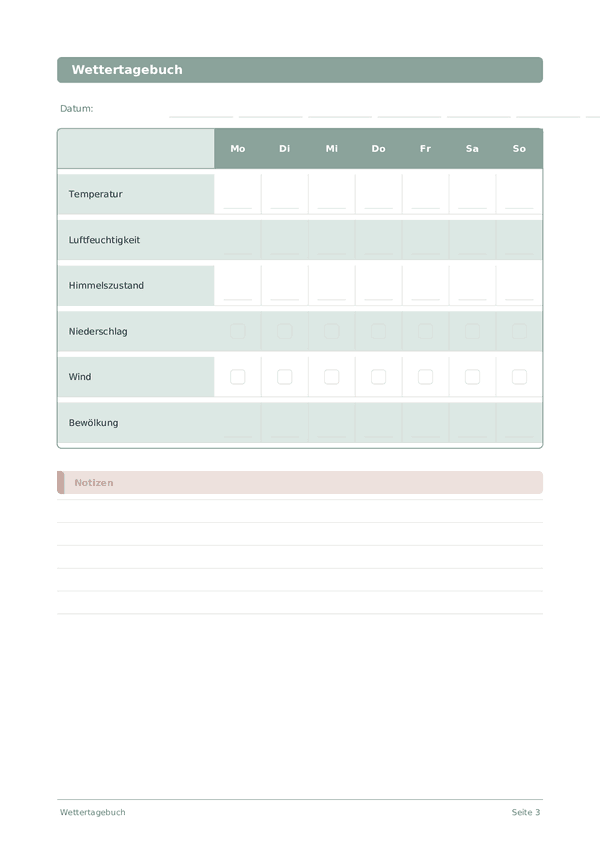
Wettertagebuch
Tägliche Wetterbeobachtungen für Hobby-Meteorologen
Scrollen zum Zoomen, ziehen zum Bewegen