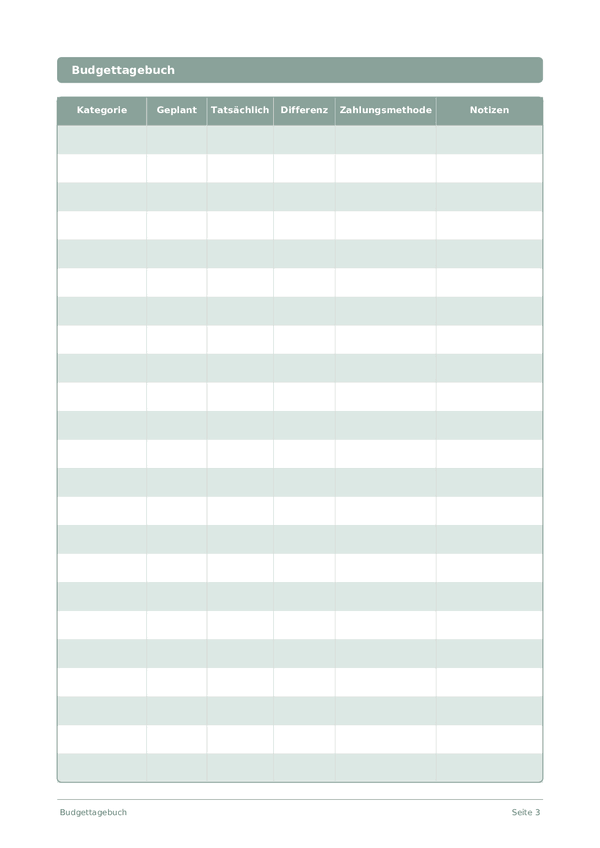
Printable Budgettagebuch
Ausgaben verfolgen, Pläne vergleichen und Sparziele erreichen
Take control of your finances with a structured monthly budget planner. List your spending categories, set planned amounts, and record actual expenses to see where your money really goes. With columns for the difference and payment method, you can identify overspending, cut unnecessary costs, and build a savings habit month after month.
Felder anpassen
Schalten Sie Felder ein oder aus. Klicken Sie auf den Stift zum Umbenennen oder fügen Sie eigene Felder hinzu.
Vorteile
Anleitung
Was ist dieses Journal?
A budget journal is a monthly planning and tracking tool that helps you allocate your income across spending categories and monitor how actual expenses compare to your plan. Each page includes space for your total income and savings goal at the top, followed by a detailed breakdown of categories with planned amounts, actual spending, and the difference between them. This journal is for anyone who wants to move beyond vague budgeting intentions to concrete financial discipline.
Budgeting without tracking is like dieting without a scale — you may have good intentions, but without measurement, you cannot know if you are making progress. This journal provides the measurement framework. By reviewing the difference column at the end of each month, you immediately see which categories ran over or under budget, enabling data-driven adjustments for the following month. Over time, your budget becomes increasingly accurate and your spending becomes more aligned with your true priorities.
Whether you follow the 50/30/20 rule, zero-based budgeting, or your own custom system, this journal adapts to your approach. It is particularly valuable during major financial transitions — starting a new job, paying for education, buying a home, or building an emergency fund — when careful allocation of every dollar or ruble truly matters.
Ausgefülltes Beispiel
So sieht ein typischer Eintrag aus, wenn er ausgefüllt ist:
| Kategorie | Geplant | Tatsächlich | Differenz | Zahlungsmethode | Notizen |
|---|---|---|---|---|---|
| Housing (rent/mortgage) | 1500 | 1500 | 0 | Bank transfer | Fixed monthly payment |
| Groceries & food | 600 | 645 | -45 | Debit card | Hosted dinner party mid-month |
| Transportation | 350 | 310 | 40 | Mixed | Biked to work 3 days — saved on gas |
| Utilities & internet | 180 | 195 | -15 | Auto-pay | Heating bill higher due to cold snap |
| Entertainment | 200 | 155 | 45 | Credit card | Stayed in most weekends |
Wie Sie jedes Feld ausfüllen
Jede Seite ist eine Tabelle mit Spalten. Füllen Sie pro Eintrag eine Zeile aus. Hier erfahren Sie, wofür jede Spalte gedacht ist:
Kategorie
Weisen Sie diesem Eintrag eine Kategorie zu (z. B. Essen, Transport, Unterhaltung). Einheitliche Kategorien machen Ihre Daten leicht analysierbar.
Geplant
Tatsächlich
Differenz
Zahlungsmethode
Notizen
Fügen Sie zusätzlichen Kontext oder Gedanken hinzu. Diese Auffangspalte ist für alles, was nirgendwo anders hinpasst, aber später nützlich sein könnte.
Tipps für den Erfolg
Wann und wie oft schreiben
Set up your budget on the 1st of each month: list all categories, planned amounts, and income. Then update actual spending daily or every other day — the shorter the delay, the more accurate your data. Do a mid-month checkpoint around the 15th to see if any category is already at 70%+ of its limit. At month-end, calculate every difference, note what worked, and carry forward adjustments into next month’s plan.
Häufig gestellte Fragen
Wie arbeiten die Spalten planned und actual zusammen?
Planned wird zu Monatsbeginn gesetzt; actual wird beim Ausgeben ausgefüllt. Das CFPB (2023, 'Your Money, Your Goals: Tracking Your Income and Expenses') (in Deutschland: Verbraucherzentrale) beschreibt diese Plan-versus-Ist-Schleife als zentrale Budgetdisziplin. Die Spalte difference legt dann Überschreitungen Kategorie für Kategorie offen. Ohne das Notieren von planned wird das Journal zum passiven Ausgabenlog statt zum Budget-Werkzeug.
Welche Kategorien soll ich in der Spalte category auflisten?
Entsprechend realer Ausgaben, nicht Wünsche. Die amerikanische U.S. Bureau of Labor Statistics (2023, Consumer Expenditure Survey) (deutsche Vergleichsdaten: Statistisches Bundesamt / Destatis) gruppiert Haushaltsausgaben in Kategorien wie Wohnen, Lebensmittel, Verkehr, Gesundheit und Unterhaltung als vernünftige Ausgangspunkte. Passen Sie sie nach Ihrem letzten Kontoauszug an. 18 Zeilen pro Seite fassen die detaillierten Kategorien der meisten Haushalte; zu feine Kategorien verbergen die Muster, derentwegen das Journal existiert.
Soll ich 50/30/20 oder Zero-Based-Budgeting mit dieser Vorlage nutzen?
Beides funktioniert - wählen Sie nach Temperament. Die 50/30/20-Regel stammt von Elizabeth Warren & Amelia Warren Tyagi, 'All Your Worth' (Free Press, 2005): 50 Prozent Notwendiges, 30 Prozent Gewolltes, 20 Prozent Sparen. Zero-Based-Budgeting geht auf Peter Pyhrr, 'Zero-Base Budgeting' (Harvard Business Review, Nov-Dec 1970) zurück: jeder Euro einer Kategorie zugeordnet. Das Journal unterstützt beide, weil die Spalte planned jede Allokationsmethode aufnimmt.
Warum enthält das Journal eine Spalte zahlungsmethode?
Verschiedene Zahlungsmethoden korrelieren mit verschiedenen Ausgabenmustern. Prelec & Simester (2001, Marketing Letters, 12(1), 5-12) fanden, dass die Zahlungsbereitschaft mit Kreditkarten gegenüber Bargeld deutlich steigt. Hirschman (1979, Journal of Consumer Research, 6(1), 58-66) dokumentierte ähnliche Effekte. Das Taggen von zahlungsmethode macht dieses Verhalten sichtbar; über Monate sehen Sie Kategorien, wo Kreditausgaben den Plan konsistent überschreiten.
Was kommt in die Seitenköpfe income und sparziel?
Netto-Monatseinkommen - was tatsächlich auf Ihrem Konto eingeht - und ein konkretes Sparziel für den Monat. Das CFPB (2023, 'Setting Savings Goals') (in Deutschland: Verbraucherzentrale) betont konkrete, zeitlich gebundene Sparziele gegenüber vager Absicht. Das Ausfüllen dieser Köpfe verankert jeden planned-Kategoriebetrag; wenn planned-Beträge income minus sparziel übersteigen, scheitert die Mathematik vor Monatsbeginn.
Wie unterscheidet sich das von Mint, YNAB oder anderen Apps?
Apps automatisieren Transaktionserfassung; Papier erzwingt bewusste Eingabe. Soman (2001, Journal of Consumer Research, 27(4), 460-474) fand, dass manuelle Erfassung von Zahlungen nachfolgende Ausgaben reduziert - Automatisierung entfernt diese Reibung. Thaler & Sunstein, 'Nudge' (Yale University Press, 2008) beschreiben schriftliche Reibung als Verhaltens-Feature. Nutzen Sie beide bei Bedarf - App für Vollständigkeit, Journal für Verhaltenseffekt.
Verändert das Aufschreiben eines Budgets tatsächlich Ausgaben?
Ja - mentales und festgehaltenes Budgetieren verschieben beide Verhalten. Heath & Soll (1996, Journal of Consumer Research, 23(1), 40-52) dokumentierten, dass explizite Budgetkategorien Ausgaben verändern. Das CFPB (2023, 'Your Money, Your Goals: Tracking Your Income and Expenses') befürwortet speziell schriftliches Tracking. Das Ausfüllen von planned, dann actual macht die Lücke Zeile für Zeile sichtbar - die grundlegende Feedbackschleife, die Verhaltensänderung verlangt.
Was ist der häufigste Budgetierungsfehler, den diese Vorlage verhindert?
Planned-Beträge setzen, aber actual nie erfassen. Das CFPB (2023, 'Your Money, Your Goals: Tracking Your Income and Expenses') stellt fest, dass Pläne ohne Tracking keine Verhaltensänderung bringen. Das 18-Zeilen-Layout, ausgelegt für monatliche Prüfung, erzwingt beide Hälften des Zyklus. Die Spalte difference macht die Konsequenz nicht erfasster Ausgaben unmöglich zu verstecken, sobald Sie sich wöchentlich hinsetzen, um Zeilen zu aktualisieren.
Das könnte Ihnen auch gefallen
Ausgabentagebuch
Jeden Euro verfolgen und die Kontrolle über Ihre Finanzen übernehmen
Investitionstagebuch
Trades verfolgen, Entscheidungen analysieren und Ihr Portfolio aufbauen
Schuldentagebuch
Schulden verfolgen und mit einer klaren Tilgungsstrategie abbauen
Spartagebuch
Tägliche Spargewohnheiten verfolgen und auf Ihre finanziellen Ziele hinarbeiten
Scrollen zum Zoomen, ziehen zum Bewegen