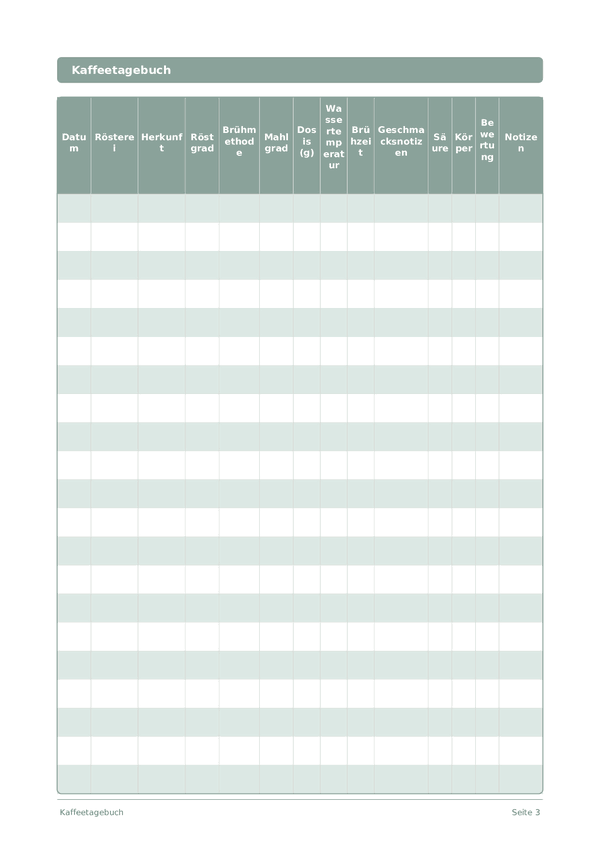
Printable Kaffeetagebuch
Brühvorgänge verfolgen, Parameter optimieren und Ihren Gaumen schulen
Log every cup with precision: origin, roast level, brew method, grind size, dose, water temperature, brew time, and tasting notes. Build a personal database of brews to refine your technique and discover what makes the perfect cup.
Felder anpassen
Schalten Sie Felder ein oder aus. Klicken Sie auf den Stift zum Umbenennen oder fügen Sie eigene Felder hinzu.
Vorteile
Anleitung
Was ist dieses Journal?
A coffee journal is a structured tasting and brewing log for documenting your coffee explorations. By recording roaster, origin, brew parameters, and detailed flavor notes, you develop your palate and optimize your brewing technique — turning your morning cup from a routine into a craft.
This journal is for coffee lovers who want to go deeper — from home brewers dialing in their pour-over technique to enthusiasts exploring single-origin beans from different regions. Whether you brew with an espresso machine, AeroPress, French press, or pour-over, tracking your variables is the path to consistently excellent coffee.
Specialty coffee professionals emphasize that the difference between good and exceptional coffee often comes down to small adjustments in grind size, water temperature, and brew time. Without records, you cannot replicate your best cups or diagnose your worst. This journal transforms coffee brewing from guesswork into deliberate practice.
Ausgefülltes Beispiel
So sieht ein typischer Eintrag aus, wenn er ausgefüllt ist:
| Datum | Rösterei | Herkunft | Röstgrad | Brühmethode | Mahlgrad | Dosis (g) | Wassertemperatur | Brühzeit | Geschmacksnotizen | Säure | Körper | Bewertung | Notizen |
|---|---|---|---|---|---|---|---|---|---|---|---|---|---|
| 2025-03-04 | Onyx Coffee Lab | Ethiopia Yirgacheffe, Gedeb station | Light | V60 pour-over | Medium-fine (18 on Comandante) | 18g | 96C | 3:15 | Bright blueberry, jasmine, honey sweetness, clean citrus finish | High, sparkling | Light-medium, tea-like | 9 | Best cup from this bag yet. The slightly coarser grind compared to yesterday reduced astringency. Bloom for 45 seconds was key. |
| 2025-03-04 | Onyx Coffee Lab | Ethiopia Yirgacheffe, Gedeb station | Light | AeroPress | Medium (20 on Comandante) | 15g | 92C | 2:00 | Muted blueberry, more chocolate, heavier body, less floral | Medium, rounded | Medium, syrupy | 7 | Same beans, different method. AeroPress brings out body but loses the delicate florals. Prefer V60 for this origin. |
Wie Sie jedes Feld ausfüllen
Jede Seite ist eine Tabelle mit Spalten. Füllen Sie pro Eintrag eine Zeile aus. Hier erfahren Sie, wofür jede Spalte gedacht ist:
Datum
Schreiben Sie das heutige Datum. Dies verankert Ihren Eintrag in der Zeit und hilft beim späteren Durchsehen der Einträge.
Rösterei
Herkunft
Röstgrad
Brühmethode
Mahlgrad
Dosis (g)
Wassertemperatur
Brühzeit
Geschmacksnotizen
Säure
Körper
Bewertung
Gesamtbewertung des Erlebnisses
Notizen
Fügen Sie zusätzlichen Kontext oder Gedanken hinzu. Diese Auffangspalte ist für alles, was nirgendwo anders hinpasst, aber später nützlich sein könnte.
Tipps für den Erfolg
Wann und wie oft schreiben
Log every brew that you want to learn from — aim for at least one entry per day if you brew at home. The table format makes this fast: 30 seconds to fill in the parameters, another 30 for flavor notes. When dialing in a new bean, log every attempt until you hit the target flavor profile. Review your logs weekly to identify which variables had the most impact. Over months, your data builds a personal brewing reference that no blog or YouTube video can match.
Häufig gestellte Fragen
Wie stelle ich Espresso-Parameter mit den Spalten Dosis, Mahlgrad, Temperatur und Zeit ein?
Die Specialty Coffee Association (SCA, Brewing Standards) definiert Extraktionsausbeute 18-22% und TDS 1,15-1,35% als Gold-Cup-Ziel für Filter; Espresso-Ziele variieren je nach Rezept. Halten Sie die Dosis konstant (z.B. 18g), dann passen Sie den Mahlgrad feiner für schnellere Shots oder gröber für langsamere an. Protokollieren Sie eine Variable pro Zeile nacheinander. Nach 10-15 Einträgen werden Muster zwischen Mahlgrad, Zeit und Aroma lesbar — eine Methode, die das Q-Grader-Training (Coffee Quality Institute) formalisiert.
Wie notiere ich Aromanoten richtig — sollte ich das Coffee Taster's Flavor Wheel verwenden?
Ja. Das SCA Coffee Taster's Flavor Wheel (2016, überarbeitet mit dem World Coffee Research Sensory Lexicon) liefert geteilte Vokabeln von breiten Kategorien (fruchtig, nussig, blumig) zu spezifischen Deskriptoren (Brombeere, Mandel, Jasmin). Beginnen Sie breit in frühen Einträgen, verfeinern Sie mit wachsendem Gaumen. Q-Grader-Cupping-Protokolle verlangen Deskriptoren aus diesem Lexikon. Paaren Sie Aromanoten mit Säure- und Körper-Feldern — zusammen bilden sie die sensorischen Kerndimensionen des SCA-Cupping-Bogens.
Wie bewerte ich Säure, Körper und Gesamtpunktzahl konsistent?
Der SCA-Cupping-Bogen bewertet jedes Attribut auf einer 6-10-Skala; 6 = gut, 7 = sehr gut, 8 = exzellent, 9-10 = herausragend. Bei Säure unterscheiden Sie Qualität (hell vs. scharf) von Intensität. Körper bezeichnet das Mundgefühl-Gewicht, nicht die Aroma-Stärke. Halten Sie die Gesamtpunktzahl innerhalb eines Punktes vom Mittelwert der Attribute — Ausreißer deuten meist auf Halo-Bias hin. Das Q-Grader-Training betont Kalibrierung durch wiederholte Referenzproben.
Warum Herkunft und Röstgrad getrennt protokollieren — sie sind doch verwandt?
Herkunft und Röstung interagieren, sind aber unabhängige Variablen. Der World Coffee Research Arabica Variety Atlas dokumentiert, dass dieselbe Sorte aus Äthiopien oder Kolumbien unterschiedliche Aromen-Linien ausdrückt, während der Röstgrad bestimmt, wie viel dieses Herkunftscharakters überlebt. Helle Röstungen bewahren Herkunftssäure; dunkle verschieben Aromen zu röstgetriebenen Noten. Beide zu tracken trennt 'Ich mag Äthiopien' von 'Ich mag helle Röstungen' — eine Unterscheidung, die viele Gelegenheitstrinker vermischen.
Welche Wassertemperatur soll ich notieren, und ist sie wirklich wichtig?
SCA Brewing Standards spezifizieren 93-96°C (200-205°F) für optimale Filterextraktion. Niedrigere Temperaturen unterextrahieren — sauer, dünn; höhere riskieren Bitterkeit. Forschung im Food Research International (etwa Studien zu Brühtemperatur und Extraktionsausbeute) bestätigt, dass Temperatur die Extraktionskinetik neben Mahlgrad und Kontaktzeit treibt. Unter 90°C erwarten Sie feineren Mahlgrad oder längere Zeit beim Einstellen. Notieren Sie die tatsächliche Temperatur, nicht die Wasserkocher-Einstellung, falls diese abweicht.
Wie unterscheidet sich dieses Papierjournal von Kaffee-Apps wie Filtru oder Beanconqueror?
Apps automatisieren Timer und Rezeptspeicher, ziehen aber Aufmerksamkeit von der Tasse weg. Papier verlangt bewusste Beobachtung — vom Q-Grader-Sensorik-Training (CQI) als grundlegende Fähigkeit betont: Instrumentierung ersetzt keine kalibrierte Verkostung. Zehn Zeilen pro Seite fördern auch horizontalen Vergleich aufeinanderfolgender Brühungen, auf kleinen Bildschirmen schwerer zu erfassen. Nutzen Sie die App für Stoppuhr-Präzision, halten Sie sensorische Daten aber hier für fokussierte Reflexion fest.
Wie viele Einträge brauche ich, um meine echten Vorlieben zu erkennen?
World Coffee Research und SCA-Dozenten nennen breit 30-50 bewusste Cuppings, bevor Muster auftauchen — bevorzugte Herkünfte, Röstgrade, Brühmethoden. Halten Sie eine Variable pro Woche konstant (gleiche Bohnen, wechselnder Mahlgrad), um Effekte zu isolieren. Sichten Sie die Bewertungsspalte monatlich: häufen sich Ihre 8+-Bewertungen bei äthiopischen Naturals, gewaschenen Kolumbianern oder bestimmten Röstern? Das Tabellenformat macht diesen Längsschnitt möglich — Ihr Gaumen wird zur Datenbank.
Welche häufigen Einstellungsfehler verderben Aufzeichnungen?
Erstens das Ändern mehrerer Variablen zwischen Brühungen — Sie verlieren Isolation. Zweitens Bewerten ohne vorheriges Riechen; das Aroma treibt 70-80% der Geschmackswahrnehmung (grundlegende Olfaktorik-Forschung, Übersichten in der Food Chemistry-Literatur). Drittens Ignorieren des Wasser-Mineralgehalts; das SCA Water Quality Handbook (2009) zeigt dessen materiellen Einfluss auf Extraktion. Viertens vage Aromanoten — 'nussig' ist weniger nützlich als 'Mandel, Milchschokolade'. Fünftens Bewerten vor Abkühlen; viele Noten erscheinen erst unter 60°C.
Das könnte Ihnen auch gefallen
Scrollen zum Zoomen, ziehen zum Bewegen