Printable Teetagebuch
Jede Tasse verfolgen — vom Blatt bis zum letzten Schluck
A structured log for tea enthusiasts who want to deepen their tasting practice. Record brewing parameters, aroma, flavor notes, and ratings to build a personal reference of your favorite teas. Whether you explore single-origin loose-leaf or seasonal herbals, this journal helps you brew better with every session.
Felder anpassen
Schalten Sie Felder ein oder aus. Klicken Sie auf den Stift zum Umbenennen oder fügen Sie eigene Felder hinzu.
Vorteile
Anleitung
Was ist dieses Journal?
A tea journal is a tasting and steeping log for documenting your exploration of tea. By recording tea type, origin, steeping parameters, and detailed sensory notes, you deepen your appreciation of one of the world's most nuanced beverages and learn to brew each tea at its best.
This journal is for tea enthusiasts who want to move beyond tea bags into the rich world of loose-leaf tea — from delicate white teas and complex oolongs to robust pu-erhs and fragrant jasmine greens. It is equally valuable whether you practice gongfu cha or Western-style brewing.
Tea masters emphasize that the same leaf can produce dramatically different cups depending on water temperature, steeping time, and leaf-to-water ratio. This journal helps you find the optimal parameters for each tea and track how teas evolve across multiple infusions — a journey that transforms tea drinking from a casual habit into a mindful practice with centuries of wisdom behind it.
Ausgefülltes Beispiel
So sieht ein typischer Eintrag aus, wenn er ausgefüllt ist:
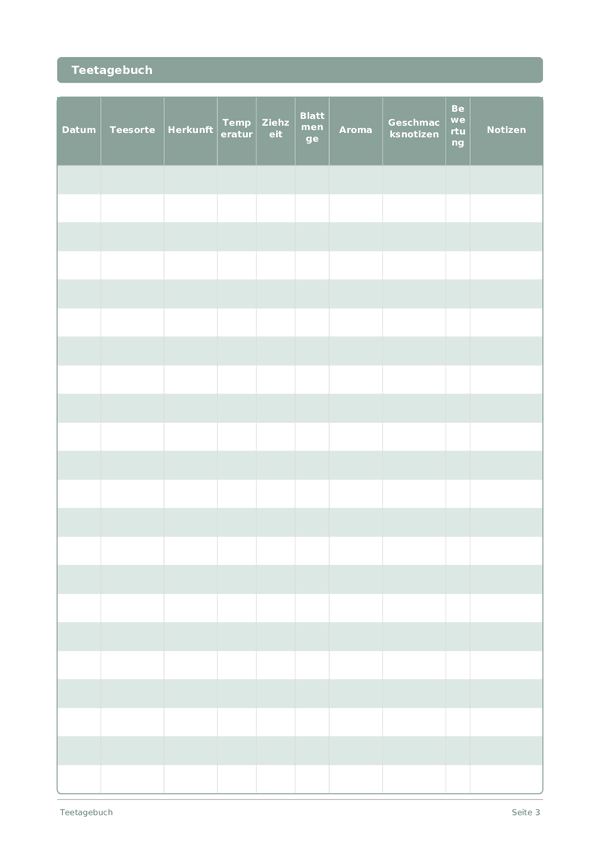
| Datum | Teesorte | Herkunft | Temperatur | Ziehzeit | Blattmenge | Aroma | Geschmacksnotizen | Bewertung | Notizen |
|---|---|---|---|---|---|---|---|---|---|
| 2025-03-04 | Oolong — Tieguanyin | Anxi, Fujian, China | 90 | 30s / 45s / 60s / 90s | 7g / 100ml gaiwan | Orchid, fresh cream, hint of roasted grain | 1st steep: bright floral, buttery. 2nd: orchid deepens, light honey. 3rd: toasted grain emerges, mineral finish. 4th: gentle, sweet, lingering. | 8 | Excellent Tieguanyin — opened beautifully over 4 steeps. The leaves unfurled into full, intact leaves. Best at 2nd and 3rd steep. Gongfu style brings out complexity. |
| 2025-03-04 | Green — Gyokuro | Uji, Kyoto, Japan | 60 | 90s / 60s / 30s | 5g / 60ml kyusu | Intense umami, seaweed, sweet grass, ocean breeze | 1st steep: rich umami bomb, sweet marine, buttery. 2nd: lighter, more vegetal, asparagus. 3rd: delicate, sweet, refreshing. | 9 | This Gyokuro is exceptional. Low temperature is essential — anything above 65C brings bitterness. The umami is almost broth-like. Paired well with mild white fish for lunch. |
Wie Sie jedes Feld ausfüllen
Jede Seite ist eine Tabelle mit Spalten. Füllen Sie pro Eintrag eine Zeile aus. Hier erfahren Sie, wofür jede Spalte gedacht ist:
Datum
Schreiben Sie das heutige Datum. Dies verankert Ihren Eintrag in der Zeit und hilft beim späteren Durchsehen der Einträge.
Teesorte
Herkunft
Temperatur
Notieren Sie Ihre Basaltemperatur. Temperaturveränderungen helfen, den Eisprung und die allgemeine Zyklusgesundheit zu verfolgen.
Ziehzeit
Blattmenge
Aroma
Geschmacksnotizen
Bewertung
Gesamtbewertung des Erlebnisses
Notizen
Fügen Sie zusätzlichen Kontext oder Gedanken hinzu. Diese Auffangspalte ist für alles, was nirgendwo anders hinpasst, aber später nützlich sein könnte.
Tipps für den Erfolg
Wann und wie oft schreiben
Log each tea session as you brew — the table format is designed for quick capture while the kettle cools. If you drink 2-3 teas daily, log the one you want to remember or improve. When exploring a new tea type (say, transitioning from black to pu-erh), log every session for at least two weeks to build baseline understanding. Monthly, review your entries to see which teas you rated highest and which brewing parameters consistently produce your best cups.
Häufig gestellte Fragen
Welche Wassertemperatur sollte ich für grünen, Oolong-, schwarzen und Pu-Erh-Tee notieren?
Das Specialty Tea Institute und große Tee-Referenzen konvergieren auf breite Bereiche: grün 70-80°C, weiß 75-85°C, Oolong 85-95°C, schwarz und Pu-Erh 95-100°C. Studien im Journal of Agricultural and Food Chemistry zur Catechin-Extraktion bestätigen, dass Temperatur die Polyphenol-Freisetzung steuert — zu heiß extrahiert Bitterkeit, zu kühl ergibt dünnen Tee. Erfassen Sie die tatsächliche Temperatur, nicht nur die Wasserkocher-Einstellung, da Ausguss und Gaiwan Wasser um 5-10°C abkühlen.
Wie lange sollte ich verschiedene Teesorten ziehen lassen und wie protokolliere ich mehrere Aufgüsse?
Specialty Tea Institute-Richtlinien empfehlen grün 1-3 Min., schwarz 3-5 Min., Oolong 1-5 Min. (pro Aufguss länger), Pu-Erh 30s-3 Min. im Gongfu-Stil. Qualitäts-Loseblatt trägt 3-7 Aufgüsse; protokollieren Sie sie als separate Zeilen mit ziehzeit '30s, 45s, 1m'. Forschung in Food Chemistry zur Tee-Aufgusskinetik zeigt, dass sich Extraktionsprofile über Aufgüsse verschieben — frühe Ziehungen lösen Aminosäuren, spätere Tannine. Aufeinanderfolgende Zeilen machen diese Entwicklung sichtbar.
Welches Aroma-Vokabular sollte ich in der Aroma-Spalte verwenden?
Übernehmen Sie etablierte Sensorik-Begriffe: blumig (Jasmin, Orchidee), grasig (frisch gemäht, Spinat), nussig (Kastanie, Mandel), erdig (Waldboden, feuchtes Holz), rauchig, marin, honigartig, mineralisch. Das Specialty Tea Institute lehrt Aroma von trockenem Blatt, nassem Blatt nach Spülung und Aufguss als drei eigene Bewertungen. Forschung in Food Chemistry zu Tee-Flüchtigen (Linalool, Geraniol, Methyljasmonat) stützt diese Kategorien chemisch. Seien Sie konkret — 'blumig' allein verliert über Hunderte Einträge analytischen Wert.
Wie präzise sollte blattmenge sein — und warum ist das so wichtig?
Erfassen Sie Gramm pro 100 ml Wasser, nicht nur Teelöffel, denn die Blattdichte variiert stark zwischen flachen grünen Blättern und gerolltem Oolong. Specialty Tea Institute-Brühparameter zentrieren typisch auf 2-3g pro 200ml westlich, 5-7g pro 100ml Gongfu. Das Verhältnis treibt die Extraktionsstärke unabhängig von der Ziehzeit — viel Blatt mit kurzer Zeit ahmt schwachen Tee aus wenig Blatt mit langer Zeit nach. Eine kleine Küchenwaage zahlt sich hier schnell aus.
Eignet sich dieses Journal für Kräuteraufgüsse, Matcha und Beuteltees — nicht nur Loseblatt?
Ja. Die Spalten funktionieren für jeden Aufguss: teesorte erfasst Matcha, Kräuter, Rooibos oder Kamille; Temperatur, ziehzeit und blattmenge gelten weiterhin. Bei Matcha-Einträgen protokollieren Sie den Besenstil statt der Ziehzeit. Beuteltee einzutragen ist in Ordnung — die ITF (International Tea Federation) verfolgt Beutelvolumen als globale Mehrheit des Teekonsums. Der Wert des Journals liegt in wiederholbarer Beobachtung, nicht in Format-Snobismus.
Wie unterscheidet sich Tee-Protokollieren vom Kaffee- oder Wein-Protokollieren?
Tee ist einzigartig, weil eine Blattladung mehrere Aufgüsse trägt — eine 'Session' füllt mehrere Zeilen. Anders als beim Wein sind Tee-Parameter (Temperatur, Zeit, Verhältnis) aktiv variabel, ähnlicher dem Kaffee. Anders als beim Kaffee verschieben Koffein- und L-Theanin-Verhältnisse das Erlebnis kognitiv — Forschung in Food Chemistry dokumentiert das beruhigende Aminosäure-Profil von L-Theanin. Reservieren Sie die Notizen-Spalte für nichtsensorischen Kontext: Tageszeit, Stimmung, Speisenpaarung.
Wie viele Sessions, bevor ich meine bevorzugten Herkünfte und Teesorten finde?
Planen Sie 30-50 protokollierte Sessions, bevor klare Muster entstehen. Filtern Sie Einträge nach teesorte und Bewertungsspalte: häufen sich Ihre 8+-Bewertungen bei Dan Cong Oolong, Darjeeling First Flush oder Yunnan Schwarztee? Auch die Herkunft zählt — Specialty Tea Institute-Kurse betonen Terroir-Parallelen zum Wein. Nach 50 Sessions erkennen Sie zudem, welche Ziehparameter konstant unterdurchschnittlich sind, sodass Ihre Brühtechnik mit Ihren Kaufentscheidungen wächst.
Häufige Fehler, die die Datenqualität des Tee-Journals ruinieren?
Erstens Blattmenge schätzen statt wiegen — tötet die Verhältnis-Variable. Zweitens nur den ersten Aufguss protokollieren, wenn mehrere gebrüht wurden. Drittens vage Aromen wie 'riecht schön' — nutzen Sie ITF- oder Specialty Tea Institute-Deskriptor-Familien. Viertens sofort bewerten, während viele Tees ihre Komplexität erst im abkühlenden Aufguss zeigen. Fünftens Wasserquelle ignorieren — Forschung in Food Chemistry zeigt, dass Mineralgehalt die Extraktion bedeutsam beeinflusst, wie beim Kaffee.
Das könnte Ihnen auch gefallen
Scrollen zum Zoomen, ziehen zum Bewegen