Printable Weintagebuch
Weinverkostungs-Erlebnisse dokumentieren
Record wines you taste with region, grape variety, rating, and tasting notes. Build a personal wine reference to remember favorites and discover preferences.
Felder anpassen
Schalten Sie Felder ein oder aus. Klicken Sie auf den Stift zum Umbenennen oder fügen Sie eigene Felder hinzu.
Vorteile
Anleitung
Was ist dieses Journal?
A wine journal is a tasting log for recording your explorations of wine with structure and detail. By tracking the wine's origin, grape, pairing, and your sensory observations of sight, aroma, and taste, you develop your palate and build a personal reference that guides future selections.
This journal is for wine enthusiasts at any level — from curious beginners learning to distinguish grape varieties to experienced tasters refining their vocabulary. It removes the intimidation from wine appreciation by providing a simple framework for describing what you see, smell, and taste.
Wine education research shows that the single most effective way to develop your palate is systematic tasting with written notes. The act of translating sensory experience into words forces you to pay closer attention and creates reference points that make each subsequent tasting more informed. Over time, your journal becomes a personalized wine guide that no app or critic can replicate.
Ausgefülltes Beispiel
So sieht ein typischer Eintrag aus, wenn er ausgefüllt ist:
Wie Sie jedes Feld ausfüllen
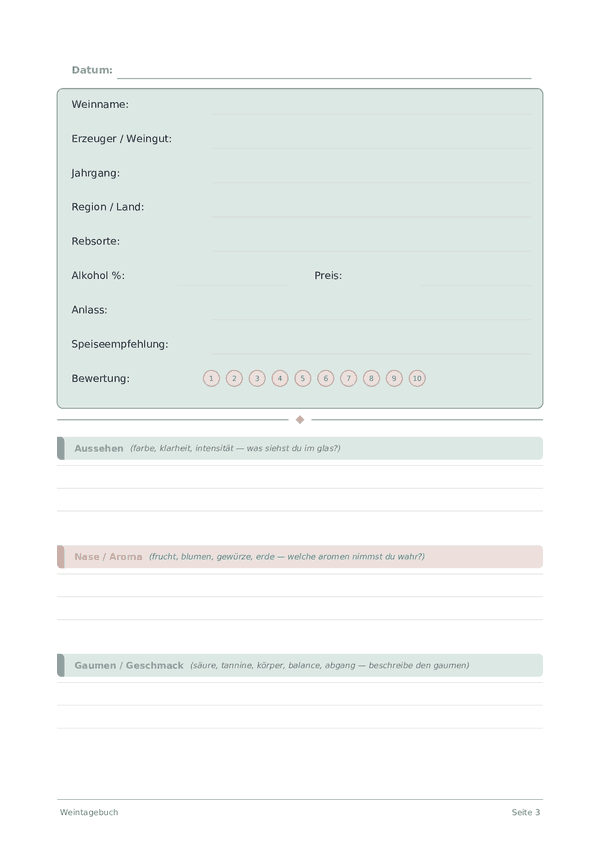
Oben auf jeder Seite befinden sich schnell ausfüllbare Felder (Bewertungen, Kontrollkästchen, Zahlen). Darunter ist ein linierter Bereich zum Schreiben. Hier erfahren Sie, was jedes Feld bedeutet:
Weinname
Vollständiger Name des Weins, wie er auf dem Etikett steht
Erzeuger / Weingut
Weingut oder Erzeuger — wer hat diesen Wein gemacht?
Jahrgang
Jahrgang der Traubenernte — z.B. 2019, 2021
Region / Land
Woher stammt er? z.B. Bordeaux, Frankreich oder Napa, USA
Rebsorte
Rebsorte oder Cuvée — Cabernet Sauvignon, Merlot, Chardonnay...
Alkohol %
Alkoholgehalt laut Etikett — z.B. 13,5%
Preis
Wie viel hast du bezahlt? Flaschenpreis in deiner Landeswährung
Anlass
Arbeit, lässig, Date-Abend, Party, Gym, Reise, besonderer Anlass...
Speiseempfehlung
Was hast du dazu gegessen, oder was würde gut passen? Käse, Steak, Pasta...
Bewertung
Deine Gesamtbewertung für diesen Wein: 1 = unangenehm, 10 = außergewöhnlich
Aussehen
Farbe, Klarheit, Intensität — was siehst du im Glas?
Nase / Aroma
Frucht, Blumen, Gewürze, Erde — welche Aromen nimmst du wahr?
Gaumen / Geschmack
Säure, Tannine, Körper, Balance, Abgang — beschreibe den Gaumen
Gesamteindruck
Würdest du ihn nochmal kaufen? Gesamteindruck zu diesem Wein
Tipps für den Erfolg
Wann und wie oft schreiben
Write an entry for every new wine you taste — capture your notes during or immediately after tasting, while sensory details are sharp. If you attend a tasting event, bring the journal and write brief notes for each pour, then expand your favorite entries later that evening. Aim for at least 2-3 entries per week if you are actively building your palate. Monthly, re-read your entries to track how your preferences and vocabulary have evolved.
Häufig gestellte Fragen
Wie strukturiere ich eine Verkostungsnotiz mit den Abschnitten Auge, Aroma, Geschmack und Notizen?
Folgen Sie dem WSET Systematic Approach to Tasting (SAT, Level 3, aktuelle Ausgabe): beginnen Sie mit dem Auge — Farbintensität und Farbton; dann Aroma — primäre Frucht, sekundäre Weinbereitung, tertiäre Reifenoten; dann Geschmack — Süße, Säure, Tannin, Alkohol, Körper, Geschmacksintensität, Abgangslänge; schließen Sie mit Gesamteindruck in den Notizen. Court of Master Sommeliers (Deductive Tasting Method) folgt derselben Sequenz. Die vier Felder des Journals entsprechen direkt den SAT-Säulen.
Was sollte ich in den Feldern Region und Rebsorte über das Offensichtliche hinaus schreiben?
Erfassen Sie die Appellation (z.B. Barolo DOCG, Sancerre AOC) statt nur das Land, denn die OIV (International Organisation of Vine and Wine, 2023, State of the World Vine and Wine Sector) katalogisiert über 1.400 geografische Angaben. Bei der Rebsorte vermerken Sie, ob es eine Einzelsorte oder ein Verschnitt mit ungefähren Prozentsätzen ist. WSET Level 2 betont, dass Region-Rebsorte-Kombinationen den Stil zuverlässiger vorhersagen als der Produzent allein und helfen, Vorlieben über künftige Verkostungen abzubilden.
Wie nutze ich die 1-10-Weinbewertung konsistent über viele Flaschen?
Wine Spectator und Decanter veröffentlichen auf 100-Punkte-Skalen, doch für den persönlichen Gebrauch empfiehlt die Court of Master Sommeliers ein einfaches, wiederholbares System. Verankern Sie Ihre Skala: 6 = solide aber unspektakulär, 7-8 = angenehm, 9 = exzellent im Stil, 10 = wirklich außergewöhnlich. Bewerten Sie im Stil des Weins — ein großartiger Beaujolais und ein großartiger Barolo können beide 9 erreichen. Kalibrieren Sie gelegentlich neu, während sich Ihr Gaumen entwickelt.
Welche Speisepaarungs-Notizen sind festhaltenswert — und warum?
Notieren Sie das Gericht, Schlüsselzutaten und ob die Paarung verstärkte, ausglich oder dissonierte. WSET lehrt: Säure passt zu Fett, Tannin zu Protein, Süße zu Süße; das Dokumentieren von Ergebnissen baut eine persönliche Paarungsbibliothek schneller auf als Regeln. Forschung der UC Davis Viticulture & Enology zu Phenolen bestätigt, dass die Tannin-Protein-Interaktion messbar ist, nicht subjektiv. Notieren Sie auch das Anlass-Feld — besondere Gelegenheiten profitieren von Kontext-Erinnerungsankern für künftige Bezüge.
Wie unterscheidet sich dieses Journal von Apps wie Vivino oder CellarTracker?
Apps stützen sich auf Crowdsource-Bewertungen, die Ihre Wahrnehmung vor dem Verkosten beeinflussen können. Eigene Notizen zuerst zu schreiben — wie die WSET-SAT-Methodik verlangt — entwickelt eine unabhängige Gaumenkalibrierung. Decanter- und Vinous-Kolumnisten raten konsequent, blind oder unbeeinflusst von Punkten zu verkosten. Das physische Format fördert zudem langsamere, bewusste Beobachtung. Apps können später als Referenz dienen, doch der primäre Eindruck bleibt Ihre eigene unverfälschte Wahrnehmung. In Deutschland ergänzt das DLG-Bewertungssystem die internationale Sicht.
Sollte ich Alkoholgehalt und Preis notieren — welcher analytische Wert steckt darin?
Ja. Die OIV (2023, State of the World Vine and Wine Sector) berichtet von steigendem Durchschnittsalkohol in großen Regionen wegen Klimawandel, sodass ABV-Tracking Stildrift über Jahrgänge offenbart. Das Preis-Qualitäts-Verhältnis ist Ihre handlungsrelevanteste Kennzahl: markieren Sie Weine, deren Bewertung Ihre Preiserwartung übertrifft, als 'Wiederholungskauf'. WSET Level 3 verlangt von Kandidaten ausdrücklich, das Quality-Price-Ratio zu bewerten — als erlernbare Fähigkeit, nicht als Meinung. VDP-Klassifikationen können in Deutschland zusätzliche Orientierung bieten.
Wie viele Weine sollte ich notieren, bevor sich Präferenzmuster zeigen?
Die meisten WSET- und Court of Master Sommeliers-Dozenten nennen 50-100 bewusste Verkostungen, bevor klare Vorliebenmuster kristallisieren. Taggen Sie Einträge nach Region, Rebsorte und Bewertung, dann monatlich überprüfen: bewerten Sie Mosel-Riesling konstant über neuseeländischem Sauvignon Blanc? Wächst Ihre Tannintoleranz? Die strukturierten Felder ermöglichen diese retrospektive Analyse, während Erinnerung allein nach etwa drei Monaten frühere Eindrücke zuverlässig verzerrt.
Häufige Fehler beim Schreiben von Verkostungsnotizen?
Erstens vage Deskriptoren — 'lecker' oder 'rund' haben keinen analytischen Wert; nutzen Sie das WSET Lexicon der Aroma-Familien (Zitrus, Steinobst, tropisch usw.). Zweitens Halo-Bias — Preis oder Produzentenruf prägt die Bewertung vor dem Verkosten. Drittens das Auslassen der Sichtanalyse, die Alter und Sorte signalisiert. Viertens stilübergreifendes Vergleichen mit einer absoluten Punktzahl. Schließlich vorschnelles Urteil — Court of Master Sommeliers-Protokolle erlauben mindestens drei Minuten pro Wein.
Das könnte Ihnen auch gefallen
Scrollen zum Zoomen, ziehen zum Bewegen