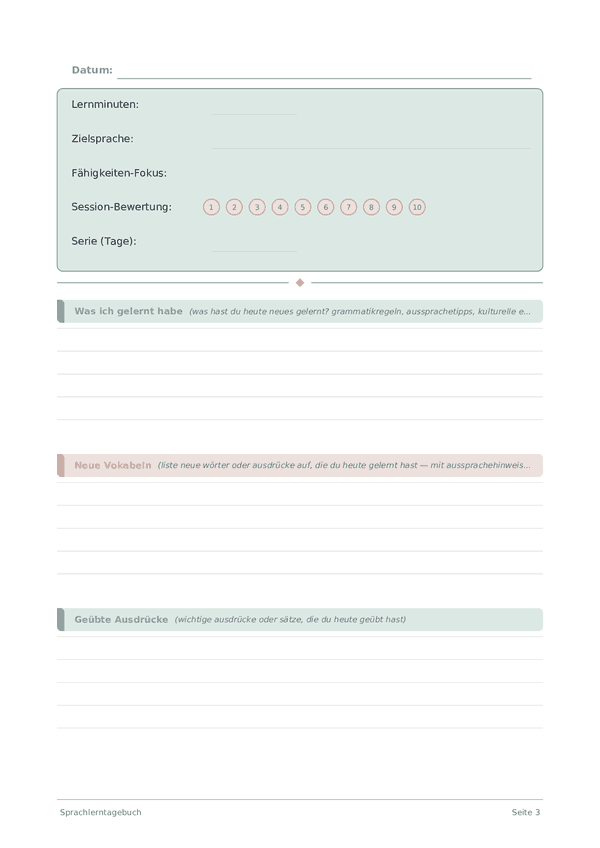
Printable Sprachlerntagebuch
Täglicher Sprachlern-Tracker und Studientagebuch
Accelerate your language learning journey with daily practice tracking, vocabulary logging, and progress reflection. Build consistency and fluency one day at a time.
Felder anpassen
Schalten Sie Felder ein oder aus. Klicken Sie auf den Stift zum Umbenennen oder fügen Sie eigene Felder hinzu.
Was ist dieses Journal?
A language journal is your personal lab for tracking daily study sessions and measuring real progress over time. Learning a language involves dozens of micro-skills — vocabulary, grammar, listening, speaking, reading — and without a structured log it is easy to mistake busy-ness for progress. This journal fixes that by combining quick metrics with reflective writing after every session.
The tracker section captures how long you studied, which language and skill you focused on, your session rating, and your streak day. The writing section is where you consolidate learning: note new vocabulary, record phrases you practised, and jot down grammar rules you encountered. Writing these out by hand strengthens memory and reveals which areas need more attention.
Whether you are working through a textbook, using an app, or practising conversation with a partner, filling in this journal right after your session locks in the gains and gives you a clear roadmap for what to study next.
Ausgefülltes Beispiel
So sieht ein typischer Eintrag aus, wenn er ausgefüllt ist:
Wie Sie jedes Feld ausfüllen
Oben auf jeder Seite befinden sich schnell ausfüllbare Felder (Bewertungen, Kontrollkästchen, Zahlen). Darunter ist ein linierter Bereich zum Schreiben. Hier erfahren Sie, was jedes Feld bedeutet:
Lernminuten
Gesamtminuten, die heute mit Lernen verbracht wurden
Zielsprache
Welche Sprache lernst du? z.B. Spanisch, Japanisch, Französisch
Fähigkeiten-Fokus
Lesen, Schreiben, Hören, Sprechen, Wortschatz, Grammatik...
Session-Bewertung
Wie effektiv war deine Session? (1=schlecht, 5=ausgezeichnet)
Serie (Tage)
Wie viele Tage in Folge hast du gelernt?
Was ich gelernt habe
Schreiben Sie eine neue Sache auf, die Sie heute gelernt haben. Es kann eine Tatsache sein, eine Fähigkeit, eine Erkenntnis über sich selbst oder eine Lebenslektion. Tägliches Lernen summiert sich zu Weisheit.
Neue Vokabeln
Liste neue Wörter oder Ausdrücke auf, die du heute gelernt hast — mit Aussprachehinweisen und Beispielsätzen
Geübte Ausdrücke
Wichtige Ausdrücke oder Sätze, die du heute geübt hast
Grammatiknotizen
Grammatikregeln, Muster oder Strukturen, auf die du dich konzentriert hast
Tipps für den Erfolg
Wann und wie oft schreiben
Write daily, even if only three sentences in your target language. Polyglot research consistently shows that 10 minutes of daily writing outperforms an hour-long weekly session for language retention. Use your journal as a warm-up before formal study sessions. Weekly, revisit five entries from the past month and correct them with your current knowledge — this spaced review solidifies grammar and vocabulary. Monthly, write one full page entirely in the target language as a benchmark of fluency progress.
Häufig gestellte Fragen
Was verfolgt das Sprachlern-Journal pro Sitzung?
Fünf Tracker-Elemente — Lernminuten, Zielsprache, Fertigkeitsfokus (Hören/Sprechen/Lesen/Schreiben/Grammatik/Vokabel), Sitzungsbewertung (0-10), Streak-Tag — plus vier linierte Zeilen für Gelerntes mit konkreten Prompts für neue Vokabeln, geübte Phrasen und kurze Grammatiknotizen. Die Struktur entspricht dem Vier-Fertigkeiten-Rahmen aus dem CEFR (Common European Framework of Reference for Languages, Europarat; im Deutschen bekannt als GER) und den ACTFL-Richtlinien.
Warum ist das Fertigkeitsfokus-Feld wichtig — kann ich nicht einfach "die Sprache üben"?
Der CEFR (Europäischer Referenzrahmen) und die ACTFL-Stufen behandeln Hören, Sprechen, Lesen, Schreiben, Grammatik und Vokabular als getrennte Kompetenzen, die sich ungleichmäßig entwickeln. Das Tracking des Fertigkeitsfokus deckt Vernachlässigung auf — die meisten Selbstlerner verlassen sich auf Lesen und Vokabel-Apps und meiden Sprechen. Rotierender Fokus bringt ausgewogenere Beherrschung als Sitzungen nach Bequemlichkeit.
Wie viele Minuten pro Tag sind für echten Fortschritt nötig?
20-30 Minuten täglich fokussierter Praxis erzeugen bei den meisten Lernenden sichtbaren CEFR-Fortschritt von einer Stufe in 6-12 Monaten. Krashens Input-Hypothese (1985, The Input Hypothesis, Longman) argumentiert, dass verständlicher Input der primäre Treiber des Spracherwerbs ist. Das Minuten-Feld misst Volumen, aber die Qualitätsbewertung der Sitzung zählt mehr — 20 fokussierte Minuten schlagen 60 abgelenkte zuverlässig.
Wie viele neue Vokabeln pro Sitzung notieren?
5-10 nutzbringende Wörter pro Sitzung sind nachhaltig; mehr lädt zum Vergessen ein. Paul Nations Vokabelforschung zeigt konsequent, dass Lernende 6-20 bedeutungsvolle Begegnungen mit einem Wort in unterschiedlichen Kontexten brauchen, um es zu erwerben. Nutze das Vokabel-Feld für Wörter aus echtem Input, nicht für Zufallslisten — kontextverankerter Wortschatz hält weit besser als isolierte Frequenzlisten.
Warum einen Streak-Tag zählen?
Tägliche Konsequenz treibt den Spracherwerb mehr als die Sitzungsdauer, besonders in frühen Phasen. Cepeda et al. (2006, Psychological Bulletin, 132(3), 354-380) zeigten, dass verteilte Praxis massierte Praxis beim Langzeitbehalten schlägt — Sprache ist der Lehrbuchfall. Das Streak-Feld macht Konsequenz sichtbar. Ein 10-Minuten-Tag zählt; schütze die Serie, bevor du Volumen optimierst.
Wie unterscheidet sich das von Duolingo oder Anki?
Apps liefern Inhalt und drillen Abruf; dieses Journal baut Metakognition. Sitzungsbewertung und Gelerntes-Feld zwingen, das Verstandene zu artikulieren — Roediger und Karpicke (2006, Psychological Science, 17(3), 249-255) zeigen, dass solcher Abruf und Ausarbeitung das Gedächtnis stärken. Nutze beides: App für Input und SRS, Journal für Reflexion und Fertigkeitsrotation. Sie decken unterschiedliche Teile des Erwerbs ab.
Was kommt in den Grammatiknotizen-Bereich?
Eine Regel oder ein Muster, das in der heutigen Sitzung verwirrt oder Klarheit gebracht hat — keine Lehrbuchzusammenfassung. Beispiel: "Deutsche Verben mit Akkusativ vs. Dativ: ‚helfen‘ verlangt Dativ, ‚unterstützen‘ Akkusativ." Kurze, persönlich bedeutsame Einträge sind leichter abrufbar als umformatierte Grammatikreferenzen. Über Wochen entsteht ein persönliches Grammatikhandbuch, geordnet nach deinen tatsächlichen Stolpersteinen, nicht der Lehrbuch-Reihenfolge.
Ist das Journal für Anfänger und Fortgeschrittene nützlich?
Ja, aber der Fokus verschiebt sich. Anfänger nutzen den Fertigkeitsfokus, um Sprechen nicht zu überspringen; Fortgeschrittene, um schwache Fertigkeiten zu pushen (oft Schreiben oder formales Sprechen). Die CEFR-Niveaus A1-C2 (Europarat) beschreiben, was jede Stufe in den vier Fertigkeiten verlangt. Nutze die Bewertung, um zu prüfen, ob Sitzungen herausfordernd genug sind — Komfortplateaus bremsen Fortschritt am schnellsten.
Das könnte Ihnen auch gefallen
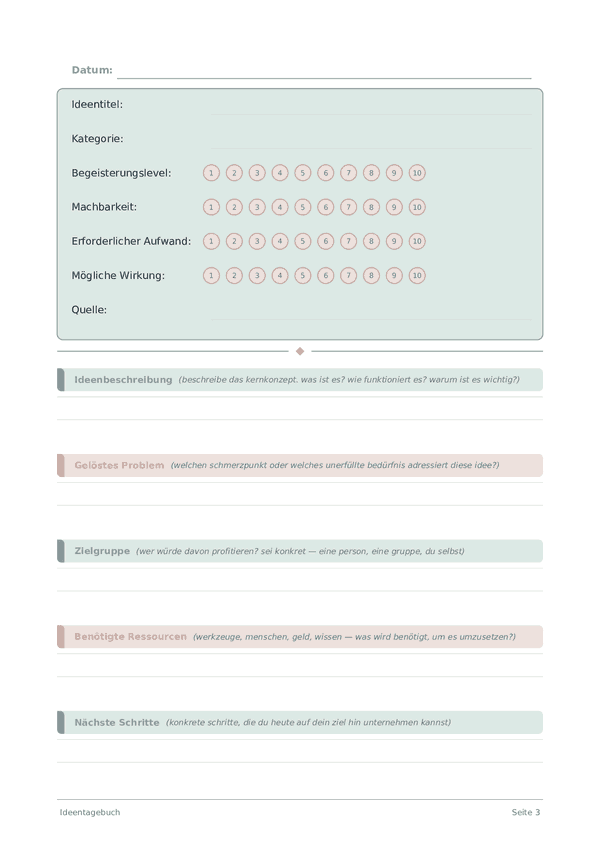
Ideentagebuch
Ihre besten Ideen festhalten, bewerten und weiterentwickeln
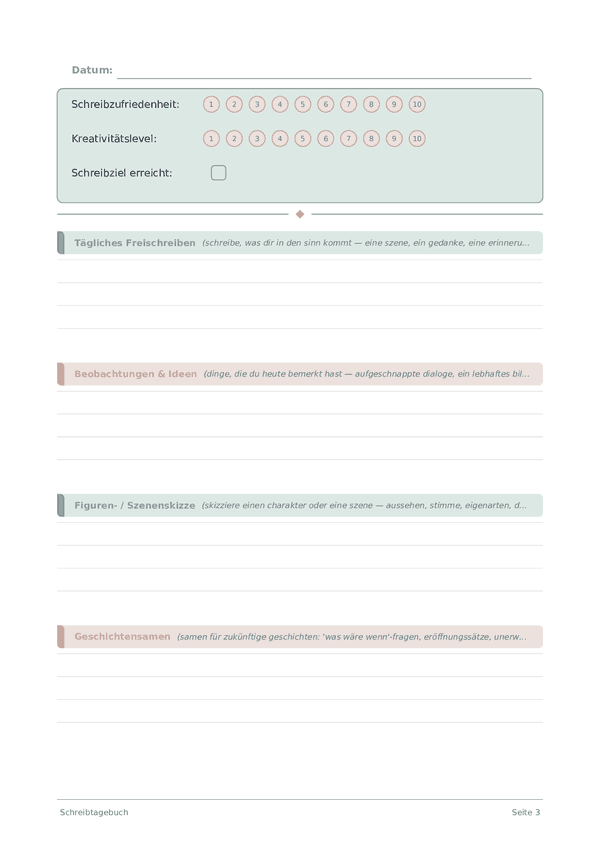
Schreibtagebuch
Tägliche kreative Schreibpraxis & Handwerksentwicklung
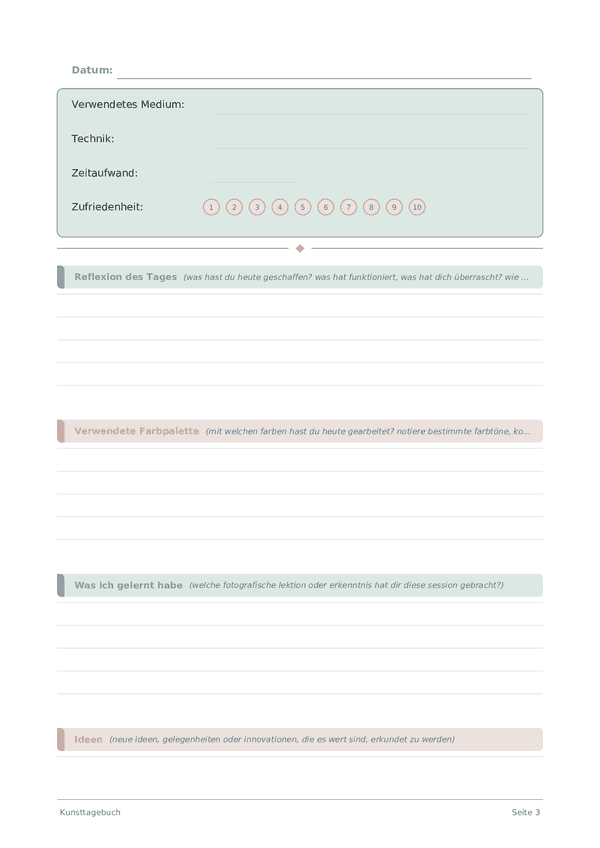
Kunsttagebuch
Dokumentieren Sie Ihren kreativen Prozess und künstlerisches Wachstum
Skizzenbuch-Tagebuch
Offene Punktraster-Seiten zum Skizzieren, Zeichnen und visuellen Entdecken
Scrollen zum Zoomen, ziehen zum Bewegen